
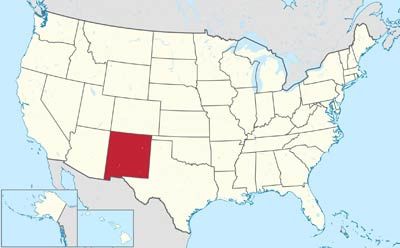
The history of New Mexico's annexation to the United States began as a result of the westward expansion of the United States in the mid-19th century and the Mexican-American War. The New Mexico region was originally under the control of Spain and later Mexico, but the Mexican-American War, which lasted from 1846 to 1848, drew the attention of the United States to this area.
After the war, the Treaty of Guadalupe Hidalgo, signed in 1848, required Mexico to cede significant territory to the United States, one of which was the present-day New Mexico region. This treaty marked a crucial turning point in the westward expansion of the United States and served as the basis for the official annexation of New Mexico into the United States.
Subsequently, in 1850, the U.S. Congress declared the New Mexico Territory and began its administrative integration. However, this process was accompanied by conflicts between Native Americans and Mexican residents, as well as controversies regarding culture and identity, which continue to contribute to New Mexico's rich cultural heritage today.
Finally, in 1912, New Mexico was elevated to the 47th state of the United States, officially gaining state status. Thus, the history of New Mexico's annexation to the United States illustrates a complex process shaped by the Mexican-American War, the Treaty of Guadalupe Hidalgo, and subsequent administrative changes and social conflicts.
New Mexico's population is estimated to be around 2.1 million, with a coexistence of various races and ethnicities. The majority of the population consists of White and Hispanic residents, with a small presence of Native Americans and Asian populations. This demographic composition is deeply related to New Mexico's historical background and serves as a foundation for its diverse culture and traditions.The median household income in New Mexico is slightly lower than the national average, with recent statistics indicating it to be around $50,000. Of course, there are differences between regions, and there is a gap in the cost of living and income levels between urban and rural areas. Thanks to lower taxes and relatively affordable living costs, some residents enjoy a stable life, but at the same time, there are challenges in terms of economic development and job creation.
In this way, New Mexico possesses a unique regional charm, characterized by its complex and multi-layered history, diverse racial composition, and economic characteristics. These elements make New Mexico a desirable place to live, but they also encompass challenges that the local community must address in the future.






 rainyday |

 Say Yes in English |
 Pointy |
 Southwestern |
 U donn |
  US Embassy |
  Korean Mom |
  My NYC |
  moo moo |
  Mr Oh |
  forevergee |
  festival |
  manchester |
  constant |
  Leapfrog Move |
  vibranto |
  Tora Tora |
  yellowbutter |
  Dolly |
  NYC saladbar |
  Finding Superfoods |
  lightyear |
  song bang |
  vexomo |
  Indiana Jones |