

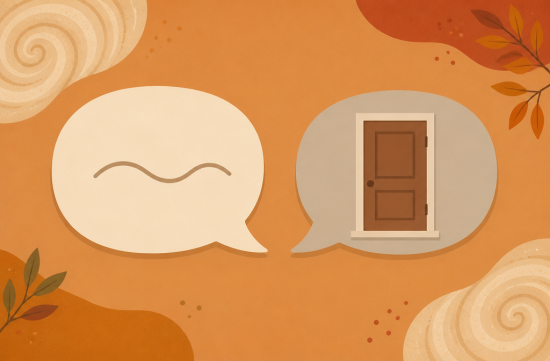
I once asked an American friend, who was my roommate in Alston, if he wanted to go to the farmers market with me over the weekend.
The response I got was "Let me check my schedule," and I took that as a genuine request to check his schedule, so I waited for a few days.
In the end, that weekend just passed by, and I later realized that his response was essentially a refusal.
I think it felt even more unfamiliar because I had just arrived from Korea.
Interestingly, the U.S. is not originally a culture that speaks indirectly.
According to anthropologist Edward Hall's classification, the U.S. is considered a low-context, direct communication culture, while countries like Korea and Japan are on the opposite side, conveying meaning through context and nuance.
However, when it comes to refusals, even people from this direct culture tend to speak around the subject.
From my experience baking bread and working in cafes over the past few years, here's a list of phrases I've encountered.
"I'll think about it" usually means you won't hear back nine times out of ten.
"Let me get back to you" is similar; a response without a specific date often indicates a predetermined answer.
"We'll circle back on this" or "Let's touch base soon" are also common in company emails, and if there's no specific follow-up date, it generally means that's the end of the conversation.
Expressions of being busy are also common. Saying "I'm swamped these days" or "I've got a lot on my plate" is a polite way of signaling that something has been deprioritized.
"Maybe next time," "Let's see how it goes," and "I'll try my best" are similarly phrases that leave the door slightly open while quietly closing it.
If someone says, "That's an interesting idea though" without any specific agreement following it, that's also a refusal, and "I'll sleep on it" usually means you won't get a response by morning.
When someone says, "No worries, but..." the following sentence is the real message, and if they respond with a bright "Sounds good!" but don't set a follow-up date, that smile is more of a polite gesture.
When I first came to this area, I was the type to take these phrases at face value and kept waiting.
When I asked the local bakery owner about a part-time position, I heard, "We'll keep your resume on file," but it took me a while to realize that was a polite way of saying no.
In schools and companies, phrases like "It's not really in the budget right now" or "Let's revisit this down the line" are often used, ultimately deflecting the blame to budget or timing while preserving the other person's dignity.
In the end, this way of speaking is not about rudeness but rather about maintaining politeness.
I often hear similar stories in the Korean community. For example, when an American colleague says, "let's grab coffee sometime," and you think it's a real coffee date and ask for a date, it can get awkward.
Understanding this not as a lie but as a way to avoid hurting someone's feelings makes it much easier to navigate.
Just like bread dough can tear if you stretch it too hard, if you give it time and let it rest, it will rise on its own.
People's feelings are similar; waiting patiently for a response, rather than rushing for an answer, ultimately causes less hurt on both sides.
It's not about labeling a culture that doesn't call refusals by their name as right or wrong.
However, if you develop the ability to read the warmth behind those words, even in the chilly morning air of Alston, the distance between people can feel a little less cold.
 midnightforestwalker1947
 RedSocks
 MagicGarden83
 CleoMadden



 Tan Zoo |

 hot chocolate |

 Chichiki Chicago Train |

 Noodle Noodle |

 Twist Kim |
 breaddough |

 Lime berry |



 ssome |
 skykong |
 Shining Our Own World |
 gardener 007 |
 golfmaster |
 Nanana Nanana Nanana |
 Who's watching? |
 endone |
 RockStar |
 Casa Mia |
 You Only Live Once |
 Hardworking CPA |
 Joyce 77 |
 Runner Kim |
 My Town My Way Blog |
 My Miami Stories |
 Entip |
 Tony Park |
 Jean Claude Bundang Blog |
 DJ DC BLOG |