

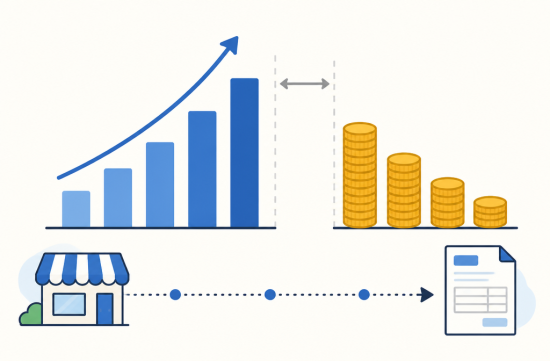
After knowing a junior from the Washington area for a few years, he closed his small catering business last year. Looking at sales alone, it wasn't bad for the first year. Orders were coming in steadily, and he had some regular customers. Yet, he still shut down. When I asked why, the answer was simple: the money he earned wasn't making it into his bank account.
Many people think of poor sales when they hear about business failures. They assume it's because there are no customers or due to intense competition. However, if you look at the actual statistics, the story is different.
According to the latest data from the U.S. Bureau of Labor Statistics (BLS), 20.4 percent of new businesses close within their first year. Contrary to the saying that half of them fail, the survival rate in the first year isn't that bad. However, a survey by U.S. Bank found that cash flow issues were cited as the cause in 82 percent of the closures. Only 42 percent pointed to a lack of demand, and 29 percent reported running out of funds completely. This means that many businesses fail not because they have no sales, but because the timing of cash flow is misaligned.
Why does this happen? The answer lies in how invoices are handled. According to Intuit QuickBooks' 2025 Small Business Payment Report, 47 percent of small business invoices are processed more than 30 days past their due date. While material costs, labor, and rent are due every month, the money they should receive is often delayed by 45 to 60 days. If they don't have the cash reserves to withstand this delay, they may show a profit on paper but find their bank account empty.
Books don't lie. The problem is that few business owners review their accounts weekly based on cash flow rather than sales. The numbers on the income statement and the actual balance available for withdrawal are two entirely different stories.
To survive the first year, there are several things you need to keep in mind. First, you should set a short collection period for receivables right from the contract stage. The moment you loosen the payment terms, that burden shifts directly to the business owner's bank account. It's also wise to secure at least two to three months' worth of fixed costs in advance. Instead of immediately reinvesting when you have a good sales month, it's important to prioritize building up a buffer fund first.
At this point, I also want to touch on some policy shortcomings. Self-employed individuals are often in a gray area where they cannot properly access unemployment benefits or sick leave. If a business collapses due to cash being tied up, it's not just a matter of individual financial management skills. This is why policies that strengthen loan guarantees for small businesses or impose penalties for delayed payments are becoming increasingly necessary.
Ultimately, the difference between business owners who survive their first year and those who do not is not how well they sell, but how accurately they can predict and prepare for cash flow. Don't just feel secure by looking at sales figures; I recommend checking your bank balance and accounts receivable list this week as well.
 HousekeepMemo
 BroPloti






 loran |

 DeArizona Blog |

 Swift Falcon |
 Tonky |

 My NYC |

 washington mom |

 Another Eden Channel BLOG |
 El Dorado |

 Holey Moley |

 Everything Students Can Do |
 Where is a really nice neighborhood? |
 Real Estate |
 Forest Gump |
 Real Estate Investment Korean American |
 Dollydori, Lover of Movies |
 dmzline |
 travelo |
 American Food Information & Calories |
 Splendid Mission |
 sparklingo |
 Watch Walker |
 Soy Angelino |
 autumn |
 K-POP TV News |
 cortiva6 |
 Nevada Teppanyaki |
 aerion99 |
 Golado |
 Maximum Pro |
 Joyce blog |