

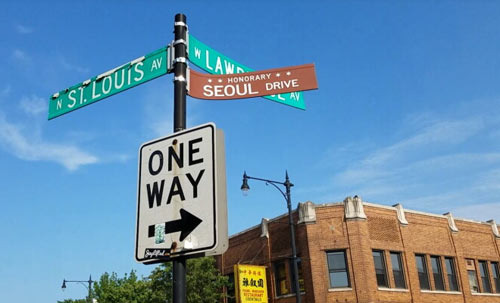
To be precise, it doesn't mean that all Koreans have left Chicago.
As of 2020, there were about 70,000 Korean Americans in Illinois, with approximately 62,000 living in the Chicago metropolitan area.
The issue is the pace of growth. The Korean community in Chicago used to grow as new immigrants continued to arrive from Korea.
Since the 1960s, immigration has intensified, bringing in doctors, nurses, students, and small business owners, leading to family reunifications.
By around 1990, some estimates suggested that the Korean population in the Chicago metropolitan area was about 100,000.
However, the influx of new immigrants is not what it used to be. Why is this important?
The Korean community needs a certain number of people to sustain itself.
Just think about a Korean restaurant. New Koreans need to keep coming in for the restaurant to have customers, for shopping at Korean markets, for attending church, and for their children to go to Korean language schools.
As those people buy homes and start businesses, the Korean economy thrives.
But the number of newcomers is decreasing, and the existing first-generation immigrants are aging.
What will happen to their children?
It's no longer the case that a child inherits the laundromat their parents ran in Albany Park.
After graduating from college, they become doctors, lawyers, engineers, or finance employees, commuting to downtown Chicago or even moving to other states.
Even if the population remains stable, the density of the Korean economy decreases.
The old Koreatown in Chicago is a good example.
In the 1980s and 90s, Lawrence Avenue in Albany Park was lined with Korean businesses like restaurants, markets, travel agencies, insurance companies, and video stores.
Records show that there were about 428 Korean businesses in that area in 1991. But then Koreans began moving to the suburbs.
They moved north to suburbs like Glenview, Niles, Northbrook, and Skokie for their children's schools.
By the time the city of Chicago installed the 'Seoul Drive' sign on Lawrence Avenue in 1993, reports indicated that more than two-thirds of Koreans in the Chicago area had already moved to the suburbs.
So, when looking at the current Korean community in Chicago, it's more accurate to say it has spread out rather than disappeared.
Nowadays, the Korean population is widely dispersed not just in downtown Chicago but also in areas like Glenview, Northbrook, Buffalo Grove, Palatine, Wheeling, and Vernon Hills.
This might be good for living conditions, as homes are larger, schools are decent, and it's quieter. However, it poses a problem for the Korean economy.
If 30,000 Koreans live in one neighborhood, multiple markets, restaurants, hospitals, tutoring centers, hair salons, banks, and real estate companies will emerge.
Conversely, if those 30,000 are scattered across 10 or 20 suburban cities, even with the same number, their ability to create a commercial district is significantly weakened.
Moreover, if new immigration does not increase significantly, the existing Korean businesses will naturally age along with their customers.
The struggles of Korean media, such as Korean newspapers and radio, can also be viewed in this context.
Korean newspapers that were in Albany Park have moved to the suburbs, and at one point, a local Korean radio station relocated to Des Plaines and Wheeling before closing in 2023.
Thus, the stagnation of the Korean population in Chicago is not just a matter of demographic numbers.
It means that fewer restaurant customers, aging churches, declining Korean language school students, struggling Korean media, and the inability of small Korean businesses to pass on to the next generation can occur simultaneously.
If there were a massive Korean economic zone like in LA or a city like New York where new people continuously arrive from Korea, it could withstand these challenges to some extent.
Chicago still represents a large Korean community in the U.S.
However, the issue is shifting from "how many Koreans are there" to "can the ecosystem of the Korean community be maintained for the next generation?"
A community that does not grow will eventually start to think more about how to avoid decline rather than how to grow.
I believe that is the concern the Korean community in Chicago should be addressing right now.
 ParisBarba
 PollockRoe






 Unknown Dog Walk blog |
 Yoyma |
 breaddough |
 Sunshine Blog |
 Tony Park |
 Rice Shop Uncle BLOG |
 Electricity Field Certification Collector |
 Life in the US |
 Enjoyable American Life Diary |
  Texas Migration Story |
  California Dreamer |
  Bearded Strawberry Smoothie |
  Heart Ticker |
  Jellia Angel |
  Moo Tang Clan |
  Khan Film Blog Production |
  yenne |
  Peter Pan Pet |
  Investment Campus Home Ownership |
  virex |
  timemachine |
  Taco Seattle |
  zenvior |
  Fortress K |
  arion9 |