

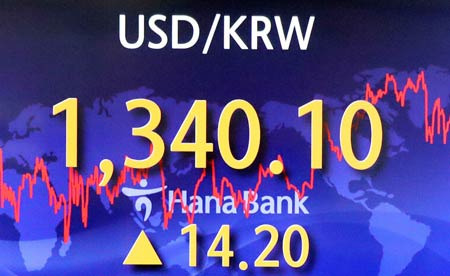
When I watch the news in Korea, I sometimes feel like the exchange rate is testing people's personalities.
Just two months ago, it was chaotic. The won-dollar exchange rate soared over 1500 won, reaching 1559 won during trading on July 1.
The news at that time made it seem like the South Korean economy was on the brink of disaster.
"The value of the won is collapsing." "Import prices are a big problem." "We can't travel abroad." "Parents of students in the U.S. are suffering."
And in the comments, there were predictions that it would reach 1600 won or even 1700 won by the end of the year. I thought to myself that if it hit 1700 won, I should exchange some dollars for won.
But now, just a little over two months later, the situation has completely reversed. On September 7, the won-dollar exchange rate closed at 1340.5 won, dipping to 1334.7 won during trading.
Compared to the peak in July, it has dropped by more than 220 won per dollar. The won has significantly strengthened in just two months.
So, shouldn't everyone be happy now?
But, of course, South Koreans are not that simple.
This time, the complaint is that "the won is too strong, and it's a problem."
From the perspective of export companies, selling a product for 1 dollar at over 1500 won is not the same as selling it for 1340 won now.
When they convert the dollars earned into won, the amount decreases, putting pressure on their performance.
Even individual investors in U.S. stocks find that when the exchange rate drops from the 1500s to 1340 won, their assets in won decrease.
In fact, someone who bought dollars around the peak in July could now face double-digit losses just from the exchange rate.
The stocks haven't dropped, but my money has decreased. This is the unique frustration that the exchange rate brings.
For someone like me, who lives on a salary and spends in dollars, this news feels indifferent.
Even if the exchange rate is 1550 won, my morning coffee doesn't suddenly become cheaper, and if it drops to 1340 won, my landlord isn't going to lower the rent.
My bank account had dollars deposited yesterday, and it will have dollars withdrawn today.
However, the story changes when I go to Korea. In the past, exchanging 100 dollars would give me over 150,000 won, but now it's about 134,000 won.
It's become harder to show off by saying, "I'll treat you since I came from the U.S." when I go to buy my friends a meal, haha.
This recent strength of the won is influenced by export companies, particularly in semiconductors, bringing dollars into the market, as well as foreign purchases of Korean stocks.
Recently, the strength of the yen has also been supporting the won.
In the end, it seems there's no exchange rate that makes everyone happy.
At 1500 won, importers and travelers complain, and at 1340 won, exporters and dollar investors are upset.
I'm sitting in LA, sipping my morning coffee while watching that news.
 SunsetVision
 Chicago773







 loran |

 DeArizona Blog |

 Swift Falcon |

 Tonky |

 My NYC |

 Weekend Movie Blog |

 Superman Cat Blog |

 Victory 1988 |

 Beauty, Health, Lifestyle Blog |
 prixon74 |
 oneonly |
 Brighto |
 racuse |
 Total Beauty |
 crystal |
 Good Hotels |
 raspberry7 |
 Que que |
 Well Done Sir |
 dance dance |
 sweetpepe |
 vegas mom |
 Olivia's Blog |
 cathywhite |
 heartbreaker |
 Giant Squid and Sweet Potato Soup |
 Valley Hong |
 The Gelaton |
 Twist Kim |
 berlon93 |