
Last weekend, I took a commuter train to Salem, and the car was packed even before we departed. There were college students in witch hats, couples in cloaks, and children carrying pumpkin baskets.
However, as soon as I got off, I felt a strange sensation. The starting point of this festival is ultimately an event where people died. Today, I want to take a moment over a latte to write a bit more about this paradox.
In 1692, in what is now Danvers, the Salem Village, several girls began to exhibit strange fits, and that's where it all started. Accusations of witchcraft began to spiral, and a special court was established. Within months, numerous people were imprisoned.
That year, a total of 19 people were executed. Five were hanged on July 19, five on August 19, and eight on September 22. Adding Bridget Bishop, who was executed earlier in June, makes exactly 19.
While the numbers seem calm, reading each name tells a different story. Rebecca Nurse was a respected elderly woman in her 70s in the community. John Proctor was a farmer who publicly questioned the unfairness of the trial.
There were also people who died in other ways. Giles Corey was crushed to death under heavy stones for refusing to stand trial. This method of execution is said to be unique in Massachusetts history.
When you include those who died in prison, the total number of lives lost due to this event is counted at 25. I paused for a moment at the mention that there were even children among them. There were no witches, but the dead were real.
So how did this dark city become a Halloween hotspot? Surprisingly, it was a TV sitcom that changed everything. In 1970, the production team of the show "Bewitched" came to Salem to film, and the atmosphere shifted dramatically.
In 1982, the current Haunted Happenings festival began. It started as a modest event but grew into a month-long celebration every October. This year, it runs from October 1 to 31.
In 2005, a bronze statue of Samantha, the main character from "Bewitched," was erected in a city park. Some residents at the time opposed it, claiming it was disrespectful to the victims of 1692. Samantha is a fictional witch, but the statement that the dead were not witches felt quite painful.
This year, especially, more people are flocking to Salem. It marks the 400th anniversary of the city's founding. The city expects over a million visitors throughout October.
As a result, the city and MBTA have urged people not to drive into downtown. On weekends, they are increasing train services, and larger ferries are being deployed from Boston's Long Wharf.
Feeling exhausted from people-watching, I stepped into a corner café. The moment I had a cinnamon-dusted pumpkin latte in my hand, I felt a bit revived.
One place I really wanted to visit was the Salem Witch Trials Memorial Park on Liberty Street. It opened in 1992, the 300th anniversary of the trials, and Nobel Peace Prize winner Elie Wiesel attended the dedication ceremony.
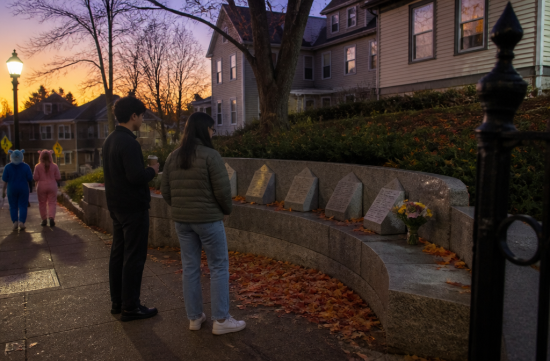
Along the stone wall, there are stone benches engraved with the names of the victims and their execution dates. The adjacent alley was bustling with tourists holding candy bags, but this area was strangely quiet. Someone had left a single flower on one of the benches.
If you walk a bit further, you'll find Proctor's Ledge. For a long time, it was believed that the execution site was at Gallows Hill, but a research team matched documents and geological surveys and confirmed the actual location here in January 2016. I was surprised to learn it was much more recent than I thought.
On July 19, 2017, the 325th anniversary of the first mass execution, a memorial was erected here. A semi-circular granite wall has 19 stones embedded in it, each engraved with a name and date.
As I stood there at sunset, the sky slowly changed from orange to purple. At the same time, a few blocks away, people dressed as zombies were taking selfies. That contrast seemed to best describe this city.
Restoration of honor took longer. Massachusetts officially corrected the names of some defendants in a resolution in 1957. However, for some reason, a woman named Elizabeth Johnson Jr. was left off that list.
Her name was finally cleared in July 2022. It was due to a petition campaign by eighth-grade students in a civic education class. I felt a bit moved that middle schoolers were able to accomplish something that took 329 years.
So, is this festival just a lighthearted consumption of tragedy? Honestly, I thought so at first. Seeing the lines in front of the witch merchandise shops still makes me a bit uncomfortable.
However, after walking around for a day, my thoughts changed a little. As people flock to the memorial park, the names of the victims are remembered again each year. Names that would have been quietly buried are now known.
Ultimately, what matters is how we enjoy it. I believe this event shows how dangerous it can be when rumors and fear shape the face of the law. The atmosphere of easily stigmatizing someone can arise at any time.
For those planning to visit this month, let me share a few tips. Leave the car behind and take the train or ferry. Early October weekdays are relatively less crowded, and you should really prepare for the last week and Halloween day.
I recommend stopping by one or two photo spots and then briefly visiting the memorial park and Proctor's Ledge. If you're with a child, it might be good to discuss why this festival exists. I think that conversation would be the real souvenir of the day.
On the train ride back, I finished my cold latte. The sunset outside the window had already faded, leaving only a faint glow in the sky toward the sea.
Witch hats are nice, and pumpkin baskets are great too. Just remember that behind that splendor are the names of 19 people; I hope you take that with you.
 WaveSmart



 Sunset Oregon |
 daisypat |
 Anjollinya Blog |
 Anova US Beauty Information |
 anchor |
 NO CAP LIFE |
 Tart Tart |
 gumdrop |
 custardnew |
 UCLA Captain |
  lattecu |
  dynamite |
  frostingline |
  Hakuna Matata |
  Your Curiosity Resolved |
  Way to easy |
  Chino Min |
  nexabyte |
  moonshine 7 |
  victoria 68 |
  golfmaster |
  Montgomery Mom |
  squidogame |
  Noodle Noodle |
  Rhode Island Good People |
  Big North |
  Famous Attractions in the United States |
  Jin Soo V |