
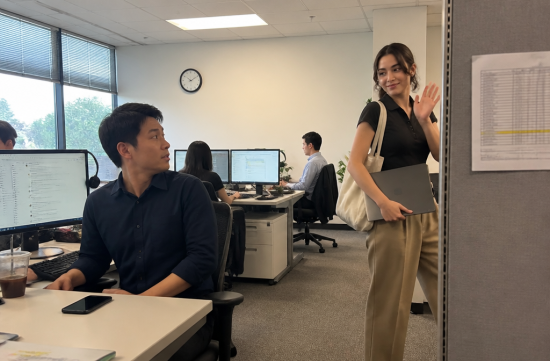
When I asked a new hire for a revised version by tomorrow, instead of a "yes," I got just a thumbs-up emoji. I was confused about whether that meant they understood or just acknowledged it. When I bring this up in a gathering of Korean managers, everyone bursts out laughing and shares their own experiences.
These days, working with Gen Z is a hot topic. It's not just a feeling; the numbers show it too.
According to an analysis by Glassdoor's economic research team, in the second quarter of 2024, the percentage of Gen Z among full-time workers in the U.S. will reach 18%, surpassing baby boomers at 15% for the first time. They are no longer just the youngest members of the team; they represent a significant generation.
The reactions from managers are quite candid. A survey by ResumeBuilder in April 2023 found that 74% of 1,344 managers and executives said Gen Z is harder to work with than other generations.
Wow, three out of four. I was a bit surprised when I first saw that number.
A similar sentiment was found in a survey by Intelligent.com in December 2023, where 38% of 800 U.S. managers and executives said they prefer to hire older candidates over recent graduates. One in five reported experiencing a recent graduate bringing their parents to the interview.
In the same survey, 58% believed that recent graduates are not ready to work. While this is a number that resonates with managers, we also need to consider that this generation spent part of their college years in remote classes due to the pandemic.
However, the points where Korean managers feel awkward are somewhat different. We are a generation that has experienced both Korean and American workplace cultures, which complicates things further.
The first awkward point is quitting time. When I see a new hire closing their laptop and saying goodbye right at five o'clock, I know logically that it's right, but I can't help feeling a bit disappointed.
Honestly, it's not that person's fault. It's natural to work during contracted hours and leave, but we have become too accustomed to working late out of obligation.
The second point is the way feedback is given. When I say, "Can we take another look at this?" in a roundabout way, sometimes it just ends up being a quick glance and nothing more.
On the other hand, if I speak directly, I worry about hurting their feelings. The answer I've found is to be specific, but to keep it short and frequent.
The third point is salary discussions. There are new hires who compare salaries with colleagues just a few months into their jobs and ask managers for justification.
In Korea, this was a taboo topic, so it initially catches me off guard. However, Maryland will implement a wage transparency law starting October 1, 2024, requiring job postings to include the minimum and maximum salary ranges and benefits for positions within the state.
Since the salary ranges are all listed in the postings, it's not strange to ask about them. It's a time when hiding information can lead to a loss of trust.
The fourth point is company dinners. There are surprisingly many friends who politely decline invitations to dinner, citing prior commitments.
Instead, they are more likely to attend lunch or team events during work hours. It makes sense to see it as a clear boundary of how much time they are willing to give to the company.
The fifth point is communication channels. Some friends prefer to exchange messages for tasks that could be resolved with a quick phone call, and they are startled when I call unexpectedly.
Conversely, when a manager sends a brief message, they might feel anxious, thinking they are in trouble. The same sentence can be received with such different levels of warmth.
So, does that mean Gen Z just doesn't want to work? The data suggests otherwise.
Deloitte's 2025 Global Gen Z and Millennial Survey, which surveyed 23,482 people across 44 countries, found that 50% of Gen Z wants guidance and mentoring from their managers. However, only 36% felt they actually received it.
This gap seems to be the key. They want to learn, but managers are only giving them work instructions.
So, if it were me, I would do the following. I would document expectations in the first week and review them together.
If emoji responses are ambiguous, let's set some rules. For requests with deadlines, let's specify the dates in our responses, for example.
Feedback should not be saved for quarterly evaluations but given in short bursts weekly. Praise what they did well immediately, and address one thing to improve at a time, along with the reason.
For questions about salary or promotions, I would show them the criteria. Knowing what they need to achieve to move to the next level can reduce the anxiety that leads them to browse job sites.
While respecting quitting time, we should agree in advance on what constitutes an urgent situation. This way, when we occasionally need to ask for help, we won't hurt each other's feelings.
For Korean managers, there's one more thing. Don't expect them to read between the lines; it's ultimately faster to express what you want verbally.
Of course, not all Gen Z individuals are the same. When you group people by generation, you risk overlooking the individual, so I believe statistics should only be used as a reference.
Looking back, we also heard a lot about how "kids these days" were perceived by older generations when we were new hires. If someone had kindly explained the standards back then, we would have grown much faster.
I believe that the managers who explain things first will ultimately win over those who feel awkward. I think I can now accept that thumbs-up emoji with a smile.
 OceanWave

 Banana Style Life |
 crystalo |
 Investment Beginner Company Information Encyclopedia |
 Always Dreaming of Big Success |
 happy 9 |
 kiwiii |




 lattecu |
  dynamite |
  frostingline |
  Hakuna Matata |
  Your Curiosity Resolved |
  Way to easy |
  Chino Min |
  nexabyte |
  moonshine 7 |
  Sunset Oregon |
  victoria 68 |
  golfmaster |
  Montgomery Mom |
  squidogame |
  Noodle Noodle |
  Rhode Island Good People |
  Big North |
  Famous Attractions in the United States |
  Jin Soo V |
  Starbucks Reserve Roastery Closure |