
Recently, I was invited to dinner at a friend's house and witnessed an interesting scene. When the grandmother asked her grandchild, "Do you want more rice?" the grandchild tilted their head and looked at their dad.
When dad translated, saying, "Grandma wants to know if you want more rice," only then did the child respond, "Yes, please!" It made me laugh, but at the same time, a part of my heart felt a little heavy.
You know what I mean, right? The first generation dreams in Korean, the second generation understands but responds in English, and by the third generation, they might like kimchi but know very few words other than "kimchi."
Scholars have referred to this phenomenon as the "three-generation model" for a long time. Linguist Joshua Fishman first outlined this trend in 1966, and Calvin Veltman often cited it in 1983.
The concept is simple. The first generation learns English but speaks their native language at home. The second generation becomes bilingual, switching between both languages.
By the third generation, the language spoken at home shifts to English, and the ancestral language mostly disappears. Doesn't this sound like a story from our neighborhood?
This is similar to old engine oil. Initially thick and clear, if not changed, it becomes thin after many miles and eventually runs out. If a language isn't continually reinforced at home, it fades over generations.
So, is this just a story about old European immigrants? Not quite. A study published in the journal Demography in 2002 recently examined whether this pattern holds true for current immigrants.
The results were somewhat bittersweet. The rate of English adoption among Asian descendants is progressing at a pace nearly identical to that of earlier European immigrants.
Descendants of Spanish-speaking families were reported to have a slower rate of change. The same study identified intermarriage with other ethnic groups and the surrounding community environment as factors influencing the home language of the third generation.
There's also a story from California. In 2006, researchers Ruben Rumbaut, Douglas Massey, and Frank Bean calculated the "linguistic life expectancy" using survey data from LA and San Diego.
They applied the method of calculating human life expectancy to languages, which is quite a clever idea. They examined how many generations a language survives after immigration.
Even languages with a vast number of speakers, like Spanish, ultimately lose their strength by the third generation. If that's the case for Spanish, it goes without saying for Korean.
In fact, scholars who study Korean as a heritage language point out that Korean is particularly prone to being forgotten quickly. In an English-dominant environment, it typically disappears by the second or third generation.
Why is Korean especially weak? I think it's partly because the Korean community isn't as large as the Chinese or Hispanic communities, and many families are dispersed across neighborhoods.
Unless you're in the heart of Koreatown, children rarely hear Korean at school. It's all English at the grocery store, soccer practice, and birthday parties.
However, there is some hopeful research. A study of 120 Korean American college students found that the best predictor of Korean language proficiency was how often and how much they used Korean.
Frequency of actual use was more important than the age of immigration or the duration of attending Korean school. This aligns perfectly with my belief that results matter more than theory.
It's easy to understand when I look at my dog. When I say "sit" or "wait" every day, he understands perfectly, but if I stop for a month, he looks at me as if to say, "What are you talking about?" Human language isn't much different.
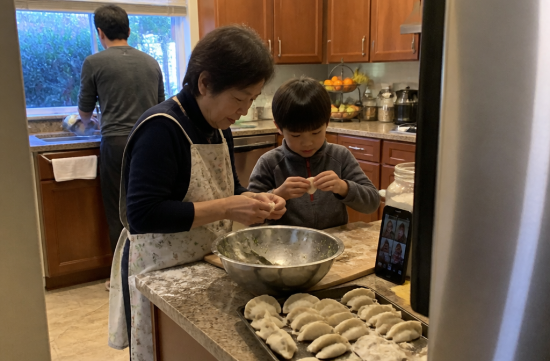
That's why I believe the kitchen is the best Korean language classroom, rather than grand educational efforts. When making dumplings together, saying, "Make sure to press this down so it doesn't burst" helps children remember the words physically.
Mixing the sauce for tteokbokki while learning words like "spicy," "sweet," and "salty" through taste lasts longer than memorizing ten vocabulary lists. Words learned through food are hard to forget.
Video calls with grandparents are also surprisingly effective. For grandchildren, Korean becomes a bridge to connect with loved ones rather than just homework.
Of course, realistically, not every household can be a perfect bilingual home. Many families have one partner who doesn't speak Korean, and after a long day of work, dinner conversations naturally flow into English.
However, I don't think there's a need to feel guilty about it. The three-generation model is more of a default setting that occurs when nothing is done. Defaults can be changed.
Nowadays, thanks to K-dramas and K-pop, there are increasing instances of third-generation children taking an interest in Korean on their own. For adults, this is a truly grateful trend.
Having observed many families, I can say that one short phrase daily is better than perfect grammar. Please consistently share short phrases like "Good night," "I love you," and "Let's eat."
Just like how adding a little engine oil at the right time helps a car last longer, I believe that gradually and consistently nurturing Korean can delay the three-generation model to the fourth or fifth generation.
How about saying "Enjoy your meal" in Korean to your grandchild tonight instead of in English? It could be the start of a significant change.
 HomerunKing



 Chichiki Chicago Train |

 Noodle Noodle |

 Twist Kim |

 U.S. Weather Bureau News |

 Community Cross |

 Mr Oh |

 B.I.G. Victor |


 US Home Buying Information Home Insurance |

 ASURA |
 rapids |
 Softember |
 mykiwi blog |
 Maria Mom |
 Watch for possible danger |
 northpeak |
 Far East Movement |
 Light of the World |
 mariashin |
 lavender |
 Bridgo |
 Tamfa Fan |
 Sunny Sunday |
 mini hometown |
 torvia |
 Univ Student |
 See It |
 Con Cheese |