

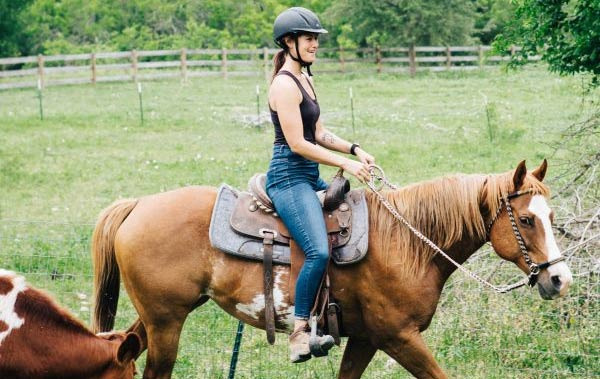
The problem is the cost, but riding a horse through fields and mountains is more than just a simple workout.
It's completely different from working out on machines at the gym. It may look like you're just sitting there, but in reality, your whole body is constantly engaged.
There are several reasons why it feels oddly refreshing after you try it.
The first is that it's a surprisingly intense full-body workout.
Just sitting on a horse is a balance challenge.
The horse is always moving, and to maintain your balance, your core, back, hips, and thighs all have to work together.
Especially, your core muscles are constantly engaged. You don't even need to do separate core exercises at the gym; you naturally get stimulated.
Interestingly, you don't feel like you're exercising much, but the next day, your muscles are surprisingly sore. This means your body already recognizes it as exercise.
The second benefit is posture correction.
If you slouch while riding, it becomes immediately obvious. If your balance is off, it becomes uncomfortable, and you could even fall.
So, you naturally straighten your back and open your shoulders. If this is repeated, it can positively affect your everyday posture.
Many people today have poor posture from looking at their smartphones, but while riding, that kind of posture is not sustainable.
The third point is that it puts less strain on your joints.
Running or jumping exercises continuously impact your knees and ankles. However, horseback riding distributes the impact more evenly. It's often mentioned alongside swimming as a form of weightless exercise.
Of course, there is some impact, but compared to repetitive impact exercises, it's much gentler. Therefore, it's relatively safe for those with weight concerns or weak joints.
However, since your muscles are still engaged, the exercise benefits are maintained. This is surprisingly a significant advantage.
The fourth benefit is the mental effect.
When you ride through fields or mountain paths, your mind quiets down. There's no room for distracting thoughts.
It feels like a form of moving meditation. If you ride while stressed, you can really feel the difference. It's a completely different kind of relief compared to running on a treadmill at the gym.
The fifth benefit is the connection with animals.
A horse is not a machine. It has its own state, personality, and reactions. If I'm tense, the horse gets tense, and if I'm relaxed, the horse becomes comfortable.
This interaction subtly touches the human heart. It creates a feeling of "moving together" that goes beyond just exercise.
In a time when human relationships can be exhausting, this kind of connection can feel even more comforting.
At this point, it seems like almost the perfect exercise, but "it's not as easy as it looks."
When you first ride, your butt hurts, you get blisters, your thighs ache, and balancing feels awkward.
And the costs are not insignificant. Completing a horseback riding course in Texas typically starts at $500, and $2,000 courses are common. Plus, it's not an exercise you can do anytime you want. That's why not many people do it regularly.
However, once you try it properly, you understand why people keep riding.
It's not just for health; it's the feeling of both your body and mind being organized at the same time.
At the gym, you only work your body, and when you get home, your mind gets cluttered again, but horseback riding engages both.
Ultimately, horseback riding is an activity that combines "exercise + posture correction + stress relief + connection" all at once.
So, it's very efficient. While it has the downside of costing over $50 each time you ride, the experience itself is definitely worth it.







 US Legal Consultation on Trials |
 Study Abroad Life Know-How Tips |
 Best Frozen Yogurt |
 Mr Cleveland |
 solvix18 |
 jaxter |
 chilli chilli |


 mariashin |
  Haha and Bomi Blog |
  glenview 89 |
  Valley Hong |
  novapixel |
  Idaho's Sumi's House |
  Mr. Midwest America |
  wildfire |
  legalway |
  postcard |
  cheesecake07 |
  My Miami Stories |
  windylotus |
  Mia Flori |
  velaro29 |
  velaro |
  foxtrot83 |
  moname |
  mapleline |
  UNI Lover |