
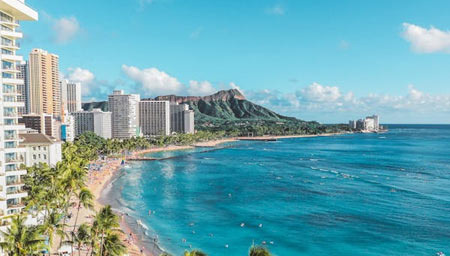
Honolulu is located on an island in the middle of the Pacific, quite far from the mainland United States, where industry is not developed, and instead, tourism and food industries are the main sectors. Tourism is the core of Honolulu's economy and has a significant impact on the overall economy of Hawaii.
Honolulu is a multicultural city where Hawaiian native culture, Western culture, and Asian culture coexist harmoniously, establishing itself as a global city with unique charm. There is a notable characteristic in the population composition, with more than half of the residents being of Asian descent, while whites make up only about 10%, which is quite low.
In fact, it is one of the major cities in the United States with the least number of whites, clearly showcasing a multicultural society. Additionally, Hawaiian natives account for about 20%, which deeply influences Hawaii's history and culture. This blend of diverse ethnicities and cultures creates a unique atmosphere and charm in the city.
Honolulu serves as the political, economic, and cultural center of Hawaii, functioning as a world-renowned tourist destination that attracts millions of visitors each year. Attractions such as Waikiki Beach, Iolani Palace, and Diamond Head showcase both the rich history and modern appeal of Honolulu.
The tourism industry in Honolulu is active year-round, but there are clearly defined peak seasons and off-seasons. The number of tourists and hotel prices vary according to these seasons.
From November to April is the peak season in Honolulu. This period mainly covers winter and spring, with mild and pleasant weather, making it the optimal time for tourism.
Especially during winter break (December-January), the holiday season including Christmas and New Year attracts many tourists. During this time, the pleasant weather and beaches in Hawaii are crowded with people, and prices tend to rise. Additionally, spring break (March-April) can also be included in the peak season.
From May to October is the off-season in Honolulu, where the weather is still warm and beautiful, but the number of tourists is relatively lower compared to the peak season.
During the summer (June-August), there are mainly family travelers, but starting from September, when schools begin, the number of tourists decreases slightly, resulting in relatively lower prices. Moreover, although summer can be considered an off-season due to high temperatures and humidity, it is a great time to enjoy the beach and water sports. During the off-season, hotel prices are cheaper and tourist attractions are less crowded, making it a good time for those seeking a relaxed and economical trip.





 victoria 68 |
 Hawaii Tourist Information |

 TEX MEX STAR |
 Vacation on Hawaii |
  US Embassy |
  Korean Mom |
  My NYC |
  moo moo |
  Mr Oh |
  forevergee |
  festival |
  manchester |
  constant |
  Leapfrog Move |
  vibranto |
  Tora Tora |
  yellowbutter |
  Dolly |
  NYC saladbar |
  Finding Superfoods |
  lightyear |
  song bang |
  vexomo |
  Indiana Jones |