
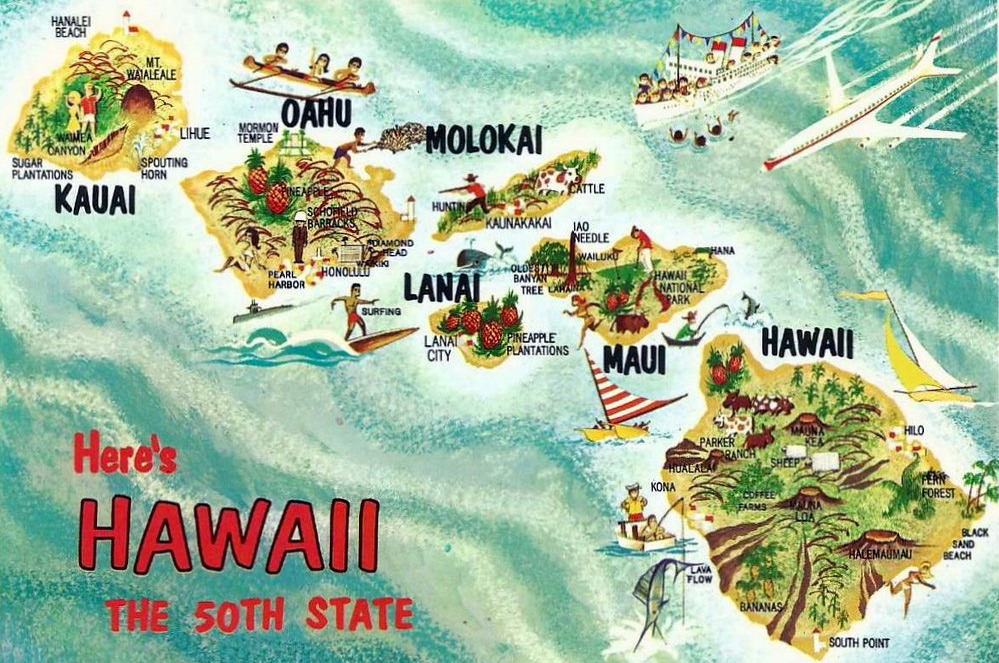
Hawaii is located about 2,400 miles (3,862 km) from the North American continent and consists of 132 islands, reefs, and atolls.
The Hawaiian Islands are made up of 8 main islands.
The Hawaiian Islands are an archipelago located in the central Pacific, consisting of a total of 19 islands and atolls. The largest island is Hawaii Island, commonly referred to as the Big Island to avoid confusion with the state name. However, the capital of Hawaii, Honolulu, is located on Oʻahu Island, the third largest island in the archipelago, not on the Big Island.
Origin of the Name Hawaii
The name Hawaii is said to originate from the legendary fisherman Hawaiʻiloa, according to Polynesian legend. He is credited with being the first person to discover the Hawaiian Islands, naming the largest island "Hawaii" after himself and the second largest island "Maui" after his son.
The name Hawaii (Hawaiʻi) comes from the ancient Polynesian word Sawaiki, which means "homeland" or "land of the ancestors." This name represents an important identity in Polynesian culture and tradition, connecting to the roots of the Hawaiian natives.
Nickname of the State of Hawaii
The state of Hawaii is nicknamed the "Aloha State." "Aloha" is a Hawaiian word meaning "hello," "love," and "welcome," symbolizing the warm hospitality and kindness of the Hawaiian people. This word is one of the core values of Hawaiian culture, allowing visitors to feel the warm spirit of Hawaii.
Composition of the Hawaiian Islands
The Hawaiian Islands consist of 8 main islands, including the Big Island (Hawaii, Maui, Oʻahu, Kauaʻi, Molokaʻi, Lānaʻi, Niʻihau, Kahoʻolawe), along with smaller islands and atolls. Each island has unique natural landscapes and cultures, making them major targets for tourism and research.
Hawaii Island (Big Island)
- Nickname: Big Island
- Features: The largest and youngest island in the archipelago, home to the active volcano Kilauea and the world's largest volcano Mauna Loa.
- Attractions: Hawaii Volcanoes National Park, Hilo, beaches of Kona.
- Climate: Boasts diverse microclimates, ranging from tropical rainforests to dry volcanic areas.
Maui
- Nickname: The Valley Isle
- Features: The second largest island in Hawaii, known for its beautiful beaches and luxury resorts.
- Attractions: Haleakalā National Park, Hana Road, Kaanapali Beach.
- Activities: Whale watching, windsurfing, hiking.
Oʻahu
- Nickname: The Gathering Place
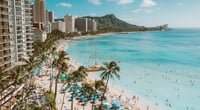
- Features: About 70% of Hawaii's population resides here, home to the capital Honolulu and Waikiki Beach.
- Attractions: Pearl Harbor, Waikiki, Diamond Head.
- Economy: The center of Hawaii's economy and culture, with military bases and tourism as major industries.
Kauaʻi
- Nickname: The Garden Isle
- Features: The oldest island in the Hawaiian archipelago, characterized by tropical rainforests, cliffs, and canyons.
- Attractions: Waimea Canyon, Na Pali Coast, Hanalei Bay.
- Activities: Hiking, helicopter tours.
Molokaʻi
- Nickname: The Friendly Isle
- Features: Preserves traditional Hawaiian culture and remains less commercialized, retaining its natural beauty.
- Attractions: Kalaupapa National Historical Park, the world's highest sea cliffs.
- Activities: Cultural experiences, nature exploration.
Lānaʻi
- Nickname: The Pineapple Isle
- Features: Once a major pineapple growing region, now famous for luxury resorts and natural exploration sites.
- Attractions: Garden of the Gods, Lānaʻi Beach.
- Activities: Golf, snorkeling.
Niʻihau
- Nickname: The Forbidden Isle
- Features: Owned by a Native Hawaiian family, access is restricted for outsiders.
- Living: A place where traditional lifestyles of the natives are preserved.
Kahoʻolawe
- Features: The smallest island in Hawaii, uninhabited.
- History: Formerly a bombing training ground for the U.S. military, currently undergoing restoration projects.
Climate and Nature
The Hawaiian Islands have a tropical climate, with mild weather year-round. They are divided into a dry season (May to October) and a wet season (November to April), with diverse microclimates on each island. Tropical rainforests, dry volcanic areas, and highland regions coexist, making it one of the places with the most diverse ecosystems in the world.
Ecology
Hawaii is one of the regions with the highest number of endemic species in the world. Native plants and animals have evolved uniquely due to Hawaii's isolated location, but many species are endangered due to the invasion of non-native species and development.
Population and Economy of Hawaii
Hawaii has a population of about 1.4 million, making it a multicultural society with diverse ethnicities. The main ethnic groups include Native Hawaiians, Asians (Japanese, Filipino, Korean, etc.), Caucasians, and Hispanics.
The main industry of Hawaii's economy is tourism, with over 10 million tourists visiting Hawaii each year. Other industries include military bases, agriculture (coffee, pineapple, macadamia nuts), and high-tech industries that support the economy.
Culture of Hawaii
Hawaii boasts a unique culture that blends the traditions of Native Hawaiians with Western and Asian cultures. Hula, ukulele, Hawaiian songs, and dances are known worldwide, and the spirit of Aloha symbolizes the life and values of the Hawaiian people.
The Native Hawaiian culture is uniquely expressed in language, art, and religion, and various efforts are underway in modern Hawaii to preserve it.
Historical Significance of Hawaii
Hawaii is strategically located in the center of the Pacific and has played an important role as a U.S. military base since the Pearl Harbor attack in 1941. Hawaii became the 50th state of the United States on August 21, 1959, and now serves as an economic and cultural hub connecting the U.S. and Asia.



 victoria 68 |
 Hawaii Tourist Information |

 TEX MEX STAR |
 HAWAII Korean Church News |
  laro90 |
  MEDBIO American Doctor Blog |
  SWAT TEAM BLK |
  DREAM BIG |
  frostbite |
  330 Forever My Love |
  El Dorado |
  dralix58 |
  Gorama Round |
  Skydiving |
  dreamport |
  Yellow Snowman |
  Toaster Pizza Magic Show |
  velvetnom |
  Anytime Journey |
  Mrs. Duluth |
  jaxter |
  Atlanta Mama |
  Baguette Blog |
  Tan Sol |