
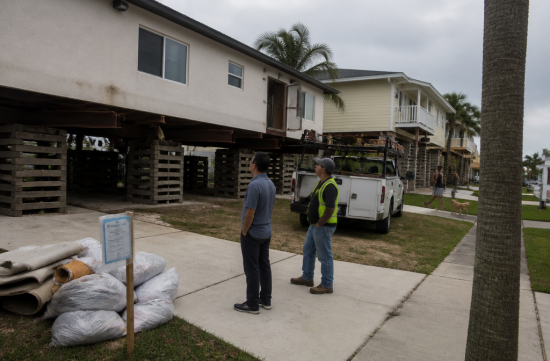
Many people hear the term "50% rule" for the first time after receiving repair estimates for their flooded homes. Just one estimate can turn a simple repair into a project that requires lifting the entire house, so let's break down the numbers step by step.
The key is simple. If the total repair costs equal or exceed 50% of the building's market value, that home is deemed to have "substantial damage."
In simpler terms, if the cost to repair exceeds half the home's value, you can no longer repair it according to old standards; you must comply with current flood construction standards.
A common point of confusion is what constitutes "home value." The benchmark is the pre-damage market value of the building itself, excluding the land.
For example, even if a house sells for $500,000, if most of that value is in the land and the building is valued at $200,000, a repair cost of $100,000 would already exceed the threshold. This can happen much faster than you might expect.
Building value is typically based on data from the Lee County Property Appraiser's office. If you believe the number is too low, you can submit an independent appraisal.
After Hurricane Ian, there was significant confusion regarding value assessments in Fort Myers Beach. Ultimately, FEMA recognized the Lee County Property Appraiser's office as the authority for determining pre-damage value.
So, who makes the determination? FEMA does not do this directly. It is decided by building officials or floodplain managers in each city or county.
As a result, even within Lee County, the forms and procedures can vary slightly between Fort Myers, Fort Myers Beach, Cape Coral, and unincorporated areas. You need to confirm which jurisdiction your address falls under.
A common misunderstanding in calculating repair costs is regarding direct repairs. According to Lee County guidelines, even if homeowners do the work themselves or receive donated materials and labor, the rule still applies.
If the terminology is unfamiliar, think of it this way: it's not about the actual cash spent, but rather the construction value assessed at market rates that serves as the benchmark.
Conversely, there are items that do not count toward repair costs. Design fees, surveying fees, and certain appliances and furniture that are unrelated to the building structure are typically excluded. However, specific criteria can vary by jurisdiction, so it's wise to ask in advance.
In the past, the "lookback" period, which combined multiple years of repairs, was a significant variable. Fort Myers Beach used a five-year cumulative approach, while Cape Coral eliminated the five-year cumulative rule after Ian.
However, with the passage of SB 180 by the Florida Legislature in 2025, the situation has changed. According to the state senate summary, municipalities participating in the NFIP can no longer create or enforce cumulative period ordinances.
In simple terms, this means that each building permit application will now be assessed separately for the 50% threshold. However, exceptions and specific conditions apply, and some municipal guidance documents still contain outdated language, so it's essential to verify the current standards in your jurisdiction.
So, what happens if you hit the 50% mark? The most common outcome is raising the lowest floor of the house above the base flood elevation. This can involve lifting the house or leaving the lower level empty and building up.
Other options include demolition and rebuilding, relocation, or outright sale. In any case, costs and time will significantly increase compared to simple repairs.
A helpful program in this situation is the Increased Cost of Compliance (ICC) coverage within flood insurance. Homes deemed to have substantial damage can receive up to $30,000 to cover the costs of meeting the standards.
For residential properties, this money can be used for elevation, relocation, or demolition. It's important to note that floodproofing applies only to non-residential buildings.
Honestly, $30,000 is not a generous amount compared to the cost of lifting an entire house. Still, since there is a deadline for claims, it's advisable to file for ICC coverage with your insurer as soon as you receive the determination notice.
Additionally, homes designated as historic may be exempt from this requirement if it threatens their designation. While this may not apply to many, it's worth checking.
A common mistake I see in practice is splitting estimates. If you intentionally report amounts separately or undertake work without a permit, you could face significant issues later during sales or insurance renewals.
Especially if unpermitted work is revealed during buyer due diligence, it can put you at a significant disadvantage in price negotiations. In the Southwest Florida market, a history of flooding is already a sensitive issue.
If it were me, I would approach it this way: first, confirm the building value with the Property Appraiser's office and, if necessary, obtain an independent appraisal.
Next, get detailed estimates from contractors item by item, and submit the repair cost estimation form to the local building department in advance to verify the percentage. You can start the work after receiving that determination.
If the percentage is in the high 40s, it may be worth renegotiating the scope with the contractor. However, removing necessary repairs to meet the numbers ultimately reduces the home's value.
On the other hand, if you exceed 50% significantly, it's better to get estimates for elevation or reconstruction without hesitation. Homes built higher often have advantages in flood insurance premiums and resale value in the long run.
Regulations and costs can vary greatly depending on individual circumstances and jurisdictions, so before making decisions, be sure to check with your local building department, insurance agent, and, if necessary, a real estate attorney. One number can change years of planning.
 ChurroTrain
 MagicForest78




 B.I.G. Victor |
 Amber H |
 uplifted |
 Dr. Kelso |
 silents |

 Vision XT |
 Way to easy |
 seouljung |

 Joyce 77 |
 strawberry |
 US Regional Information Local News |
 USA Business News |
 Blondee |
 E whisper |
 Potato House |
 freshmint |
 Ansaso |
 Golado |
 babybay |
 honeycom |
 French Macarons |
 Exploring American Life Information |
 Sunshine Blog |
 Community Cross |
 Sayonara H |
 What can make money? |
 Information Search LifeMAN |
 morvex37 |
 neontrail |