
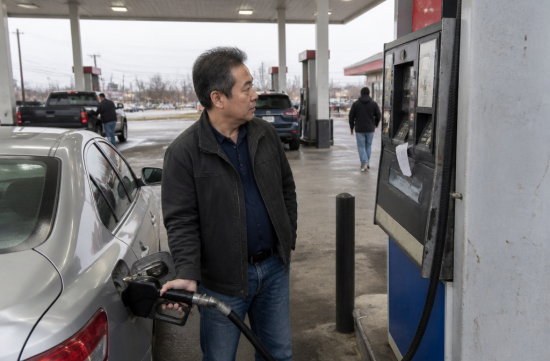
These days, when I swipe my card at the gas station and receive the receipt, I can't help but sigh. Last year at this time, filling up my tank didn't bother me, but this year, the numbers are definitely different.
So, I decided to recalculate my commuting fuel costs from scratch. It's much more reassuring to see the numbers rather than just saying, "It's gotten expensive."
First, let's get the facts straight. According to a Fox 4 report on October 27, the average gasoline price in Texas, according to AAA, was $3.71 per gallon.
The same report stated that this price is $1.11 higher than a year ago. A mid-October report indicated that the difference had risen to $1.15.
In just one year, the price has increased by over $1 per gallon. Honestly, I was a bit surprised when I saw this number.
However, the numbers for Fort Worth are slightly different. According to data from the AAA Texas page on November 5, the average price for regular gasoline in the Fort Worth-Arlington area was about $3.47.
The same table showed that the average a year ago was around $2.77. Calculating the difference, it comes to nearly 70 cents per gallon.
This means that while the state average has risen by over $1, the increase in our area was smaller. Depending on where you look at the numbers, the perception can vary.
There is some good news, though. A Fox 4 report on November 11 stated that the average price in North Texas has dropped to around $3.15 per gallon.
The same report mentioned that the national average is $3.94, which has fallen below $4 for the first time in seven months. It was reported that prices dropped nearly 20 cents in just one week.
However, we shouldn't get too comfortable. Even at $3.15, it's still higher than the average in Fort Worth from a year ago.
Now, let's get to the main point: the commuting calculations. I based my example on a round trip of 40 miles, a fuel efficiency of 25 mpg, and 21 workdays in a month. For those commuting by car from DFW, these numbers aren't particularly unusual.
This results in a monthly driving distance of 840 miles, requiring 33.6 gallons of fuel. From here, it's simple multiplication.
If we calculate using the early November average of $3.47 in Fort Worth, the monthly fuel cost comes out to about $116. A year ago, at $2.77, it would have been around $93.
The difference is just over $23 a month. Over a year, that adds up to nearly $280, which is not an insignificant amount.
If we assume the state average has risen by $1.11 per gallon, that would mean an additional $37 a month, or nearly $450 more over the year. For those with longer commutes, the increase would be even greater.
Conversely, if prices remain around $3.15, the monthly cost would drop to about $106. That's a savings of $10 a month compared to early November, which is a relief.
It's also worth noting the taxes included in gas prices. Texas has a state fuel tax of 20 cents per gallon, unchanged since 1991, plus a federal fuel tax of 18.4 cents.
Since taxes haven't changed in the past year, this increase isn't due to taxes. There's a lot of blame being thrown around in politics, but I believe we should look at the numbers before assigning blame.
Gas prices rise when supply decreases and fall when demand drops. Individuals can't control that flow, so it's more realistic to find what we can do on our end.
So, what can we actually do? Here are a few methods I've been practicing lately.
First, I always compare nearby prices using apps like GasBuddy before filling up. Even in the same neighborhood, there can be significant price differences between gas stations across the street. I've often seen that a station just one block away from the highway can be cheaper.
Second, I actively use membership gas stations like Costco or Sam's Club and take advantage of grocery store fuel points. Since I'm spending money anyway, not using these savings would be a loss.
Third, I check my tire pressure at least once a month. The U.S. Department of Energy's fueleconomy.gov states that maintaining proper tire pressure can improve fuel efficiency by an average of 0.6%, and in some cases, up to 3%.
Fourth, I reduce sudden starts and stops. This is a cost-free way to save, but I find it surprisingly difficult to change that habit.
Fifth, if possible, I try to increase my work-from-home days by at least one. Working from home just one day a week can reduce commuting fuel costs by 20%, so it's worth discussing with my employer.
Of course, no one can guarantee that gas prices will continue to fall. They could fluctuate again due to holiday demand or international oil prices.
Still, my stance is clear. While we can't change the prices, we can calculate and manage how much fuel our cars consume each month.
Today, take a receipt home from work and calculate your commuting distance and fuel efficiency. Once you know the numbers, you'll start to see more concrete ways to save.
 Kdaddy
 DalgonaSweet







 Nevada Vegas UNLV |

 Things to know |
 West Kong |

 havero70 |

 Grow Your Gut Bacteria Well |

 sunny flower |

 chilli chilli |

 jaxter |

 Coco Chanel |

 Raymond K. |
 gravity |
 714 Success Era Real Estate |
 Investment Beginner Company Information Encyclopedia |
 musicque |
 The Gelaton |
 ovelion |
 Chicagonian |
 Freedom Yea |
 AZ Road Master |
 glenix39 |
 Something is popping in the situation |
 orvella |
 vella |
 comets |
 Banana |
 Yes Dorian |
 Minnesota Sonata N |
 zentar |
 mykiwi blog |