

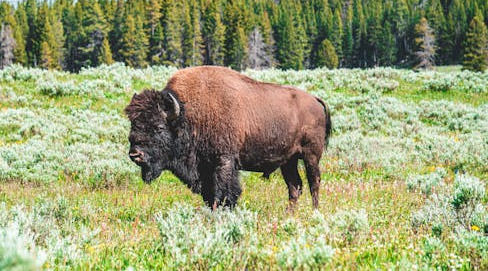
The fate of bison during the American Frontier Era is quite a dramatic story. You might feel like it's a scene from a Western movie.
The American Frontier Era typically refers to the period from the early 1800s to the 1890s. It was a time when settlers in the eastern United States expanded their territory westward beyond the Mississippi River. Events such as the Louisiana Purchase (1803), the Gold Rush (1849), and the completion of the Transcontinental Railroad (1869) occurred in succession, and the American West gradually transformed from a 'frontier' into 'part of America.'
Before the pioneers headed west, there were over 30 million bison living in North America. These massive herds roamed the vast plains from the Rocky Mountains to the Mississippi River and from southern Canada to northern Mexico. And these bison were not just part of the scenery; they were the very essence of survival for the Plains Indians.
Every part of the bison was used—meat, bones, hides, and even horns. Life for the Indians was impossible without bison.
However, as the Frontier Era intensified, the fate of the bison changed dramatically.
-
The arrival of the railroad fragmented bison habitats and made it easier for hunters to access them.
-
The bison hide industry became popular, leading to a surge in demand, and hunters began mass slaughter.
-
Even the U.S. government and military turned a blind eye to or encouraged the slaughter of bison to subdue the Plains Indians.
As a result, by the 1880s, the bison population plummeted to below 1,000. This was nearly the brink of extinction.
Fortunately, due to the efforts of a few individuals, bison did not completely disappear.
-
In 1905, former President Teddy Roosevelt and conservationist William Hornaday founded the American Bison Society and began protecting bison in places like Yellowstone National Park.
-
Today, there are about over 500,000 bison living in North America. Most are raised on private lands or reserves, but wild bison still roam freely in places like Yellowstone.
Bison are not just simple animals
-
They are a symbol of Indian culture,
-
a victim of the American Frontier Era,
-
and the starting point of the conservation movement.
And even today, they are designated as the National Mammal of the United States, remaining a symbol to reflect on the past.
If you get the chance, I recommend seeing a herd of bison slowly crossing the road in Yellowstone National Park.






 Magic Cabbage School of Martial Arts |
 Vacation on Hawaii |
 morvex37 |
 Ari Songhan American Immigration Life |
 Bearded Strawberry Smoothie |
 Kitchen Ideas |
 Toaster Pizza Magic Show |


 business lim |
  meloncat |
  novapixel |
  mortrix |
  Esther 1983 |
  fortbliss |
  Moscow Kim |
  My Two Way |
  toastyfox |
  FLORIDA Acus |
  tracker |
  TONTON COFFEE |
  sunrise |
  ultron78 |
  uplifted |
  Folding Instructions |
  same same life |
  USA Hyundai Kia |
  BOL SA RAM |
  TOUCHE NEWS |