
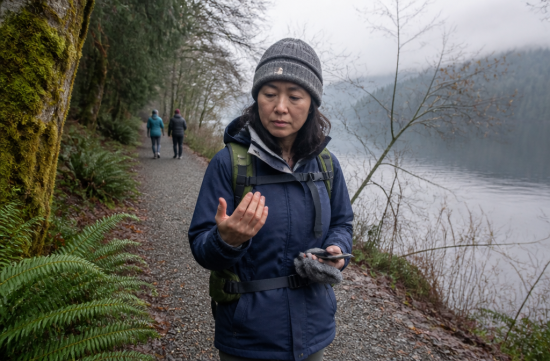
Last weekend, I took a walk along the lakeside trail early in the morning and briefly took off my gloves to take a photo. A few minutes later, the tips of my index and middle fingers had turned white like paper.
This isn't the first time I've experienced this. Every year in November, when the damp cold wind starts blowing in Puget Sound, my fingertips lose color at least once or twice.
This time, instead of brushing it off, I looked up information from the National Institute of Arthritis and Musculoskeletal and Skin Diseases (NIAMS). It turns out it's called Raynaud's phenomenon.
Raynaud's phenomenon refers to a condition where the small blood vessels in the fingers and toes excessively constrict due to cold or emotional stress, leading to poor blood flow. This causes the skin to turn white and sometimes bluish.
When the body warms up again, blood returns, causing the area to flush red and possibly feel painful or tingly. Rarely, it can also occur in the ears, nose, or tongue.
According to previous NIAMS materials, it typically takes about 15 minutes for normal blood flow to return after warming the skin. That's when I understood why my fingers had been stiff for such a long time.
This is a more common symptom than I thought. According to the same NIAMS materials, 3-12.5% of men and 6-20% of women reported experiencing Raynaud's symptoms.
I was a bit surprised by the relatively high figure for women. There's a reason why many people around me have particularly cold hands. I felt a bit awkward for having brushed it off as just a personal trait.
Importantly, there are two types of Raynaud's. The primary type has no specific cause, while the secondary type occurs due to other diseases or exposures.
The primary type is much more common. The Merck Manual states that 80-90% of cases are classified as primary.
NIAMS also explains that most primary cases have mild symptoms and do not significantly impact daily life. In contrast, secondary cases tend to have more severe symptoms.
Common diseases associated with secondary Raynaud's include lupus and scleroderma. Exposure to certain work environments is also mentioned as a potential cause.
According to materials from HSS Hospital in New York, 85-95% of scleroderma patients also experience secondary Raynaud's. This means that changes in fingertip color could be a signal of other issues within the body.
So when should you go to the hospital? Common signals identified in the materials can be summarized as follows.
When symptoms appear in only one hand or one foot, it should be viewed differently than if both sides react the same way. The same applies if there are wounds or ulcers on the fingers or toes.
Wounds on the fingertips should not be taken lightly. Although rare, they can lead to tissue damage if they do not heal.
Adults who first experience symptoms after the age of 35 often undergo tests to check for underlying diseases. If symptoms that were not present in youth suddenly appear, it's wise to get them checked out.
Tests include blood tests and nailfold capillaroscopy, which magnifies the capillaries under the nails. This helps determine whether it is primary or secondary Raynaud's.
I also compiled some management tips. The key is to keep not just your hands and feet, but your entire torso—chest, abdomen, and head—warm.
This means that just wearing gloves while dressed in a thin shirt is not sufficient. Nowadays, when I go to the trail, I always bring a hat and a thin vest, and I change wet gloves for dry ones immediately. The winter here is more frightening due to humidity than temperature.
It's best to quit smoking. Nicotine in regular cigarettes and some e-cigarette liquids can constrict blood vessels and cause long-term damage.
Caffeine can also trigger symptoms for some people. Harvard Health recommends reducing it for a while to see if there's any difference.
Surprisingly, medications can also be a factor. NIAMS lists decongestants containing phenylephrine or pseudoephedrine, beta-blockers for blood pressure, ergotamine migraine medications, and the ADHD medication methylphenidate as drugs that can trigger episodes.
Over-the-counter cold medications that you might casually buy during cold season could be the cause. Always consult with a doctor or pharmacist before starting new medications.
When an episode occurs, you can soak your hands and feet in lukewarm water or warm them by placing your hands in your armpits. You can also move your arms in large circles to promote blood flow. It's best to avoid placing your hands directly on a heater or in hot water in a hurry.
In summary, if your fingertips occasionally turn white and return to normal quickly, it's often manageable with lifestyle adjustments. However, if it only happens on one side or if wounds develop, the situation changes.
I would take photos on my phone to document when and how long the symptoms last. Symptoms often don't show up in a warm doctor's office, so those few photos can provide the most reliable explanation.
It's a season of rainy and chilly days. Whether hiking in the mountains or walking around the neighborhood, developing the habit of checking the color of your fingertips can be surprisingly useful.
 RobNeighbor
 NatlSlaveShow




 zestorbit |

 hihihi |

 fruitflash |
 Anjollinya Blog |
 United States Army |

 bluebird |

 Seattle - Emerald City |



 gravity |
 714 Success Era Real Estate |
 Investment Beginner Company Information Encyclopedia |
 musicque |
 The Gelaton |
 ovelion |
 Chicagonian |
 Freedom Yea |
 AZ Road Master |
 glenix39 |
 Something is popping in the situation |
 orvella |
 vella |
 comets |
 Banana |
 Yes Dorian |
 zentar |
 mykiwi blog |
 shinramen wang |