
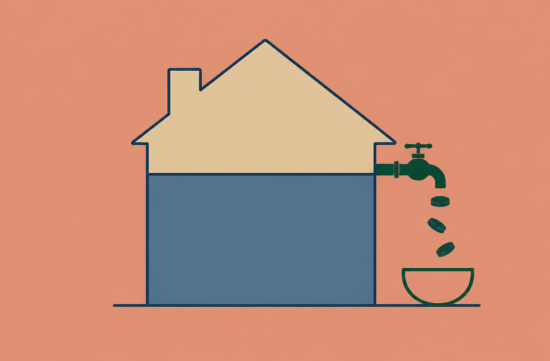
Recently, I've noticed an increase in inquiries where people say, "Home prices have gone up, but I have no cash." The reasons vary, from roof repairs to children's tuition and credit card debt consolidation, but ultimately, the question boils down to one: how to access the equity built up in their homes.
There are three main options. HELOC, home equity loans, and cash-out refinancing. Although the names sound similar, their structures are entirely different, so choosing based solely on interest rates can lead to regret later.
First, let's look at HELOC. It's a credit line secured by your home, essentially a negative balance account tied to your property.
You can withdraw funds as needed within your limit, and interest is charged only on the amount you actually use. This structure works well for situations where money is needed in stages, like for construction.
However, most HELOCs have variable interest rates. Many products are tied to the prime rate, so when the benchmark rate changes, your monthly interest payments will also fluctuate.
Another aspect that is often overlooked is that once the withdrawal period ends, HELOCs transition into a repayment period where you must start paying back the principal. I've seen cases where people only pay interest during the withdrawal period, and then their monthly payments jump significantly when they enter the repayment phase.
Home equity loans are also second-lien loans, but they work differently. You receive a fixed amount upfront and typically repay it in fixed monthly payments at a stable interest rate.
If you know how much money you need from the start and are concerned about interest rate fluctuations, this option may provide peace of mind. However, keep in mind that interest starts accruing on the full amount from the first month.
Cash-out refinancing is a completely different approach. It involves replacing your existing first mortgage with a new loan for a larger amount, allowing you to receive the difference in cash.
Since the loans are consolidated, managing them is simpler. However, not only the amount you withdraw but also the remaining balance of your existing loan will be subject to the new interest rate. This difference is crucial in the current market.
Looking at the numbers makes it clear. According to Freddie Mac's weekly survey, as of November 12, the average 30-year fixed mortgage rate was 7.11%. This is actually higher than the same time last year when it was 6.24%.
Many people who bought or refinanced their homes between 2020 and 2021 at rates around 3% are still in this area. Switching from that low rate to a 7% rate generally doesn't make sense without a compelling reason.
For example, let's assume you have a remaining balance of $400,000 at a 3% interest rate. If that balance changes to 7.11%, your interest for the first year alone would increase by over $16,000. The cash you intended to withdraw hasn't even been factored in yet.
HELOC rates aren't getting cheaper either. According to Bankrate's survey, as of November 4, the national average HELOC rate was 7.49%. Still, the biggest advantage is that you can maintain the lower rate of your existing first mortgage.
You should also check the cash-out limits. According to Fannie Mae, the maximum for a primary residence cash-out refinance is 80% of the home's value. For 2-4 unit properties or investment single-family homes, it's lower at 75%.
Closing costs cannot be ignored. Zillow indicates that closing costs range from 2-6% of the loan amount, while Rocket Mortgage states 3-6%. For a $500,000 refinance, this means costs could range from $10,000 to $30,000.
The cost structures for HELOCs and home equity loans vary significantly by bank. Some may waive closing costs but charge early termination fees or annual fees, so it's wise to compare the fee items on the estimates line by line.
There are many misconceptions about the tax implications, so I'll clarify that separately. The interest on home equity loans is only deductible if the funds are used to buy, build, or substantially improve the home that secures the loan.
Interest on amounts used for credit card debt consolidation or car purchases is not deductible. If you mixed your spending, only the portion used for home improvements is recognized.
The deductible loan limit, combined with the first mortgage, is $750,000, or $375,000 for married couples filing separately. This limit was changed from a temporary to a permanent regulation by last year's tax law. However, without receipts and records of usage, it can be difficult to claim, so it's advisable to check with a tax professional in advance.
In summary, the criteria for decision-making can be narrowed down to three points: whether your existing mortgage rate is lower than the current market rate, whether you need the money all at once or in stages, and whether you can afford to handle interest rate fluctuations.
If your existing rate is low and you need funds in stages, HELOC is the most reasonable choice. If the amount is fixed and consistent payments are important, a home equity loan is the right fit.
There are definitely cases where cash-out refinancing makes sense. This is true when your existing rate is already similar to or higher than current market rates, or when consolidating first and second mortgages is clearly beneficial.
Before applying, it's simple to check your current mortgage statement for the current rate and balance, and roughly calculate your total loan-to-value ratio.
Then, get estimates from two or three places on the same day for comparison. The key is to look at the APR and total fees side by side rather than just the interest rate.
Personally, I wouldn't recommend cash-out refinancing for someone with a current loan in the 3-4% range in this interest rate environment. If you need the same cash, I would keep the existing loan as is and withdraw only what I need through a HELOC.
The rates mentioned in this article are based on publicly available data from early to mid-November and change weekly. Actual conditions can vary significantly based on credit scores and home appraisals, so before making a final decision, consult with your loan officer and tax expert regarding your specific situation.
 EndureRL
 SunsetVision








 Something is popping in the situation |

 lumix88 |

 quiet river |

 Doori Ark |

 My Town My Way Blog |

 Curry Dragon |

 ROLDU WAY |

 714 Success Era Real Estate |


 Good Karma |
 gravity |
 Investment Beginner Company Information Encyclopedia |
 musicque |
 The Gelaton |
 ovelion |
 Chicagonian |
 Freedom Yea |
 AZ Road Master |
 glenix39 |
 orvella |
 vella |
 comets |
 Banana |
 Yes Dorian |
 Minnesota Sonata N |
 zentar |
 mykiwi blog |
 shinramen wang |