
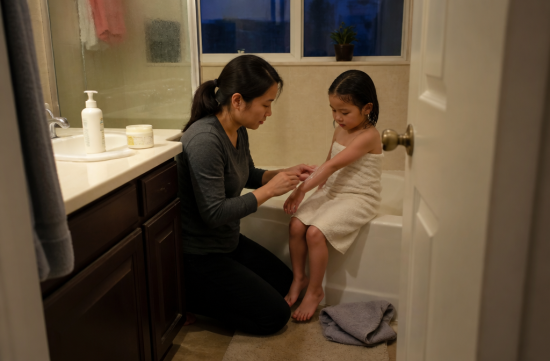
These days, I find myself checking my child's inner elbows and behind the knees every morning. If they're red from scratching overnight, my mood is already half down for the day.
Since Southern California has warm winters, I thought we wouldn't have to worry about skin issues, but living here has proven otherwise. Especially in the Inland area, when the wind blows, the air gets so dry that my child's skin reacts immediately.
According to the Riverside city website, the Santa Ana winds frequently blow from around September to May during the cooler seasons. The air from the desert compresses and heats up as it descends from the mountains, making it feel hot and dry.
With the heater running indoors, the indoor air also dries out. So, I decided to completely reorganize our routine for this season from scratch.
The guidelines I used are from HealthyChildren.org, operated by the American Academy of Pediatrics (AAP), and the eczema management guide from the American Academy of Dermatology (AAD). I found that referring to these primary sources saves time compared to reading blog reviews.
The first point is bath time and water temperature. The AAD advises using warm water that isn't hot and limiting bath time to 5 to 10 minutes.
HealthyChildren.org also recommends bathing or showering in lukewarm water for about 5-10 minutes daily or every other day. Honestly, this is the hardest part since my child loves playing in the water.
For reference, AAP materials mention that there is no data indicating that bathing daily improves eczema. I interpreted this to mean that the key is to keep it short and lukewarm rather than focusing on whether it's daily or every other day.
The second point is the drying method. Various pediatric resources commonly state not to rub with a towel but to gently pat to remove excess water.
The third and most crucial point is the 3 minutes after bathing. The AAD checklist states to apply a fragrance-free moisturizer within 3 minutes after bathing and to reapply whenever the skin feels dry.
This method is commonly referred to as soak and seal. The principle is to cover the skin with moisturizer while it's still damp to trap moisture, so if you miss the timing, it can actually become drier.
That's why I open the moisturizer lid before the bath and place it on the bathroom shelf. If I go to the room to find lotion after drying my child, those 3 minutes can easily slip by.
If there's a prescribed ointment, the order of application is also important. HealthyChildren.org advises applying the prescribed topical medication to the affected area first, followed by the moisturizer.
The fourth point is the type of moisturizer. Lotions are too thin and less effective, while ointment types like Vaseline or fragrance-free creams are generally better, according to both AAP and AAD.
The AAD also notes in its baby guide that thicker creams and ointments are generally more effective than lotions or oils. Although they can be sticky and my child dislikes them, I compromise by using ointment at night and cream in the morning.
One thing to be cautious about is that products labeled as unscented and fragrance-free are not the same.
According to the AAD, unscented means that the scent is masked by other ingredients, while fragrance-free means there are no fragrance ingredients at all. It's easy to confuse these when quickly grabbing items at the store.
The fifth point is clothing and bedding. The AAD recommends loose cotton clothing and advises that wool should not come into direct contact with the skin.
They also suggest that bed sheets, pillowcases, and towels should be 100% cotton. Instead of putting on knits right away in winter, it's more practical to layer a cotton t-shirt underneath.
It's also advisable to switch to fragrance-free and dye-free laundry detergents. Fabric softeners or dryer sheets with scents can also be irritating, so consider organizing these during this opportunity.
I couldn't find specific information about humidifiers on the AAD checklist. Other health information sites suggest maintaining indoor humidity between 30-60% and changing the water daily, but due to mold issues, if you're not confident in managing it, it's okay not to push it.
In summary, my winter routine looks like this: wash in lukewarm water within 10 minutes, pat dry, and within 3 minutes, apply the prescribed ointment first, followed by the moisturizer.
Then, dress in cotton clothing, use fragrance-free detergent, and if it looks dry during the day, apply moisturizer again. Writing it down, it seems simple, but sticking to it daily is the real challenge.
Having worked in finance for a long time, I have a habit of evaluating everything based on cost-effectiveness. I believe that applying a cheaper ointment frequently is much more beneficial than using an expensive functional cream.
However, since each child's skin condition and causes are different, if symptoms persist or if there's oozing or severe itching, be sure to consult a pediatrician or pharmacist. Moisturizing at home is not a substitute for treatment but rather a way to establish a foundation.
If it were me, I would organize the bathroom shelf this weekend. Keeping the moisturizer within reach makes a small difference that can help maintain those 3 minutes.
What products and order do you use at home? If you have any tips that can be used throughout the winter, please share them in the comments.
 SkewerFighter
 OrangeSoul








 Augusta 90 |

 Pointy |

 rissa |

 Gomo Nim |

 lattepop |

 Purple Moons, |


 East Side |

 Asparagus Blog |

 gravity |
 714 Success Era Real Estate |
 Investment Beginner Company Information Encyclopedia |
 musicque |
 The Gelaton |
 ovelion |
 Chicagonian |
 Freedom Yea |
 AZ Road Master |
 glenix39 |
 Something is popping in the situation |
 orvella |
 vella |
 comets |
 Banana |
 Yes Dorian |
 Minnesota Sonata N |
 zentar |
 mykiwi blog |
 shinramen wang |