

When discussing health check-ups, the term thyroid cancer comes up quite often these days.
People around you might say things like, "They found something on the thyroid," or "There was a nodule, so they did a biopsy."
However, despite hearing about this cancer frequently, many people are not exactly sure what it is.
First of all, the thyroid is a small butterfly-shaped gland located at the front of the neck.
Although it is small, it produces thyroid hormones that affect our body's energy use, temperature, and heart rate.
The cancer that occurs here is called thyroid cancer, and an interesting fact is that just because there is a nodule on the thyroid, it doesn't mean it's cancerous.
Thyroid nodules are quite common. Especially as people age, many are found to have small nodules on ultrasound, but most of them are benign.
So, finding a nodule does not necessarily mean it is cancer.
Another common misconception is that thyroid cancer is always a 'good cancer.'
In fact, the most common type, papillary thyroid cancer, often grows slowly and has a very good prognosis after treatment.
Therefore, in the case of small, low-risk cancers, doctors may choose to monitor changes with regular ultrasound exams instead of performing immediate surgery.
However, not all thyroid cancers are mild.
There are several types of thyroid cancer, and some, like anaplastic thyroid cancer, can progress very rapidly.
Ultimately, it is not accurate to conclude that 'thyroid cancer = not a serious cancer.'
Another surprising point is that even if thyroid function tests are normal, cancer can still be present.
Just because thyroid-related blood tests like TSH come back normal during a health check-up does not mean there is no thyroid cancer.
The thyroid can produce hormones normally while still having nodules or cancer.
Another characteristic is that there are often no symptoms.
In the early stages, there is usually no pain, and the body does not feel particularly fatigued.
It is often discovered incidentally during a health check-up ultrasound or when a small lump is felt in the neck, prompting further investigation.
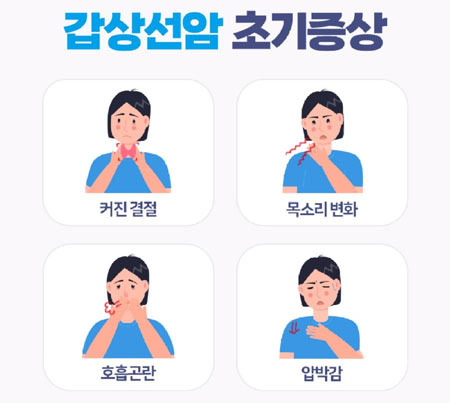
On the other hand, if a lump in the neck suddenly grows, or if the voice becomes hoarse, swallowing becomes difficult, or breathing becomes uncomfortable, it is advisable not to ignore these symptoms and seek medical attention.
There are also risk factors. If you were exposed to a lot of radiation around the neck during childhood or have a family history of certain types of thyroid cancer, your risk may be higher.
Additionally, just because surgery is performed does not mean you will receive the same treatment for life.
Depending on the size and location of the cancer, only part of the thyroid may be removed, or the entire gland may be taken out.
If the entire thyroid is removed, you will need to take thyroid hormone medication to compensate for the lack of hormones.
It is clear that thyroid cancer is often treatable. So, there is no need to be overly fearful, but it should not be taken lightly either.
Ultimately, what is important is to accurately determine what type of thyroid cancer I have and how risky it is when it is discovered.
 moonriver82
 Chickumentary
 HedgehogToot







 Tora Tora |
 neroyo |
 nivex85 |
 Old English |
 nixxon |
 Virginia Butterfly Mom |
 Cool Beach Freeway |
 zonter88 |
 Next Year, Let's Become Rich |
  bongo |
  Bushing Around Life |
  Active |
  Cherokee Rose |
  Kor. Master |
  Holey Moley |
  Conflite Teacher |
  Hodong Prince Over Flex |
  Mist inn |
  citrus pop |
  Onion Ring |
  phoenixia |
  viewtop |
  loverun |
  Kim Do Sun |
  SEVEN SEVEN |
  yentra |
  Make My Day |
  Victory 1988 |
  Tonky |
  viroma |