
Thanksgiving is just ten days away. Lately, what catches my eye more than articles about turkey prices are those about year-end inheritance and tax planning.
When reading financial reports, the conclusion is always similar. It's not about how much wealth you have, but whether your documents are properly organized that determines family costs.
The problem is that there's rarely a good time to bring up these topics. That's why I see this holiday, when the whole family sits around one table, as an opportunity.
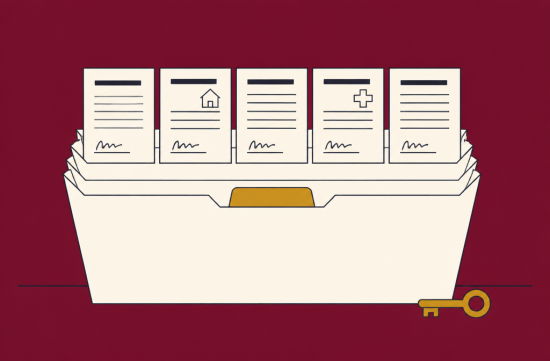
I'm not suggesting we have a grand discussion about wealth. Just asking whether certain documents exist and where they are can accomplish half the task. Here are the five documents I've organized.
The first is a will or living trust. More important than whether it exists is knowing where the original is stored.
The New York Surrogate's Court generally requires the original will. If only a copy remains, the process can become much more complicated.
For reference, in New York, if personal property excluding real estate is valued at $50,000 or less, you can use the Small Estate procedure. If it exceeds that amount, it often goes through formal probate, so whether a will exists can make a significant difference in time and cost.
The second is a financial power of attorney. This is the most practical legal means to handle banking matters when your parents may struggle to make decisions. Without this, you might have to go through court guardianship procedures.
There's a date to check here. New York has been using revised statutory forms since June 13, 2021.
The new form requires not only notarization but also the signatures of two witnesses. Powers of attorney created before this date remain valid, but banks can be picky about older documents, so be sure to check the date of creation.
The third is a health care proxy and living will. These documents specify who will make medical decisions on behalf of your parents.
In New York, a health care proxy is signed in front of two adult witnesses and does not require notarization. However, the designated agent cannot be a witness.
A living will is a document that outlines specific wishes regarding life-sustaining treatment, so it's good to keep it with the proxy. This serves as a basis for showing your parents' wishes when family opinions differ.
You can obtain the forms for free from the state health department's website. It costs almost nothing but can significantly reduce confusion in emergency situations, making it the best value among these five documents.
The fourth is the beneficiary designations for bank accounts, retirement accounts, and life insurance. Surprisingly, this is often overlooked.
401(k)s, IRAs, and life insurance go to the beneficiaries listed on the accounts, regardless of what the will states. If the name written down 20 years ago remains unchanged, it could lead to completely different outcomes than what the will specifies.
There's no need to write down account numbers. Just knowing which financial institutions have which accounts and whether the beneficiaries are updated is sufficient.
The fifth is the deed to the house and property tax bills. You need to check how the ownership is titled.
New York will implement the Transfer on Death Deed system starting July 19, 2024. If a homeowner designates a beneficiary, notarizes it, and registers it with the county clerk while alive, ownership will transfer upon death without probate.
In the past, many would add their children's names to the title for this purpose. That method can lead to tax or creditor issues, so it's worth comparing with the new system.
Be sure to check for a copy of the deed, recent property tax bills, and whether any benefits like senior exemptions are being received. If the title changes or you miss a renewal application, the exemptions can be lost.
I'll briefly mention taxes. The New York estate tax exemption limit for 2026 is $7.35 million, and the federal exemption limit is $15 million.
Most families won't be affected, but New York has what's called a cliff provision. If the taxable estate exceeds 105% of the exemption limit, the exemption benefit disappears entirely.
With rising home values in New York, just one house combined with a retirement account can add up to more than you might expect. Therefore, I believe it's appropriate for families to share a rough idea of their asset size.
The way you bring up the conversation is also important. In my experience, starting with "I got curious while organizing my documents" tends to elicit a much smoother response.
Don't try to check everything at once; aim to ask about the existence of documents and their storage locations this holiday. You can follow up on the rest before Christmas.
Of course, the information provided here is general. The application may vary depending on individual circumstances, so when actually creating or modifying documents, be sure to consult with a lawyer or tax professional.
It's said that the most expensive cost in the market arises from information asymmetry. The same goes for families.
If it were me, I would definitely ask about these five documents while sharing a slice of pie. After all, the conversation is what lasts longer than the turkey.
 JustHurtKid
 Bliss O







 American Politician Community |

 memorabilia |

 orvian89 |

 looksee 78 |

 vivavida |

 canyon |

 linex |


 crystalo |
 bloomberg |
 donggul donggul |
 korvix |
 Noodle Zin |
 Forever Tiger Teacher |
 strongman |
 U.S. Military Recruitment Information |
 |
 cherry cherry |
 Star Way |
 Pleasant K |
 Spaghetti Flying Religion |
 Texas Migration Story |
 Forever Coco is Bangga |
 nougat |
 coloradoman |
 Village Man |
 endone |
 Live and that's it |
 what gives |
 willow woo |