
On a winter day when snow is falling heavily and you can't even get your car out, seeing a letter in your mailbox brings a sense of wonder.
"Neither snow nor rain nor heat nor gloom of night." That's the phrase that comes to mind, suggesting that mail will be delivered regardless of the weather.
I also believed for a long time that this was the official motto of USPS. I thought of it as something like a basic setting learned in a tutorial for a game.
However, this is not the official motto.
The USPS information page states that they do not have an official motto. They even add a note of gratitude for the sentiment expressed in the phrase.
Materials released by the USPS history department convey the same message. They summarize that what people believe to be a motto is more of a tribute to postal workers.
Those who have played some games will immediately understand. It's like a fan-created setting that everyone thinks is official because it has circulated in the community for so long, even though it's not in the official guide.
So where did this phrase come from? Following its origins reveals a surprisingly long quest line.
The first stage is 8th Avenue in Manhattan. The famous phrase is engraved on the gray granite above the entrance of the old New York Central Post Office.
The architectural firm McKim, Mead & White designed it, and it opened on Labor Day in 1914. Its current name is the James A. Farley Building.
Yes, that's the building where the Moynihan Train Hall is located. Thanks to the train station hall that opened on January 1, 2021, people heading to catch trains now pass by this entrance.
The person who chose the phrase was not a government official but an architect. William Mitchell Kendall, who was part of that firm, selected it himself.
This person's profile is interesting. He was the son of a classicist and reportedly read Greek as a hobby.
I'm not sure how an architect ends up reading Greek as a hobby, but honestly, that's pretty cool.
Kendall took a translation by Harvard professor George Herbert Palmer and made some adjustments, which were approved by the then Post Office Department. So, the phrase we know is essentially a modified version of a translation.
The next stage is an even older source. The original text is from Herodotus's Histories, Book 8, Section 98.
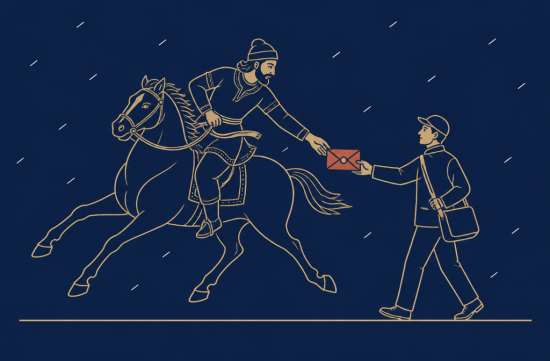
Here comes the twist. The protagonist of this phrase is neither an American mail carrier nor a Greek, but a Persian mounted courier.
USPS materials explain that this is set against the backdrop of the Persian mounted postal system that operated during the wars between Greece and Persia from 500 to 449 BC.
What's even more interesting is the context. Just before this passage, Xerxes sends a courier to inform Persia of the defeat of his fleet at the Battle of Salamis.
So, the introduction of the courier system happens right at the moment of delivering bad news about a defeat. It's like a cutscene in a game where you go back to your base to report that you lost a boss battle.
The system itself was well-designed even by today's standards. They placed horses and riders at intervals along the journey, passing messages to the next runner in a relay style.
Herodotus likened this to a torch relay. To me, it looks like a speedrun where you switch characters at each checkpoint.
So what is the actual official phrase? The mission of USPS is outlined in Title 39, Section 101(a) of the United States Code.
The essence is about uniting the country through personal, educational, literary, and business correspondence. It also includes a directive to provide prompt and reliable service to all areas.
While the sentiment is good, it's definitely less impressive compared to the image of braving a snowstorm. It's easy to understand why people remember the engraved phrase instead of the legal text.
For reference, there's another lesser-known inscription. It's on the old Washington DC Post Office, now the National Postal Museum building.
The original text is "The Letter" written by former Harvard president Charles W. Eliot, with slight modifications by President Woodrow Wilson. It describes a letter as a comfort for the lonely and a bond connecting scattered families.
One more thing to note is that this phrase is not an official promise either. If the weather is severe, mail can indeed be delayed, so invoking this phrase when deliveries are late won't be of much use.
Still, I like this fan-created setting. The fact that people have believed it to be official for over a century is because there have been those who actually traveled that route every day.
The next time someone brings up the USPS motto, feel free to add a comment. That's actually a story about a Persian courier, chosen by an architect who loved Greek.
I'll make sure to express my gratitude when I meet the delivery person on a snowy day. Unlocking a hidden setting, mission accomplished.
 GlowHeadAnne




 Noodle Noodle |

 Chino Min |

 Glow Yo |

 Michigan Enthusiast |
 xylora |

 rosed |

 lavender |

 linex |
 sweetee |


 Vivid Information US News |
 canyon |
 juniper |
 novaline |
 sunny side |
 kimchi warrior |
 nero kim |
 refresh |
 rainyday |
 springw |
 American History This and That |
 goldenleaf |
 mistily |
 selviro |
 strongman |
 Waiting for Godot |
 Sunny Mom |
 Blondee |
 El Dorado |
 passive |
 gardener 007 |