
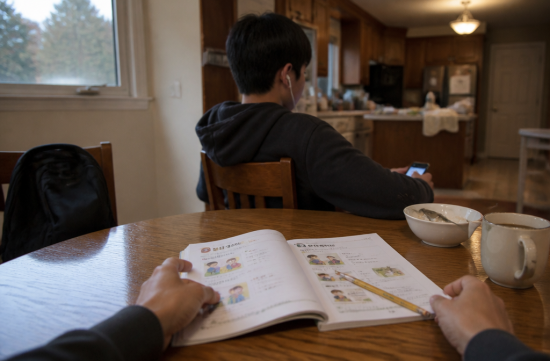
The child who used to say, "Mom, give me food" until elementary school suddenly starts responding with, "Mom, I'm good" when they enter middle school. This is a scene many Korean families might have experienced.
Next Friday, October 9th, is Hangul Day. Around this time, I tend to reassess how much Korean is still spoken at our dining table.
First, let's clarify what Hangul Day is. The year King Sejong promulgated the Hunminjeongeum was 1446, and Hangul Day commemorates that proclamation.
In Korea, Hangul Day was removed from the list of public holidays in 1991. However, it was reinstated as a public holiday starting in 2013.
It's interesting that it wasn't even a holiday in the homeland for a while. I see this as evidence that preserving a language doesn't happen automatically.
Now, let's look at the numbers. According to the Pew Research Center, 68% of Asian Americans born in the U.S. only use English at home.
When looking specifically at Koreans, even when combining immigrants and U.S.-born individuals, 39% report using only English at home. This is significant, even considering the mix of generations.
Honestly, I was a bit surprised when I first saw this number. It felt faster than I expected.
So why does this break happen during adolescence? Researchers commonly point to identity as the first reason.
Studies involving second-generation Korean American youth indicate that they often feel caught between two cultures, unable to fully belong to either. For kids at this age, Korean can easily become something that makes them feel different.
Another Pew survey found that second-generation Asian Americans born in the U.S. are the group most likely to have hidden parts of their roots. Avoiding Korean in front of friends isn't due to laziness.
The second reason is time. As students move into middle and high school, sports, music, and AP classes all pile up.
Research reports also point out that due to busy schedules and competition with other activities, enrollment in Korean language classes decreases as children get older. Saturday morning Korean schools are often the first to be dropped.
The third issue is related to parents. Research shows that how much parents value the Korean language and how involved they are can greatly affect their children's proficiency.
This point hit me the hardest. When a child responds in English, parents often unconsciously switch to English as well.
So what are some realistic solutions? I believe it's better to show children the practical benefits rather than appealing to emotions.
In Ohio, there is a Seal of Biliteracy program. If students can prove proficiency in English and another language, they receive a certification seal on their high school diploma.
This applies to students who entered 9th grade on or after July 1, 2014, meaning it affects graduates from 2018 onward. For foreign languages, they must meet criteria such as Intermediate High or higher on approved assessments.
However, not all schools automatically participate. Schools must choose to opt in, so it's advisable to check with the relevant counselor first.
For reference, the SAT Subject Test in Korean was discontinued in 2021 when the College Board eliminated the Subject Tests altogether. Therefore, state-level certifications like this are more useful nowadays.
There are also more local resources than you might think. In our neighborhood, there are several weekend Korean schools centered around churches, some of which have been running since 1995.
Registration times and class placements vary by school, so it's best to contact them directly. If your child is in adolescence, make sure to check if there are peers in the class.
And one more thing. Research indicates that among children from immigrant families, those who only speak English have noticeably higher dropout rates than their peers who maintain their mother tongue.
Of course, this is a correlation, not a causation. However, it can be said that concerns about Korean interfering with studies are not strongly supported.
The method I recommend is simple. Let's have at least one meal at the dinner table in Korean, and allow the child to respond in English without reprimanding them.
Some families set a specific time for video calls with grandparents in Korean as a sort of homework. When there's a clear conversation partner, children find their own reasons to use Korean.
Using K-drama or K-pop as an excuse is also a good idea. If children engage with content they are already interested in, they are much less likely to resist.
There are second-generation individuals who initially stopped using Korean during adolescence but later sought out Korean classes in college. I believe it's the parents' job to ensure that the bridge back is not burned.
This Hangul Day, instead of grand plans, why not start with just one sentence in Korean at dinner tonight? I believe that's the most certain investment you can make.
 SunrayPlus


 morvex37 |
 Ari Songhan American Immigration Life |
 Bearded Strawberry Smoothie |
 Heart Ticker |
 Duck Duck Go |
 happy 9 |

 Mr Cleveland |
 Real Estate Investment Korean American |
 peace |
 sylven |
  Sammy Beach |
  Bliss O |
  blue ocean |
  greenlight |
  Watanaka Karametibaksa |
  castle |
  xelton52 |
  carefree |
  vrixen73 |
  AZ Road Master |
  Victory 1988 |
  summita |
  business lim |
  Colorado Lee |
  Make My Day |
  Fros Pro |
  lioness |
  La Bean |
  American History This and That |