
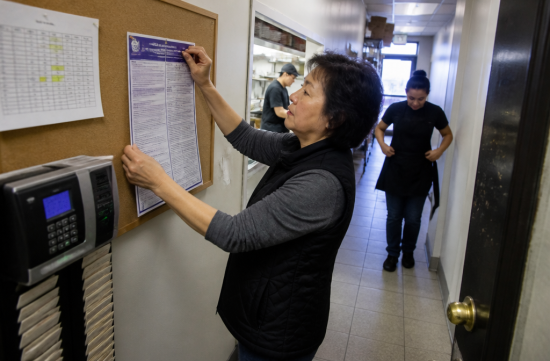
$11.40. This is the minimum wage that will apply to general workers in Ohio starting January 1. This figure was announced by the Ohio Department of Commerce on September 30.
This year's wage is $11, so that's a 40-cent increase. It may seem insignificant, but when I see numbers like this, I immediately pull out my calculator.
If you consider one full-time employee working 40 hours a week for 52 weeks, that totals 2,080 hours a year. Multiplying by 40 cents means an additional $832 per year.
But that's not all. Adding the employer's FICA contribution of 7.65% brings in another roughly $63.
What if a store employs five part-time workers for 30 hours a week? Each would cost an additional $624, totaling an increase of $3,120 in labor costs for all five.
So why does it increase every year? It's because of a constitutional amendment passed by Ohio voters in 2006 that mandates annual adjustments based on inflation.
The index used is the CPI-W, which tracks the consumer price index for urban wage earners, looking at changes over the past 12 months up to August. Therefore, changes in the governor or legislature won't stop this adjustment.
Media reports indicate a 3.5% increase. However, dividing the 40-cent increase by $11 results in a 3.6% increase, which seems to be a rounding difference.
There may be questions about whether Cincinnati has its own minimum wage. From my research, I haven't found such data, so it's best to refer to the state standard first.
Ohio's SB 331, passed in 2016, prohibits local governments from setting minimum wages different from the state. However, there was litigation questioning the legislative process, so if you need to examine the provisions, consulting a lawyer is advisable.
One area that confuses business owners the most is tipped employees. Next year's tipped wage will be $5.70 per hour, an increase of 20 cents from this year's $5.50.
However, simply paying $5.70 is not enough. The combined total of hourly wage and tips must equal $11.40, and employers using tip credits must be able to prove this.
For example, if a server works 30 hours a week and receives $120 in tips, that amounts to $4 per hour in tips.
Adding $5.70 to $4 only totals $9.70. The remaining $1.70 multiplied by 30 hours equals $51, which the employer must cover.
There are also criteria for tipped employees. They must consistently earn over $30 in tips per month.
Next is the revenue threshold. According to the state poster, businesses with annual revenues below the threshold must pay at least the federal minimum wage of $7.25.
This threshold will increase next year from $405,000 to $419,000, as stated in the Ohio Department of Commerce's 2027 poster.
Local news reports sometimes cite the figure as $420,000. When numbers differ, I prefer to rely on the official poster.
Here, revenue refers to gross receipts, not net profit. Just because there are no profits doesn't mean a business qualifies for this exception.
A business with $410,000 in revenue this year is on the borderline. Be sure to confirm with an accountant which year's revenue is being considered.
Employees aged 14 and 15 are subject to the federal minimum wage of $7.25. The poster states that this applies to those under 16.
Family employees in businesses run solely by owner families, as well as true managerial or professional employees, are exempt. Just having the title of manager doesn't mean they all qualify, so be cautious.
Overtime must also be considered. Hours worked over 40 in a week are paid at 1.5 times the regular rate, with exceptions for businesses earning less than $150,000 annually according to the state poster.
Next year's overtime rate for minimum wage employees will be $17.10, an increase of 60 cents from this year's $16.50.
Record-keeping is also crucial. You must retain employee names, addresses, job titles, hourly rates, hours worked, and pay amounts for at least three years from the employee's last day of work.
This provision should not be taken lightly. If a violation is recognized under state law, you may have to pay double the back wages owed, plus attorney fees for the employee's side.
In trying to save 40 cents, you could end up paying several times that amount. Just looking at the numbers, it's not a profitable venture at all.
If I were a business owner, my steps would be as follows. I would change the hourly rates in the payroll system by December. For pay periods that include January 1, I would calculate based on the specific dates.
Next, I would check the weekly totals for tipped employees. I would replace the poster with the 2027 version. Finally, I would decide whether to raise menu prices.
I believe the current method of gradual increases in line with inflation is better. It's easier for both the owner and employees to plan than having a large jump after several years.
Of course, $3,120 is not a small amount for a small business. However, since this figure was released at the end of September, there is still plenty of time to prepare.
 WhatDoUSA


 Bald Eagle Brothers |

 sunny side |

 kodak |

 Valley Hong |

 Casa Mia |

 content |


 peace |

 hopeful |

 Cinci |

 nova nova |
 figtop |
 Yahoo LALA |
 Korea News Economic News |
 calvor |
 timistic |
 Lee Sang Don |
 victoria jung |
 The Long Shot |
 Univ Student |
 Tora Tora |
 pandaworld |
 lumix88 |
 choi family |
 Lansinger |
 Giant Squid and Sweet Potato Soup |
 InJung Gu |
 cake money |
 swiftlane |