
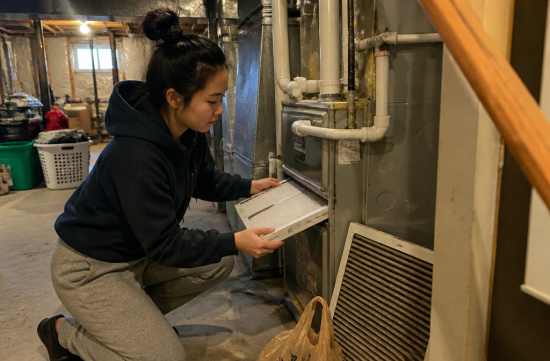
A few days ago, I turned on the heater and noticed a slight smell of dust in the air. At first, I thought it was just because I hadn't used it in a while, but just to be sure, I opened the furnace door.
The filter was beyond gray and almost a dark brown. Honestly, I couldn't even remember the last time I changed it, which was a bit embarrassing.
So today, I want to talk about furnace filters. With Thanksgiving coming up and people gathering at home, this is a quick task that can be done in just 5 minutes, so I hope you'll take care of it.
First, let's go over what the filter does. The furnace pulls in air from inside the house, heats it, and then sends it back out through the ducts, filtering out dust and hair at the intake with the filter.
If this gets clogged, the airflow is restricted. You can think of it like trying to drink a beverage through a straw that's partially blocked.
With less air coming in, the blower motor has to work harder and longer. The house won't warm up as much as you'd like, and you'll end up using more electricity and gas.
According to the U.S. Department of Energy, changing a clogged filter to a clean one can reduce energy use by 5-15% for cooling. The same principle applies to heating since the air passes through the same filter.
More concerning than the cost is safety. When airflow is restricted, heat builds up around the heat exchanger inside the furnace.
This triggers a safety device called the high limit switch, which shuts off the burner. It cools down, turns back on, and then shuts off again when it gets hot, causing short cycling.
If your heater keeps turning on and off every few minutes, the first thing to suspect is the filter. Many companies list a clogged filter as the most common cause of this symptom.
If this overheating happens repeatedly for a long time, it can strain the heat exchanger, and if it cracks, there's a risk of carbon monoxide leaking. If you change the filter and the symptoms persist, be sure to call an HVAC technician.
While you're at it, it's a good idea to check the battery in your carbon monoxide detector as well. I find it's less of a hassle to check everything at once before winter sets in.
So how often should you change it? Energy Star recommends checking the filter monthly, changing it immediately if it looks dirty, and replacing it at least every three months, even if it looks clean.
If you have pets or allergies, or if you've done any construction or remodeling, the filter will get dirty faster. In these cases, changing it every month or two is more comfortable.
The MERV rating you see when choosing a filter can also be confusing. A higher number means it filters out smaller particles.
The EPA advises using a MERV rating of 13 or higher if your system can handle it, or the highest rating possible otherwise. However, the higher the rating, the greater the air resistance can be, which is a catch.
So instead of just buying the highest-rated filter, it's best to check the recommended rating in your furnace manual first. If you're unsure, ask a technician if your system can handle a MERV 13 filter.
By the way, filter prices can vary quite a bit depending on the rating and thickness. However, buying them in bulk can significantly reduce the cost per filter, so I plan to stock up next time.
Size is also important. The dimensions (width, height, thickness) are printed on the side of the filter currently in place, so taking a picture of that will help you avoid confusion at the store.
Changing the filter is really simple. First, turn off the heater at the thermostat, then slide out the filter located next to the furnace or behind the return grill.
Before throwing away the old filter, put it in a plastic bag to take it outside. If you shake it out inside, all the dust that has accumulated will just get released back into the air.
There's an arrow on the edge of the new filter indicating the direction of airflow. Make sure the arrow points toward the furnace when you install it.
I want to emphasize this because I've installed it backward before. If the direction is wrong, the filter won't perform properly.
After installing it, write the replacement date on the filter's edge with a marker. This way, when you open it next time, you'll know exactly when you changed it, so you won't forget like I do.
This time, I even set a recurring reminder for three months in my calendar app. If you have a smart thermostat, many models have a filter replacement reminder feature, so check your settings for that.
Setting up regular deliveries from Amazon or filter companies is also a good option. When the filter arrives at your home, it serves as a reminder, which is quite convenient.
In fact, this kind of maintenance can be more confusing for renters. Many lease agreements specify who is responsible for changing the filter, so check that and request it from your landlord if it's their responsibility.
Also, check the vents where the air comes out. If furniture or rugs are blocking the vents, even a new filter won't improve airflow.
To summarize: check it once a month, change it if it's dirty, and don't go longer than three months.
Considering that the cost of one filter is much cheaper than the cost of heater repairs or several months of heating bills, I would change it without hesitation this weekend. Wishing everyone a warm and safe winter.
 Drving Ball


 donggul donggul |

 Mr. Largo |

 Silent Sea |

 Noodle Noodle |
 figtop |

 maple lady |

 Princess Park |

 kiwiii |

 bigcheese |

 wexlin84 |
 Victory 1988 |
 noraro |
 korando9 |
 Scade Studio |
 flingstone |
 Rynex |
 Mint Star |
 Dalsabet dolstar |
 Winter bear |
 FLORIDA Acus |
 Anytime Journey |
 Information on All Regions of the United States |
 Lim Ario |
 Mr Oh |
 Lululala |
 Atlanta Business Information |
 Yo Lock Me Up |
 Joyce 77 |
 ANSLO NEWS |