
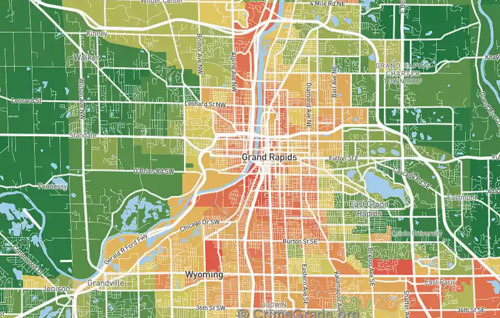
Examining the crime data of Grand Rapids can provide useful information for making decisions about relocating to the city.
Based on the FBI's Uniform Crime Report (UCR), the Grand Rapids Police Department's (GRPD) annual public reports, and data from crime analysis platforms like NeighborhoodScout and CrimeGrade, we summarize the current status and recent trends of major crime types.
Looking at homicide statistics, Grand Rapids has a lower rate compared to nationally recognized high-risk cities like Detroit or Flint, but it is somewhat higher than the average for mid-sized cities. According to the Grand Rapids Police Department, the annual number of homicides has fluctuated around 20 cases in recent years, with a homicide rate of 10 to 13 per 100,000 people, which is higher than the national average (about 5 to 7). The incidents tend to be concentrated in the western and southwestern areas of the downtown.
Motor vehicle theft is one of the major crime types that residents in Grand Rapids feel acutely. Since 2020, there has been a nationwide surge in vehicle thefts, which has also been reflected in Grand Rapids. Specific models of Kia and Hyundai vehicles have been reported as targets due to security vulnerabilities, and the police department has recommended the use of mechanical locks like steering wheel locks. Incidents are relatively more reported in exposed street parking or poorly lit parking areas.
The property crime category includes burglary, larceny-theft, and theft from vehicles. According to CrimeGrade.org, Grand Rapids has an overall property crime grade of 'D', placing it in the lower tier compared to other cities in the U.S. Burglary primarily targets homes without security systems, especially those that appear vacant or have weak security at back entrances. Larceny is frequently reported in large shopping mall parking lots or near grocery stores.
Recent trends indicate that the Grand Rapids Police Department is consistently implementing community policing strategies and reporting crime suppression effects in some high-risk areas. In neighborhoods undergoing urban redevelopment and gentrification, there tends to be a decrease in crime rates alongside improvements in living conditions. Conversely, structurally, there are ongoing issues with property and violent crimes in low-income areas with high housing instability. When considering relocation, it is more beneficial to look at trends over 3 to 5 years rather than relying on data from a single year.
Basic rules for crime prevention in everyday life include keeping valuables out of sight in vehicles or removing them from the car, reinforcing apartment or home entry doors, installing security cameras or smart doorbells, and quickly sharing any unusual signs in the neighborhood through community platforms like Nextdoor. Saving the Grand Rapids Police Department's non-emergency reporting line (616-456-3400) and actively reporting suspicious situations can help enhance community safety.
 ForestWalker




 moo moo |
 ultron78 |
 garlic bread |
 Sugar Cream Door Bulletproof Noodles |
 urbanmint |
 apricotla |
 carpflow |
 oneonly |
 icotla |
 So is multiplied by So, So Ji-sub |
  Where is a really nice neighborhood? |
  Real Estate |
  Forest Gump |
  Real Estate Investment Korean American |
  Dollydori, Lover of Movies |
  dmzline |
  travelo |
  American Food Information & Calories |
  Splendid Mission |
  sparklingo |
  Watch Walker |
  Soy Angelino |
  autumn |
  K-POP TV News |
  cortiva6 |
  Nevada Teppanyaki |
  aerion99 |
  Golado |
  Maximum Pro |
  Joyce blog |