

Do you know what frustrates me the most about living in America?
The middle class used to be a comfortable group, but these days, there's no money.
When I check my credit card statement, I see I haven't bought luxury items or gone on trips.
I've just shopped at Costco, filled up my car with gasoline, paid the electric bill, and paid for insurance. Yet, there's no money.
What on earth is going on?
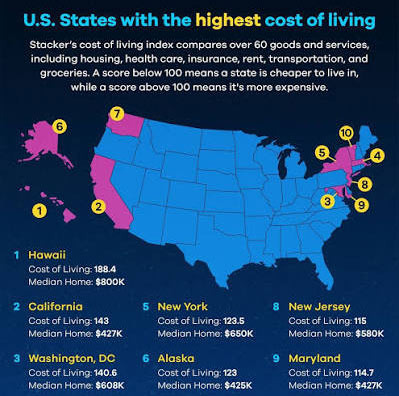
Especially in places like California, New York, Massachusetts, and Hawaii, it's astonishing.
Politically, these areas tend to lean Democratic, but if you line up the most expensive places to live in America, these neighborhoods are right at the top.
Of course, it's an oversimplification to conclude that "prices have risen because the Democrats are in power."
Hawaii is an island, so logistics are expensive; New York is a global metropolis; and California has great weather and tremendous housing demand.
Massachusetts also has high-income industries and prestigious universities centered around Boston.
Even considering all these factors, residents are frustrated.
I understand that the government is trying to implement good policies by collecting taxes, creating regulations, protecting the environment, and increasing welfare, but what does that mean for our monthly living expenses?
Housing prices are high, rent is high, car insurance is high, and electricity bills are not cheap either.
If you earn $100,000 a year, it used to mean "you've made it in America," but these days, in big cities, raising two kids while paying a mortgage just makes you an average worker.
What's even scarier is that people are starting to buy essential goods with credit cards instead of luxury items.
By 2026, the credit card balance in the U.S. is expected to exceed $1 trillion again, and the burden of delinquency is increasing.
Even if prices aren't skyrocketing like before, the prices that have already risen aren't coming down.
In July 2026, consumer prices were 3.4% higher than the previous year. This is important.
When you hear news that inflation is down, it's easy to think that prices have dropped, but that's not the case.
If something that cost $100 last year is now $110 and this year it's $113, they say "the inflation rate has decreased."
I'm still paying $113, but the news says prices are stabilizing.
So, from a consumer's perspective, it's maddening.
Moreover, credit cards are not free money.
If I swipe my card for $500 this month because I don't have enough money for groceries and then swipe it again next month because I'm still short, my living expenses turn into debt.
Once interest starts accruing, a strange situation arises where I'm paying for groceries I bought last year this year.
Politicians shouldn't take this issue lightly.
Prices aren't determined solely by the president or a single governor.
The Federal Reserve's interest rates, housing supply, energy prices, tariffs, corporate pricing policies, wages, state taxes, and regulations all mix together.
However, voters are not economics students.
When I buy a gallon of milk at the store and see the price at the checkout, that's economics.
When I receive a renewal notice for my exorbitant car insurance in LA and feel frustrated, that's economics, and if my rent for a two-bedroom apartment goes up by another $200, that's economics too.
Democratic strongholds certainly gain in areas like education, healthcare, and social services.
The problem is that good policies must ultimately be manageable for residents.
If the money I receive on payday disappears into rent, insurance, electricity bills, and groceries, and I have to pull out my credit card at the end, it's hard to feel good about it.
Politics may seem to be evaluated by grand slogans, but in the end, the final judgment is very simple.
"So, has it become a bit easier for me to make a living?"
If they can't answer that, whether it's a red state or a blue state, they'll get hit during elections, but the reality is not so simple.
 GymForPhotos
 MintCreator
 SilverCore73




 washington mom |
 California Dreamer |
 Investment Campus Home Ownership |
 U.S. Retirement Pension Information |
 Victory 1988 |
 There Are Such Things in the World |
 Anjollinya Blog |
 novapixel |
 Sunny's Travel in America |
  coloradoman |
  lumora |
  Valley Bang |
  pravix22 |
  Cohesive Kong |
  werehere |
  problemo |
  galaxy88 |
  breezelove |
  hazelnut |
  Korean News American Blog |
  AH LALA |
  Savion |
  pintos |
  Good Good |
  oh my salami |
  Lemonade Cider Planning Director |
  Way to easy |