
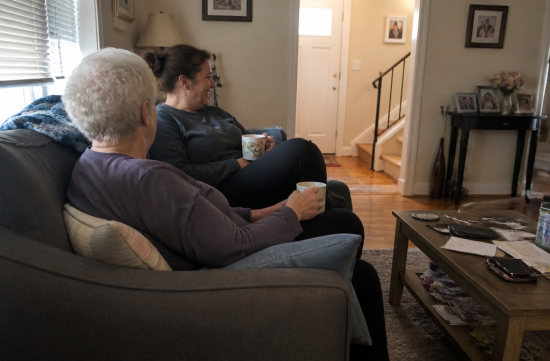
Not long ago, I casually asked a friend, "Are there people living with their parents these days?" and everyone looked surprised.
It was as if I had brought up something unusual, which made me feel even more awkward.
When you think about it, in America, there's a subtle perception that if an adult is still living with their parents, they haven't achieved independence yet.
But this hasn't always been the case.
As recently as 1950, 21 percent of the U.S. population lived in multi-generational households.
However, by 1980, that percentage had dropped to 12 percent, marking the lowest figure in history.
What happened during this time was that after the war, there was a rapid increase in single-family homes in the suburbs, centered around the nuclear family.
The decrease in the immigrant population and the noticeable improvement in the health and economic conditions of the elderly also contributed to this trend.
If we dig a little deeper into the improved conditions for the elderly, we find an interesting story.
With the passage of the Social Security Act in 1935, seniors began receiving monthly cash payments, allowing them to afford separate nursing facilities instead of living with their children.
This led to the growth of what were once small boarding houses into full-fledged nursing home businesses.
By the introduction of Medicare and Medicaid in 1965, the nursing home industry experienced explosive growth.
For reference, the average cost of a private room in a nursing home today is about $127,750 per year, making it an unaffordable option for most families.
In other words, the idea of parents living separately, especially in facilities, is largely a product of specific policies from a certain period.
It's not that older people have always wanted to live apart from their children; it's that the financial means and facilities to do so only became available then.
Thus, the normalization of living separately from parents is actually a relatively recent development, created under specific social conditions.
The generation that grew up during that time is now our parents and grandparents, which seems to have solidified that standard as common sense.
Interestingly, this trend began to reverse around 1980.
In 1971, about 14.5 million people lived in multi-generational households, but by 2021, that number had increased to 59.7 million.
Whenever the economy struggles, it has become more common for parents and children to move back in together, and the demographic makeup has also changed.
As the proportions of immigrant families, Asian, Black, and Hispanic populations have increased, the culture of multi-generational living, which was originally more natural, has been more significantly reflected in the statistics.
And this trend isn't just happening among the parents' generation.
In the summer of 2020, 52 percent of young adults aged 18 to 29 were living with their parents, surpassing records from the Great Depression in the 1940s.
In fact, the term 'boomerang generation' was coined by the Pew Research Center to describe the trend of adult children returning to their parents' homes, first used in 2012 to explain the situation following the 2008 financial crisis.
Ultimately, on one side, aging parents are moving back in, while on the other, adult children are also returning to the same household.
At this point, the idea that living separately is the default seems to lose its meaning.
In American individualism, leaving the parental home at 18, or around the time of college graduation, is often seen as a rite of passage into adulthood.
However, these days, with the high costs of nursing facilities, more families are choosing to bring their parents back home instead of placing them in facilities.
In fact, a 2020 AARP survey found that 53 million people in the U.S. were providing unpaid care to family members, which is about one in five adults.
In the 1930s, you needed money to live separately, but now it's almost the opposite, where financial constraints are leading to reunification, which is ironic.
Looking at this, it seems that the barriers between generations are not about morality or affection, but rather have shifted according to financial circumstances over time.
From what I see, among immigrant families from cultures where multi-generational living is common, like Italy or Korea, these statistical changes don't seem particularly surprising.
In the Korean community, for instance, living with parents has never really been seen as unusual.
In fact, it seems more odd if adult children don't visit their parents frequently.
So, I feel a bit unfairly judged by the perspective that independence should be measured strictly by age.
Living together or apart is just a choice that fits each person's circumstances, and there's no reason to attach notions of maturity or immaturity to it.
Looking at the statistics alone, the idea that living separately is the norm appears to be more of a fleeting trend from a generation ago.
The next time someone asks in surprise, I think I'll be able to confidently respond with the numbers to back it up.
 foxriverdreamer1982







 AH LALA |
 Victory 1988 |
 Panorama Kstar |
 Giant Squid and Sweet Potato Soup |
 Lol Life |
 mortrix |
 Lim Ario |
 Flying Shooting Star |
 U.S. College Admission Information |
 Korean News American Blog |
  Savion |
  pintos |
  Good Good |
  oh my salami |
  Lemonade Cider Planning Director |
  Way to easy |
  American Hardcore Band |
  Dala Dala |
  Pointy |
  Springs Korea |
  nixon |
  mini hometown |
  Gleeee |
  MacMorningBlog |
  ASURA |
  Elastico |
  shaket |