
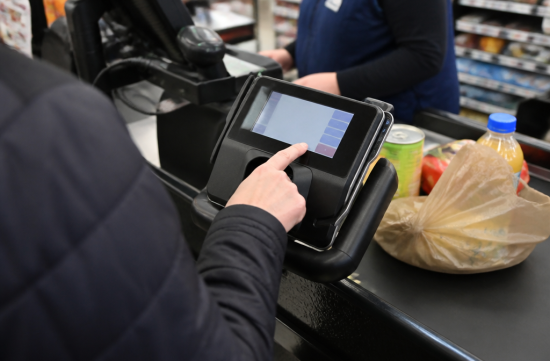
When you're at the checkout counter, swiping your card, and a button pops up asking, "Would you like to donate?" you've probably seen it at least once. I initially brushed it off, wondering what it was all about.
But it turns out this isn't just a trend at a few stores; large supermarkets, pharmacies, convenience stores, and even fast-food restaurants are all doing it.
This indicates that it's not just a spontaneous event at one store but a system that has been established across the industry for quite some time.
In fact, this type of checkout donation is known as checkout charity in English, and it has been implemented in the U.S. for over 30 years.
In the past, cashiers would ask customers directly, but now it has smoothly transitioned to a system where a button appears on card readers or self-checkout screens.
By having the screen ask instead of a person, stores reduce their burden, and customers can comfortably choose to donate or skip without feeling rushed.
In just 2024, there were 92 campaigns in the U.S. alone, raising over $275 million, which is quite impressive just by looking at the numbers.
In 2020, the total was $605 million, which increased to $749 million in 2022, showing that this method has gained more traction post-pandemic.
When you combine all the donations collected over the past 30 years, the total amount raised through checkout donations in the U.S. exceeds $5 billion, which is a staggering figure even if it's just a few dollars at a time.
For instance, Domino's Pizza has raised over $126 million for St. Jude Children's Hospital through rounding up change at the checkout over the past 20 years.
Money collected by rounding up just a few cents or dollars has accumulated to such a large scale over time.
Looking at where the funds go, animal-related organizations receive about $78 million, health and medical causes get $69 million, food assistance receives $36 million, and disaster relief gets around $18 million.
A notable example is Walmart, which raised $33 million for a children's hospital foundation through a month-long campaign, and Walgreens raised $37 million through the Red Nose Day campaign, most of which came from small donations at the checkout.
The methods are becoming more standardized, with campaigns increasingly using the round-up method, where the total is rounded up to the next dollar, rather than just asking for a set amount. The automatic prompts on electronic payment screens are also rapidly increasing.
Many campaigns don't even ask for a specific amount but offer options like $1, $3, or $5, which actually helps reduce the time customers spend deciding, leading to larger donations.
In Korean supermarkets, it's rare to see such direct inquiries about donations at checkout, so when I first saw it in the U.S., it felt both fascinating and a bit strange.
The reason they ask at checkout is that at that moment, customers have already opened their wallets, so they don't feel too burdened by adding a few cents or dollars.
With just a button press, there's no need for a grand decision right before swiping your card, making it easy to respond spontaneously.
While waiting in line at the checkout, I often see a child asking their parent, "What's this?" while looking at the button on the screen, and it's nice to see parents briefly explaining what a donation is in that moment.
However, there are also many opinions that don't view this positively. One complaint is why the company's image improves at the expense of customers' wallets.
This dissatisfaction isn't just talk; CVS has faced lawsuits over the checkout donation method, which were ultimately dismissed by a New York court, indicating that there are certainly uncomfortable perspectives on this issue.
Some argue that while the customers are the ones donating, it seems like the company is taking credit for it, and others feel pressured to click the button in a line where it's awkward to refuse.
Honestly, I've pressed the button without thinking when I felt rushed at checkout with someone behind me, and each time I wonder if that's really a voluntary donation.
That said, I don't think we should entirely condemn this method. I believe it's much better than companies advertising with their own money.
In reality, the funds raised are used for specific causes like pediatric cancer hospitals or local food banks, and some stores have even seen sales increase during the campaign periods, so it's a structure that benefits companies, customers, and organizations alike.
I just treat it casually, pressing the button if I feel like it that day and skipping it if I'm in a hurry.
Since it's usually just a few dollars, there's no need to feel burdened, but it's worth developing a habit of checking where that money actually goes through receipts or screens from time to time.
 DOCTORMED


 AH LALA |
 Victory 1988 |
 Panorama Kstar |
 Giant Squid and Sweet Potato Soup |
 Lol Life |
 brandon |

 zentar |
 nixon |
 Fairfax Fox |
 victoria jung |
  coloradoman |
  lumora |
  Valley Bang |
  pravix22 |
  Cohesive Kong |
  werehere |
  problemo |
  galaxy88 |
  breezelove |
  Minnesota Sonata N |
  hazelnut |
  Korean News American Blog |
  Savion |
  pintos |
  Good Good |
  oh my salami |
  Lemonade Cider Planning Director |
  Way to easy |