
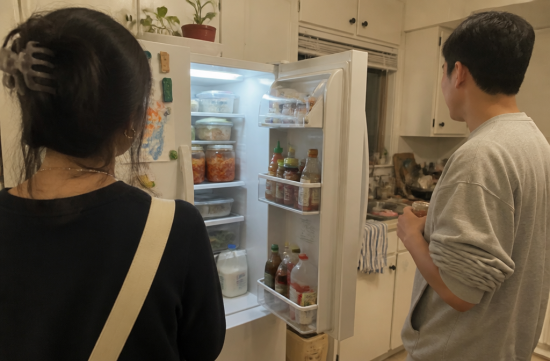
There are moments when an American guest at a housewarming party opens the refrigerator and slightly furrows their brow, asking about the source of the smell. The complexity of feelings that arise from that brief expression is because kimchi is not just a side dish, but a part of our kitchen's identity.
When faced with such reactions for the first time, feelings of unfairness often come to the forefront. There's a sense of disappointment that the unique smell of fermented food is not understood, and yet, since it's in front of guests, there's also the calculation that one must smile and brush it off.
However, this issue of smell has actually been a long-standing concern within Korea itself. The first kimchi refrigerator model released by Geumseong in 1984 was an attempt to solve the problem of kimchi odors permeating other side dishes through technology.
The idea really took hold with the introduction of the Dimchae by Mando Machinery in 1995. The company established a kimchi research institute in 1993 and, after three years of experimenting with a million heads of kimchi, launched the Dimchae.
Since then, the Dimchae has maintained its position as the number one preferred brand in the kimchi refrigerator market for over 25 years. With the market forming around 900,000 to 1,000,000 units annually, a survey shows that Dimchae alone holds nearly 40% market share, indicating how long and how seriously this smell issue has been addressed in many households.
Instead of hiding the smell issue, the solution was found by precisely controlling temperature and humidity to manage fermentation. The fact that they sought a way to manage the smell rather than eliminate it still seems practical today.
The reactions encountered in the U.S. are a different matter than this technical solution. Sometimes, the perception of the smell carries racial weight beyond the smell of kimchi itself.
In fact, an interesting result emerged from a study dealing with immigrant foods and their smells. Non-European foods, even if priced similarly or higher, tend to receive more evaluations as cheap or unclean.
There's also research that gathered thirty-five Korean immigrant participants to ask what kimchi means to their identity. One of the themes that emerged from their responses was the feelings of shame and sadness, which lingers in the mind.
In contrast, strong-smelling European foods like French cheese or Italian gorgonzola are often rated as luxurious, even if they have the same intensity of smell. This suggests that it's not just the smell itself, but who the food belongs to that influences the evaluation.
Foods like durian from Southeast Asia or surströmming from Northern Europe are in a similar situation. Despite having much stronger smells than kimchi, they are often introduced as exotic delicacies among travelers.
In a study involving nine countries, it was found that people who have a strong aversion to body odor also tend to have heightened wariness towards unfamiliar immigrant groups. This indicates that reactions to smells are not purely sensory issues.
Thus, it's ambiguous to interpret comments about the smell of kimchi purely as a sensory reaction or to conclude that they are entirely discriminatory. In reality, it's often a combination of both.
Among children of Korean immigrant families, the smell issue often remains a particularly sensitive memory during adolescence. It's not uncommon to hear experiences of being reluctant to bring friends home due to the smell from their lunchboxes.
There's even a term for these moments that occur during school lunches or with packed lunches. It signifies the moment one realizes that their culture is different from the majority due to just one smell.
However, recent studies have shown that the atmosphere has changed somewhat. Children who grew up in neighborhoods where diverse foods are common are increasingly responding that instead of feeling embarrassed about their lunchbox side dishes, their friends are curious and envious.
Ultimately, the smell itself remains the same, but the atmosphere surrounding that smell has changed. Over time, familiarity has replaced aversion.
With the theory laid out, the question remains: what can be done? The answer is surprisingly simple.
First, there's no need to feel intimidated when a guest opens the refrigerator and is surprised by the smell. A straightforward explanation usually helps most people move past it naturally.
Simply saying that it's a fermented food that gets stronger in smell as it ripens, and that it's something we eat every day, is usually sufficient. Instead of hurriedly closing the refrigerator door as if to apologize, it's better to take this kind of relaxed approach.
Using materials like baking soda or activated charcoal can also be practically helpful in reducing refrigerator odors. Baking soda is slightly alkaline, which neutralizes acidic odor particles, and activated charcoal works on the principle of adsorbing odor molecules through its tiny pores, making it more effective when used with airtight containers.
On the day of making kimchi, opening windows for ventilation and using separate refrigerators or airtight containers are, of course, helpful. However, it's important to clarify to oneself that the reason for using these methods is convenience, not shame.
It may seem excessive to think this much about just one smell, but ultimately, these small moments accumulate to shape our attitudes towards our culture. Choosing to explain rather than hide the smell has made me feel much more at ease.
 midnightforestbuilder1948







 AH LALA |
 Victory 1988 |
 Panorama Kstar |
 Giant Squid and Sweet Potato Soup |
 Lol Life |
 Minnesota Lakes and Clouds |
 Minnesota Sonata N |
 chiobase |

 breezelove |
  hazelnut |
  Korean News American Blog |
  Savion |
  pintos |
  Good Good |
  oh my salami |
  Lemonade Cider Planning Director |
  Way to easy |
  American Hardcore Band |
  Dala Dala |
  Pointy |
  Springs Korea |
  nixon |
  mini hometown |
  Gleeee |
  MacMorningBlog |