
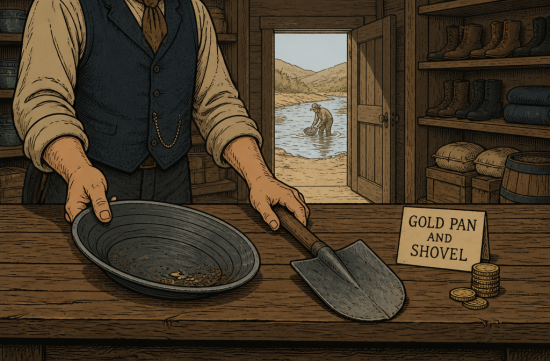
When people think of the Gold Rush, they often picture miners panning for gold in riverbeds. However, the ones who truly made a fortune during that time were those who never picked up a pickaxe.
In 1848, when news spread that gold had been discovered near Sacramento, California, people flocked from across the nation and even from other countries starting the following year. Those who arrived during this time were called forty-niners.
This single piece of news transformed California almost overnight. Before gold was discovered, the population was just over a thousand, excluding Native Americans, but by the end of 1849, it swelled to around one hundred thousand. With so many people arriving, California skipped the territorial stage and was officially admitted as a state in 1850.
Initially, miners were reportedly making quite a decent amount of money each day. Compared to the daily wages of farm workers or skilled laborers at the time, it was certainly a higher level of income.
The problem arose as more people arrived. While the number of gold seekers increased daily, the supply routes to California were long and slow.
As a result, the prices of basic items like a pair of boots or a sack of flour skyrocketed. The cost of living began to exceed the amount of gold being mined.
Just looking at the price of eggs illustrates how much prices soared. In 1849, a single egg sold for one dollar in San Francisco, and in mining areas where supplies were scarcer, the price shot up to three dollars each, which is astonishing even by today's standards.
Moreover, mining itself was no easy task. Spending all day in cold river water and repeatedly swinging a pickaxe often led to physical ailments.
As a result, many returned home lighter in their pockets than when they left, having gone to mine for gold only to come back in debt.
In contrast, a merchant named Samuel Brannan had a completely different strategy. He stocked up on pickaxes, shovels, and pots in his store located on the way to the goldfields and waited for customers.
He bought a pot for twenty cents and sold it for fifteen dollars, and a one-dollar shovel for thirty dollars. In just nine months, he made thirty-six thousand dollars, equivalent to what a miner would earn from an entire mine.
He didn't stop there; he expanded into real estate and banking, eventually earning the title of California's first millionaire, all without ever stepping foot in a gold mine.
Levi Strauss followed a similar path. Arriving in San Francisco in 1853 as a merchant selling fabric and dry goods, he noticed miners complaining that their pants wore out quickly.
He began making work clothes from durable fabric and patented a method in 1873 to reinforce pocket corners with metal rivets. This was the beginning of the jeans we all wear today.
We can't forget the story of John Studebaker, who made handcarts. He sold handcarts to miners and used the money he made to return home and start a wagon-making business.
That wagon business eventually led to an automobile company, and the name still exists today. It all started with handcarts at the feet of miners, not in the mines themselves.
Later, Leland Stanford, who would become the governor of California and found Stanford University, also started on a similar path. He was just a merchant running a general store for miners in a mining town with his brothers.
The capital he gathered from the general store later became the seed money for building the transcontinental railroad. Like the others, he chose the cash register over the pickaxe to change his life.
The common thread among these four individuals is simple: they focused not on where gold was buried but on what the people in front of them needed.
While miners came hoping to strike it rich, their success depended entirely on luck and location. The merchants, on the other hand, targeted certain demand rather than chasing after a big score, resulting in much more stable profits.
Even today, there's a saying among investors: don't mine for gold, sell shovels instead. This means that when a new trend emerges, it's better to focus on the tools needed for that trend rather than the trend itself, which can be traced back to the Gold Rush.
Looking at the current AI boom, a similar picture emerges. While everyone is trying to cash in on AI services, the companies consistently making money are those supplying the semiconductors or servers needed to run those services, which is the same principle.
Personally, I find this story interesting because the structure hasn't changed much even today. When new opportunities arise, everyone rushes to the first ones they see, but often, what lasts longer is the one filling the needs beside them.
The more sensational the success story, the more luck plays a role, while consistent success relies more on observation and preparation. It may sound conservative, but I want to lean towards the latter.
Though the Gold Rush ended over 170 years ago, this structure continues to repeat itself everywhere. Even if you can't find the gold vein, there will always be someone selling pickaxes.
 PaydayCrisis


 AH LALA |
 Victory 1988 |
 Panorama Kstar |
 Giant Squid and Sweet Potato Soup |
 Lol Life |
 ansdal |
 Pleasant K |
 Northeastern |

 fantastic |
 Cohesive Kong |
  werehere |
  problemo |
  galaxy88 |
  breezelove |
  Minnesota Sonata N |
  hazelnut |
  Korean News American Blog |
  Savion |
  pintos |
  Good Good |
  oh my salami |
  Lemonade Cider Planning Director |
  Way to easy |
  American Hardcore Band |
  Dala Dala |
  Pointy |
  Springs Korea |