
Last week, I heard that an acquaintance slipped a bit in a grocery store parking lot. It was a minor fall, but I was surprised to hear that she broke her wrist.
After being examined at the hospital, they found out she had osteoporosis. She had no pain at all before, so she was completely unaware.
After hearing that, I got curious and looked up some information. To cut to the chase, if you are a woman over 65, getting a bone density test is definitely the right thing to do.
The scary thing about osteoporosis is that there are no symptoms. While bones are thinning, there's no pain or swelling, so usually, you only find out after a fracture occurs.
That's probably why it's referred to as a silent disease. I found that expression a bit chilling.
Looking at the numbers makes it more real. According to an analysis by the National Center for Health Statistics (NCHS) under the CDC, the prevalence of osteoporosis among women over 65 was 27.1% based on age-adjusted criteria from the 2017-2018 National Health and Nutrition Examination Survey.
In the same data, the prevalence for all adults over 65 was 17.7%. Women definitely have a higher rate.
The Bone Health and Osteoporosis Foundation (BHOF), a nonprofit organization specializing in osteoporosis, states that 1 in 2 women over 50 may experience a fracture due to osteoporosis in their lifetime. For men, it's up to 1 in 4.
So, who should get tested? The U.S. Preventive Services Task Force (USPSTF) released final recommendations in January 2025, and the criteria are quite clear.
All women over 65 are recommended to undergo osteoporosis testing. The grade is B, meaning they believe there is a definite benefit.
Even if you are under 65, women who are postmenopausal and at high risk for fractures should also be tested. This recommendation has been refined to include not just bone density but also an initial assessment of fracture risk.
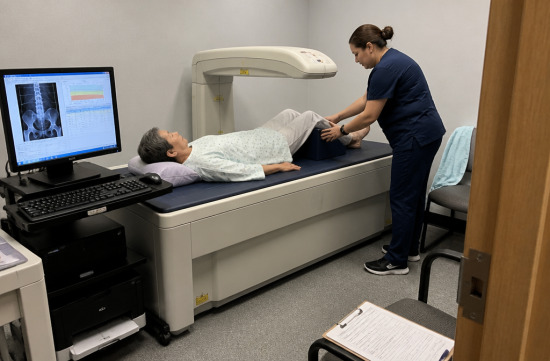
The test itself is simpler than you might think. It's usually a bone density test called DXA (dual-energy X-ray absorptiometry), where you lie down and a machine scans your hip and spine.
The results come out as a T-score. According to World Health Organization standards, a score of -1.0 or higher is normal, between -1.0 and -2.5 indicates osteopenia, and -2.5 or lower is considered osteoporosis.
One thing to note is that the number -2.5 is not a strict cutoff between safety and risk. As the score decreases, the risk of fractures gradually increases, so being classified as osteopenic is not a reason to feel reassured.
The most pressing question is, of course, the cost. Medicare Part B covers bone density tests once every 24 months, and more frequently if medically necessary.
If the doctor accepts the Medicare assignment, there's no out-of-pocket cost for you. I found this part really reassuring.
However, there are conditions attached to Medicare. It applies to women whom the doctor deems to be at risk for osteoporosis due to low estrogen levels, or if X-rays show potential for osteoporosis or spinal fractures.
It also includes those who are taking or about to start steroid medications like prednisone, those diagnosed with hyperparathyroidism, and those being monitored for the effectiveness of osteoporosis medications.
If you're unsure whether you qualify, it's a good idea to ask when you make your appointment. You can search for bone mass measurements on the official Medicare site, medicare.gov, to find all the conditions listed.
There are also people who are not yet on Medicare but have employer or private insurance. Most private insurers cover preventive services recommended with a B grade or higher by the USPSTF without any out-of-pocket costs.
Still, the specific conditions may vary by insurance company, so it's a good idea to call the number on the back of your insurance card to confirm. I know these calls can be annoying, but it's better than being surprised by a bill later.
Honestly, I used to think of these issues as someone else's problem. I thought bone health was something to worry about when you get older.
But after looking into it, I realized that how much bone mass you build up when you're young affects your future, so I've been trying to climb stairs more often lately.
And I've become more proactive in talking to the older adults around me. Korean elders, in particular, tend not to go to the doctor if they don't feel any pain.
Many also delay making appointments because they feel burdened by having to explain things in English. Just making a phone call to help them schedule an appointment can make it much easier.
Of course, whether to get tested or take medication based on the results depends on individual health conditions. It's best to discuss this with your doctor or pharmacist.
If I were in a situation where I turned 65 and hadn't had a bone density test yet, I would definitely bring it up at my next check-up. It's just a matter of saying one sentence.
Knowing in advance is a hundred times better than finding out after a fall. I hope you can take a light trip for a test, just like going for a walk on a clear autumn day.
 TacoTime



 nivex85 |
 Old English |
 nixxon |
 LIZ Legal Information Blog |
 Karina's Blog |
  yolanda78 |
 Lightning Sikhye Cooking Method |

 Kentucky Fried Chicken |
 Cahty Chung |
  Koreab Date |
  CA Real Estate |
  Round and Round Children's Song Kingdom |
  Mia Flori |
  nova nova |
  healthy |
  leaves |
  sparkling |
  maryland park |
  persiste |
  conte |
  blueman |
  Going Once |
  Eldorado 88 |
  cherrydino |
  garlic bread |
  middlekick |
  Moscow Kim |