
When I was a child, the scariest thing wasn't ghosts, but the phone ringing. It was that moment when my mom would hand me the receiver and say, "Listen to what they're saying." The caller was an insurance company, and I was more terrified than in a horror movie.
Back then, I thought it was just a household chore, like doing the dishes or taking out the trash. But I only realized as an adult that there was an academic term for this role.
It's called 'language broker.' It refers to the role of a child in an immigrant family who bridges communication and culture between their parents and the outside world. Researchers like Lucy Tse in the mid-1990s helped establish this concept in their papers.
When I first saw the term, I found it a bit amusing. A broker? It's not like I was a real estate agent. But upon reflection, it was a fitting description.
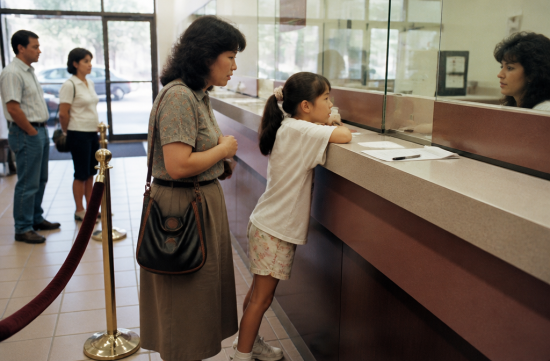
I wasn't just translating words. I also conveyed the doctor's ambiguous expressions and the bank employee's oddly short responses. It was also my job to soften my words so my mom wouldn't feel hurt.
This isn't just my story. A study published in the Asian American Journal of Psychology in 2014 surveyed 499 Chinese and Korean American adolescents, with 262 of them being Korean American.
I was genuinely surprised by the results. It showed that 73.1% of Korean American adolescents reported having interpreted for their parents at some point. That means about three out of four, so nearly all kids in a Sunday school class would be 'active' language brokers.
There's an interesting point in the same study. Children who interpreted for their mothers felt a greater sense of their mothers' sacrifices, which led to increased respect for them. This respect was ultimately linked to a decrease in problem behaviors.
However, there's a twist. This effect was even stronger in households where communication between mothers and children was not open. I wonder if they learned through interpreting feelings that couldn't be expressed in words.
Of course, not all stories are sweet. Other studies have shown that children who feel they can't interpret well tend to experience higher levels of depression and greater distance from their parents. The same ingredients can make both a cake and burnt bread.
In fact, I have quite a few memories of burnt bread. I once heard my mom's test results at the hospital but didn't understand the terms, so I just said, "It's fine" and moved on. That night, I searched the dictionary and cried a lot.
It seems I wasn't the only one who experienced such moments. The U.S. Department of Health and Human Services (HHS) has established regulations for the implementation of Section 1557 of the Affordable Care Act, effective July 5, 2024, which generally prohibits medical institutions from assigning minors as interpreters.
The only exceptions are in emergencies where life or safety is at stake. Even then, if a professional interpreter is present, the child's conveyed information must be verified or supplemented. I wish such rules had existed back then.
So nowadays, when hospitals offer interpretation services first, it feels more like an obligation than a kindness. If your parents still take you to the doctor's office, make sure to let them know they can request an interpreter.
The role of a language broker isn't unique to Korean families. According to the U.S. Census Bureau's 2018-2022 American Community Survey (ACS), only 78.3% of the population aged five and older speaks only English at home. This means that more than one in five people speaks another language at home.
Among them, Spanish is the most prevalent at 61.1%, followed by Chinese and Tagalog. Somewhere at those family tables, there were probably little interpreters like me.
As generations change, the landscape is also shifting. According to data from the Pew Research Center, as of 2019, 67% of Korean Americans aged five and older were proficient in English. In other words, one in three still finds English challenging.
Scholars sometimes view this work as a form of child labor. Professor Marjorie Faulstich Orellana addressed children's interpreting as serious 'work' in her 2009 book Translating Childhoods.
Reading about that book oddly reassured me. It felt like someone was finally acknowledging, "Yes, you did work back then."
However, that time wasn't just about feeling wronged. Thanks to it, I developed the ability to read the emotions behind others' words. Even when reading a recipe, I now notice the patience implied in the phrase "simmer on low heat."
My mom and I became a special team in that way. I still laugh when I think about how we would silently strategize in front of the bank teller.
But I don't want to romanticize that weight too much. It's too early for a ten-year-old to read a lease or a hospital consent form, no matter how impressive it may seem.
So nowadays, I try to do this: when I need to ask my child to interpret, I first say, "Thank you for helping me." For difficult documents or medical matters, I use a professional interpreter from the start.
And one more thing: I never blame my child for making mistakes in interpretation. The mistake lies not with their English but with the adult who entrusted that situation to them.
Perhaps some of you reading this have memories of receiving the phone receiver. I wonder if it would be nice to say to that younger version of myself, "You did well," even if it's late.
The term language broker certainly carries weight. But I believe that weight doesn't have to remain a burden. Like well-aged kimchi, it can develop a deep flavor over time.
Tonight, I think I'll give my mom a call. This time, I want to chat in Korean without needing to interpret.
 ChocoMilkTowr




 horse |
 Sunset Oregon |
 daisypat |
 Anjollinya Blog |
 Anova US Beauty Information |
 Then you must be spring |
 refresh |
 fantastic |
 conte |
  maryland park |
  persiste |
  blueman |
  Going Once |
  Eldorado 88 |
  cherrydino |
  garlic bread |
  middlekick |
  Moscow Kim |
  nivex85 |
  quanta7 |
  Tomato Health Club blog |
  Egg Steamed Pot |
  Helpful Life Stories |
  UNI Lover |
  zen zeng |
  oh my salami |
  wendra |