
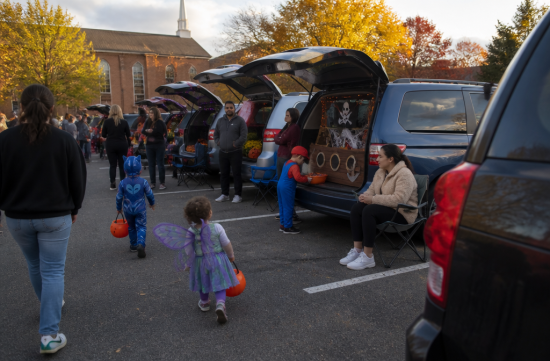
These days, around the second week of October, the sign in front of the local church changes. It reads Trunk or Treat, along with the date, time, and the word Free. When I first came to America, I passed by without knowing what this event was.
When I went to check it out, the setup was simple. Dozens of cars in the church parking lot lined up with their trunks open. Each trunk was decorated with pumpkins, pirate ships, or movie characters, handing out candy to kids.
Instead of ringing doorbells at each house, kids make a loop around the parking lot. In just an hour, their bags are full. From a parent's perspective, it's honestly very efficient.
This made me curious. When did this start, and why did it happen? My nature wouldn't let me just pass by, so I did some research.
The first recorded mention dates back to the early 1990s. A Baptist church in Alabama is frequently cited as having held this event in 1994. By the early 2000s, churches in the southern regions began adding it to their calendars.
The initial motivation leaned more towards faith than safety. Many churches at the time were uncomfortable with the ghosts and skeleton imagery associated with Halloween. However, it was also difficult to completely ban Halloween for kids.
So, the compromise was this: if the church hosted the event, they could control the atmosphere and image. Instead of banning it, they created an alternative, which I think was quite a clever solution.
However, the spread of this event beyond churches to schools, fire stations, and shopping malls was due to different reasons. Parental anxiety played a crucial role. Tracing the roots of this anxiety leads us back to the 1980s.
In the fall of 1982, a case emerged in the Chicago area where seven people died after consuming Tylenol laced with poison. This occurred just weeks before Halloween. This fear transferred directly to Halloween candy.
Reports indicated that some stores saw Halloween candy sales drop by 20% to 50% that year. The advice to throw away candy received from strangers became common sense. I remember hearing similar urban legends in Korea when I was a child.
Interestingly, data tells a different story. Sociologist Joel Best has searched newspaper articles dating back to 1958. He found no cases of children dying or being seriously injured from Halloween candy given by strangers.
There is a frequently mentioned incident from Texas in 1974. However, the perpetrator was not a stranger but the child's biological father, who poisoned candy given to his son for insurance money.
Ultimately, the fear of poisoned candy has been exaggerated compared to the actual risks. Yet, people respond more to stories than statistics. This phenomenon is also observed in IT when analyzing risks.
The real danger was elsewhere. A study published in JAMA Pediatrics in 2019 analyzed traffic accident data in the U.S. from 1975 to 2016. It found that the risk of pedestrian fatalities on Halloween night was 43% higher than on the same day of the week in the weeks before and after.
For children aged 4 to 8, the risk was ten times greater. I was a bit shocked when I first saw this number. The problem wasn't candy; it was cars.
From this perspective, Trunk or Treat is an ironic solution. It takes children off the roads where cars are present and gathers them among parked vehicles. While the source of fear was misplaced, it effectively reduced the real danger.
The layout of neighborhoods also played a role. In American suburban areas, houses are often spaced far apart, and many streets lack sidewalks. In my neighborhood, you have to drive to visit just five houses.
In such places, traditional trick or treating feels more like a chore than fun. Streetlights are sparse on dark roads. With all the candy gathered in one parking lot, parents can't help but appreciate it.
There are other advantages as well. Some trunks prepare separate candy for children with food allergies. Kids in wheelchairs can move much more easily in a flat parking lot.
Social media has fueled this trend. Decorating trunks has become a sort of competition. Many homes follow ideas from photos posted on Pinterest.
Of course, there are clear downsides. The opportunity to see familiar neighbors' faces has decreased. The brief conversations complimenting kids' costumes at the door are definitely a loss.
Some argue that this is evidence of a weakening community. I see it differently. I believe the community hasn't disappeared; rather, the gathering places have changed.
What I find noteworthy is that this change didn't come from the top down. It wasn't a government program created with a budget. Churches, parent associations, and local organizations solved the problem on their own.
The costs are also shared among participants. Everyone brings their own car, candy, and time. The fact that such voluntary solutions endure suggests that the strength of American civil society is still alive.
That said, the tradition of going door to door isn't over. In neighborhoods with well-paved sidewalks, Halloween night is still bustling. The two methods are more likely to coexist according to local circumstances.
If it were up to me, I would do it this way: I would stop by a church or school trunk or treat early in the evening, then walk to a few nearby houses before dark. This way, I can enjoy both efficiency and the faces of neighbors.
And whichever way you choose, I hope one thing is remembered: the real danger isn't the candy, but the cars on dark roads. Attaching a reflective tape to a child's costume is a much better investment than inspecting candy.
 SunnyBear





 horse |
 Sunset Oregon |
 daisypat |
 Anjollinya Blog |
 Anova US Beauty Information |
 bubblo |
  blueman |

 positive x |
 Fransco Family |
  persiste |
  conte |
  Going Once |
  Eldorado 88 |
  cherrydino |
  garlic bread |
  middlekick |
  Moscow Kim |
  nivex85 |
  quanta7 |
  Tomato Health Club blog |
  Egg Steamed Pot |
  Helpful Life Stories |
  UNI Lover |
  zen zeng |
  oh my salami |
  wendra |
  coloradoman |