
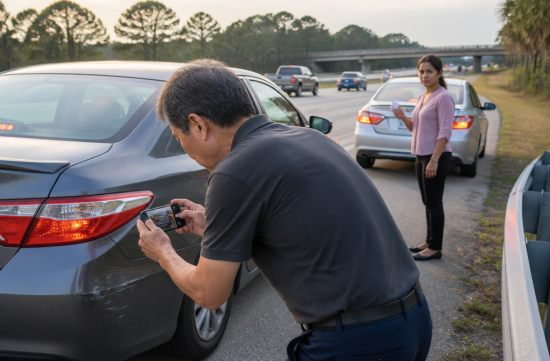
From $500 to $2,000, that's a fourfold increase. Starting October 1, the threshold for reporting property damage in minor accidents in Florida has been raised.
Last week, a friend contacted me saying they lightly bumped the bumper of the car in front of them on the I-295 entrance ramp. Their first question was, "Do I need to call the police for this?" I'll clarify that the answer has changed.
The basis for this change is SB 488, which was passed this year. The governor signed it on April 21, it was confirmed as Chapter 2026-39, and it took effect on October 1.
It passed the Senate with a vote of 38 to 0 and the House with a vote of 108 to 1. This indicates there was almost no disagreement between the parties.
The changed provision is Florida Statute 316.065. If a person is injured or killed in an accident, or if there is visible damage to a vehicle or other property exceeding $2,000, the driver must notify the police by the quickest means possible.
The reporting agencies are the city police, county sheriff, or highway patrol. In this area, the sheriff's office (JSO) acts as the police, so for non-urgent accidents, you can call the non-emergency number 904-630-0500.
A word that can be easily overlooked here is "apparent," meaning visible damage. This refers to the amount assessed at the scene, not the final repair costs determined later at a repair shop.
The issue lies with modern car bumpers. With sensors and cameras embedded, even a slight dent can lead to estimates that are much higher than expected.
Therefore, I recommend erring on the side of caution and reporting if you think the damage exceeds $2,000. You won't be penalized for reporting an accident that doesn't require a report.
Conversely, failing to report an accident that should be reported will be treated as a noncriminal traffic violation, specifically a nonmoving violation. While it's not a crime, you will receive a ticket.
Additionally, the monetary threshold applies only to property damage. If anyone is injured, regardless of the damage amount, the obligation to report remains.
There are specific circumstances under which the police must write a formal report (long form). These include cases of death or injury, when a tow truck is needed due to significant vehicle damage, or when a commercial vehicle is involved.
Accidents involving hit-and-runs or drunk driving also fall under this requirement. In these cases, the $2,000 threshold is irrelevant.
So, what about minor accidents under $2,000? Can you just part ways? Not quite.
Section 316.066 states that even for property damage accidents that do not require a police report, the driver must file a written report with the state Department of Highway Safety and Motor Vehicles (FLHSMV) within 10 days. The driver self-report form is available on the FLHSMV website and can be submitted via email.
It's unclear from the summary materials whether this amendment has affected the 10-day self-reporting requirement. If an accident occurs, it's advisable to check the latest guidance on the FLHSMV site.
The actions to take at the scene remain the same. You should stop your vehicle and exchange names, addresses, vehicle registration, and insurance information with the other party.
If the vehicle is operable and there are no injuries, there's also a provision (316.061) stating that you should move to the shoulder to avoid blocking the road. It's most dangerous to linger in the middle of I-95 taking pictures, risking a secondary accident.
You can quickly take photos before moving the vehicles. Capturing the entire vehicles, the damaged areas, and the other party's license plate and insurance card should suffice.
Let's also touch on insurance. Just because the obligation to report to the police has been removed doesn't mean the obligation to notify your insurance company has also disappeared.
If the other party changes their story later, the side without a police record may find themselves at a disadvantage. This is not a legal stipulation but a practical consideration.
Additionally, in Florida, to receive PIP insurance benefits, you must seek medical treatment within 14 days of the accident. Many people feel fine on the day of the accident but may experience soreness the next day, so it's important to remember this timeframe.
Comparing this to South Korea is interesting. South Korean traffic law also has a clause that exempts the obligation to report to the police if there is only property damage and safety measures have been taken at the scene.
However, in South Korea, the obligation to exchange contact information is not exempted. Ultimately, both places emphasize that "police focus on serious accidents, and minor ones should be settled between the parties."
Personally, I find this amendment reasonable. The $500 threshold was set decades ago based on inflation, and nowadays, that amount barely covers a bumper repaint.
It's better for tax-paying citizens that police resources are used for serious accidents and public safety rather than being tied up at every minor bumper scrape. Regulations should be adjusted to reflect reality.
Still, my principle is simple. If the other party is a stranger and there's any ambiguity, I will call the non-emergency number first.
The law allows for not reporting, but it doesn't prohibit it. One record could save you thousands of dollars later.
 NoPayBeauty







 dermoon |
 hoosierdaddy |
 sun walker |
 Let's Be Like a Salt-like City Person |
 Springs Korea |
 Taco Bell Candy Note Blog |
 Kims Spring |
 US Home Buying Information Home Insurance |
 Good Good |
 Well Done Sir |
  Round and Round Children's Song Kingdom |
  Mia Flori |
  nova nova |
  healthy |
  leaves |
  sparkling |
  maryland park |
  persiste |
  conte |
  blueman |
  Going Once |
  Eldorado 88 |
  cherrydino |
  garlic bread |
  middlekick |
  Moscow Kim |
  nivex85 |
  quanta7 |
  Tomato Health Club blog |
  horse |