
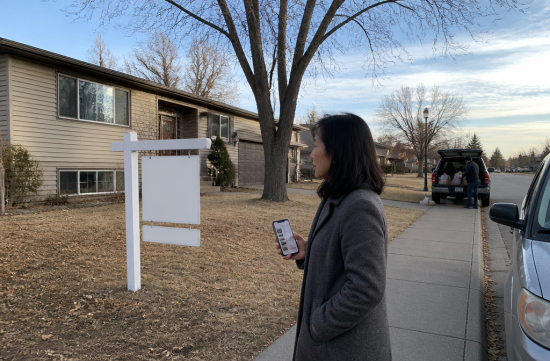
As I compiled the numbers for Cheyenne's housing market in October, one notable point caught my eye. The median listing price has decreased compared to a year ago, while the price per square foot has actually increased.
This might leave you confused about whether home prices have fallen or risen. Today, I will start with that topic and then cover listings, transaction speed, interest rates, and rent in order.
First, let me clarify the basis for these figures. The sales data is compiled by Realtor.com and is based on the October data for the Cheyenne metropolitan area from the St. Louis Federal Reserve's FRED.
The median listing price in October was $477,000. Compared to last October's $496,294, this represents a 3.9% decrease.
Compared to summer, the drop feels even more significant. In July, it peaked at $522,422, then fell to $473,975 in September, with a slight rebound in October.
Let me clarify one term here. The listing price is the asking price set by the seller and differs from the actual sale price recorded in the contract.
In simpler terms, think of it as the difference between the price tag on a store shelf and the receipt at the checkout. According to Redfin, the median sale price in Cheyenne for the first half of this year was $401,377, indicating a significant gap between the asking price and actual transactions.
So, what about the price per square foot? Based on October listings, it stands at $203, which is higher than last October's $191.
While the overall median value has decreased, the price per unit area has increased. This suggests that rather than homes becoming cheaper, the composition of homes on the market has changed.
In summer, larger and more expensive homes tend to be listed, while as fall approaches, the proportion of smaller, lower-priced homes increases. Therefore, it would be premature to conclude that home prices have dropped based solely on the median value.
Now, let's move on to the inventory. In October, there were 366 active listings, which is 2.8% more than the 356 from the same month last year.
This is a slight decrease from September's 377 listings. Active listings refer to homes currently on the market for sale.
There were 124 new listings. This is fewer than last October's 132 and just over half of April's 214.
On the transaction side, things have definitely slowed down. The number of pending listings, which are contracts in progress, is 162, down 11.5% from last October's 183.
If you're unfamiliar with pending listings, think of them as homes where an agreement to buy and sell has been reached, but the closing—meaning the final payment and transfer of ownership—has not yet occurred.
The time homes are staying on the market has also increased. The median days on market for October listings was 51 days, which is 8 days longer than September's 43 days and 6 days longer than last October's 45 days.
There are also a significant number of price reductions. In October, out of the 366 active listings, 104 had their asking prices lowered at least once.
This is slightly fewer than last October's 112, but compared to March's 36, it's nearly three times as many. This indicates a significant seasonal influence.
Behind this trend are interest rates. The average rate for a 30-year fixed mortgage from Freddie Mac was 6.95% on September 17, rising to 7.40% for two consecutive weeks on October 8 and 15.
In the announcement on November 5, it dropped to 7.18%. However, it remains high compared to mid-September, which appears to have caused buyers to take a step back.
Now, let's talk about rent. According to data updated by RentCafe on October 31, the average rent in Cheyenne is $1,479.
By bedroom count, the figures are $1,239 for one-bedroom, $1,579 for two-bedroom, and $1,985 for three-bedroom units.
However, according to Zumper's data as of November 7, the figures are much lower at $950 for one-bedroom and $1,275 for two-bedroom units. The overall median rent was $1,350.
You might wonder why there is such a discrepancy in the same city. RentCafe focuses on larger apartment complexes, while Zumper is based on actual listings, which tend to include more older, smaller buildings.
Therefore, when looking for rentals, I recommend not relying solely on one site's numbers but comparing several actual listings in your desired neighborhood.
From a tenant's perspective, winter is typically a slow season for moving, making landlords hesitant to leave properties vacant. If you're approaching a lease renewal, capturing a few ads for similar properties in the area can be a useful negotiation tool.
In summary, Cheyenne's market in October has similar or slightly more listings than last year, fewer transactions, and longer selling times. The previously favorable conditions for sellers have definitely eased.
If I were to buy a home right now, I would see winter as an opportunity. For properties that have been on the market for a while or those that have already lowered their prices, there may be room to negotiate closing cost assistance or a rate buy-down.
If you're selling, it's wise to decide whether to wait until spring or adjust your price realistically now. However, judgments may vary based on interest rates and personal circumstances, so be sure to align your numbers with your mortgage advisor.
 RiverBlog
 TomatoGym






 B.I.G. Victor |

 Amber H |
 uplifted |
 Dr. Kelso |

 silents |

 yenne |

 FROM Wyoming |

 Real Estate |


 nixxon |
 strawberry |
 US Regional Information Local News |
 USA Business News |
 Blondee |
 E whisper |
 Potato House |
 freshmint |
 Ansaso |
 Golado |
 babybay |
 honeycom |
 French Macarons |
 Exploring American Life Information |
 Sunshine Blog |
 Community Cross |
 Sayonara H |
 What can make money? |
 Information Search LifeMAN |
 morvex37 |
 neontrail |