
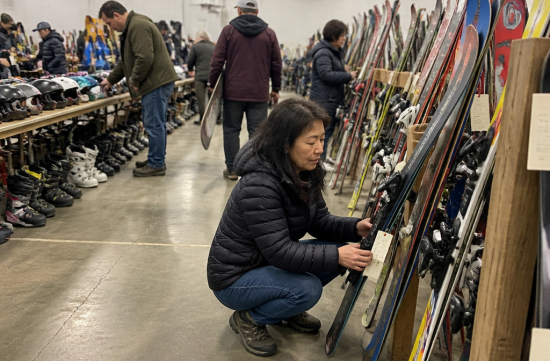
When the first week of November rolls around, I find myself pulling out last year's ski pants from the closet and sighing. The pants are fine, but the waist is not.
When I go to the store to buy new ones, I'm shocked again by the price tags on a pair of boots or a snowboard. So these days, I start looking into ski swaps before the season begins.
A ski swap is essentially a winter gear flea market. It's mostly a consignment model where you sell your used gear and buy gear that others have put up for sale.
Unfortunately, the large swap held in Cheyenne this season has not yet been scheduled. However, there are a few decent options within a one to two-hour drive.
The first is the Outdoor Gear Swap hosted by the University of Wyoming Nordic Ski Team in Laramie. This event takes place every fall, and last year it was held on November 1 at the Laramie Railroad Depot.
Last year, early bird admission at 11 AM was $10, and entry was free from noon to 1 PM. If you want to grab good items first, you pay $10; if you just want to browse, you can go at noon.
Sellers register their items on the team's website and drop off their gear the evening before the event. If it sells, a 25% commission is taken, which goes towards the Nordic team's operating costs.
The date for this year hasn't been announced yet, so be sure to check the gear swap page at uwyonordic.com. If you think about it as helping student athletes, the commission feels less painful.
The second option is in Denver. The official schedule for Jefferson County lists The Denver Ski Swap on Friday, November 6, from 5:30 PM to 9 PM at the Golden Event Center.
Last year, the Denver swap was organized by Rocky Mountain Ski Swaps, which started in Utah, and it was held at Jeffco Fairgrounds with an admission fee of $8 for those 14 and older. The details for this year's event and fees are not listed, so it's best to double-check before you go.
According to the company's guidelines, the rules are quite straightforward. Paid admission is only on Friday night, and tickets are sold only at the venue.
If you pay by card, there's a 2.5% fee. If you're buying a board worth several hundred dollars, cash might be a better option.
Sellers can drop off their gear between 10 AM and 3 PM on Friday, and pick up their payment or unsold items between 4:30 PM and 6 PM on Saturday. If it doesn't sell, there's no fee, but if it does, the seller takes 25% of the sale price.
Interestingly, they don't accept gear that is over seven years old or in poor condition. So, if you have a neon one-piece ski suit from the 90s that came out of the attic, it's best to keep it as a memory.
The third option is Outpost Sunsport in Fort Collins, which has also held a fall swap every year, with last year's event taking place in October. The best way to find out this year's schedule is to ask the store directly.
Now, here comes the practical part. The organizers openly say that the best items come out on Friday opening night.
So, if you think the admission fee is too much and casually go on Saturday afternoon, you'll likely find only ill-fitting boots and a single glove left. I've experienced that once myself.
The most important thing to watch out for is bindings. Ski shops won't adjust or check old bindings that the manufacturer no longer guarantees due to insurance issues.
The industry releases an indemnified list each year of bindings that shops can handle. If a binding is not on that list, no matter how cheap the skis are, you'll have to calculate the binding cost separately.
So, when I choose skis, I take a picture of the binding model name with my phone. When I get home, if I find out it's not good, I let it go without hesitation.
Make sure to try on the boots as well. If the boot and binding sizes don't match, it can lead to safety issues, and there are cases where the standards have changed, like with the Grip Walk soles.
Honestly, I recommend buying a new helmet. Even if it looks fine on the outside, you can't tell if it's been in a serious crash just by looking at it.
On the other hand, jackets, pants, goggles, and poles are great items to buy used. For kids' gear, since they grow out of it after one season, swaps are the most reasonable option.
Of course, there are opposing views. Some say that using rental shops or seasonal lease programs is more reassuring since they take care of inspections and adjustments.
I see the point. So, for someone new to skiing, starting with rentals and then buying at swaps once you know your preferences is less regretful.
Before you go, make sure to prepare your essentials. Cash, a tape measure, a note of your current boot's mondo size, and a level-headed companion to prevent impulse buys are all you need.
I once went without a companion and ended up with telemark boots I didn't need. Now they're just a decoration in my entryway.
It's a good idea to stop by a local shop for waxing and binding checks before you get home with the gear you bought at the swap. If the total cost is still cheaper than new gear, then you've successfully shopped.
If it were me, I would go to the Denver swap on Friday night with cash in hand and keep an eye on the Laramie schedule when it comes out. This winter, let's be surprised only on the slopes, not by the price tags.
 RamenSparta








 Carolina border |

 juicylol |

 Mr Song Song |

 Way to easy |

 holy cow |
 U.S. Weather Bureau News |
 Real Estate |

 celtics |

 yenne |
 FROM Wyoming |
 Glow Yo |
 heartwarming |
 Jersey City |
 content |
 My Love Bambino Alaview |
 Lord Island |
 fantastic |
 nero kim |
 Alaska Salmon Buyer |
 solvix18 |
 California Information News |
 HAWAII Korean Church News |
 My Love DS |
 Hardworking CPA |
 People Moon |
 korian87 |
 dancing in the rain |