

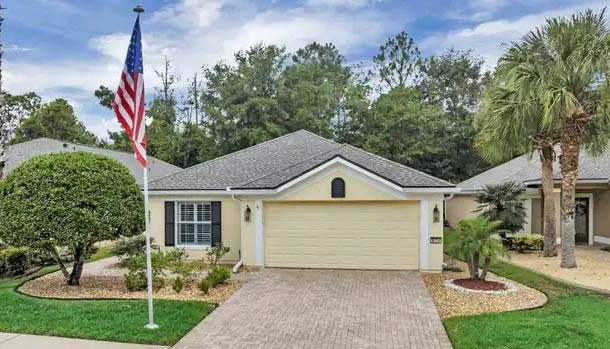
If you decide to live in Jacksonville for a few years, you will eventually face the dilemma of whether to continue paying rent or to buy a house instead.
Especially since housing prices in Jacksonville are lower compared to Miami, Tampa, or Orlando, you might find yourself thinking, "Wouldn't it be better to just buy at this price?" as you look at listings.
Currently, let's say a 2-3 bedroom rental costs about $1,750 per month, and the average home price is around $335,000.
Renting is straightforward. At $1,750 per month, that amounts to $21,000 a year. Even if you live there for five years without any increase in rent, that totals $105,000. This ongoing expense can lead you to consider buying a home.
When comparing home prices and rent, we also use a figure called the Price-to-Rent Ratio. It's not complicated. You simply divide the home price of $335,000 by the annual rent of $21,000. The result is about 16.
Generally, a lower number indicates that buying is more favorable, while a higher number suggests renting is better. A ratio of 16 isn't overwhelmingly in favor of either option, but it's certainly a range worth considering for purchasing a home.
However, you need to be cautious. You can't just compare the home price of $335,000 with the rent of $1,750.
For example, if you put 20% down on a $335,000 home, you would initially invest $67,000 and borrow the remaining $268,000.
If you secure a 30-year fixed mortgage at 6.75%, your monthly payment for principal and interest would be about $1,740.
At first glance, it seems obvious to buy since the mortgage payment of $1,740 is less than the rent of $1,750.
But the actual expenses for a homeowner don't stop there.
There are property taxes and homeowners insurance to consider. Depending on the property, there may also be HOA fees and maintenance costs. If the air conditioning breaks, the homeowner is responsible for repairs, and eventually, the roof or water heater will need to be replaced. Even conservatively adding property taxes and insurance can push monthly housing costs over $2,100.
Including HOA and maintenance can further increase the actual costs.
This creates a significant difference compared to the $1,750 rent.
In Jacksonville, you can't afford to underestimate insurance costs. Even for a $335,000 home, the insurance premium can vary greatly depending on proximity to the coast, flood risk, and the age of the roof. Therefore, I recommend not just looking at the listing price but also obtaining insurance quotes before making an offer.
Another financial consideration is the initial $67,000 down payment. If you hadn't bought a home, you could have used that money for savings or investments. Conversely, by purchasing a home, you gradually build equity in your property as you pay down the mortgage. If home values increase over the long term, you can benefit from that appreciation.
Thus, how long you plan to live in Jacksonville is crucial.
If you might move to another state for work after 1-3 years, I don't think there's a need to rush into buying a home. There are various costs associated with buying and selling a home, so if you only live there briefly, even a slight increase in home value may not yield significant returns.
On the other hand, if you've settled on a school for your kids, have a stable job, and plan to stay in Jacksonville for at least 5-7 years, the situation changes. Given the current home prices and rental rates, there are sufficient reasons to seriously compare buying and renting.
One advantage of Jacksonville is that compared to other major cities in Florida, you can find single-family homes in the $300,000 range.
However, approaching the situation with the mindset of "I don't want to waste money on rent, so I must buy a house" can be problematic.
Ultimately, the calculations are surprisingly simple. If you plan to stay for 2-3 years, renting may be more comfortable, while if you plan to settle for over 5 years, you should actively compare buying options.
And when buying a home, don't just look at the mortgage; you need to factor in property taxes, insurance, HOA fees, and maintenance costs to compare with your current rent.
In Jacksonville, just doing this calculation can help you determine whether you should buy a home or continue renting.
 foxforestbuilder1974
 FunSmoothie




 neapolis |

 moo moo |
 ultron78 |
 garlic bread |

 Sugar Cream Door Bulletproof Noodles |

 Taco Bell Candy Note Blog |

 Well Done Sir |

 FLORIDA Acus |

 oh my salami |
 ASURA |
 rapids |
 Softember |
 mykiwi blog |
 Maria Mom |
 Watch for possible danger |
 northpeak |
 Far East Movement |
 Light of the World |
 mariashin |
 lavender |
 Bridgo |
 Tamfa Fan |
 Sunny Sunday |
 mini hometown |
 torvia |
 Chichiki Chicago Train |
 Univ Student |
 See It |
 Con Cheese |