
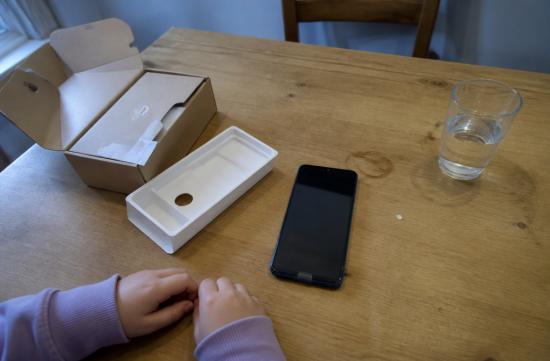
When it comes to getting a child's first phone, most people start by choosing the device. However, when calculating the total cost over three years, the difference in plan structure can be much larger than the device cost.
According to a Common Sense Media survey, 42% of 10-year-olds, 71% of 12-year-olds, and 91% of 14-year-olds have their own mobile phones.
The timing for activation varies from household to household, but it's something that will happen eventually. Calculating in advance means you won't lose out.
There are usually two options: either add another line to an existing family plan or get a separate line with a budget carrier.
One point that is often overlooked is that the number to compare is not the average cost per line, but how much the bill actually increases when adding one more line.
Let's look at the Verizon Unlimited Welcome pricing. With auto-pay and paperless billing, one line costs $65, two lines cost $110, and four lines cost $120.
The total only increases by $10 when going from two lines to four. This breaks down to about $5 per line, which honestly surprised me.
T-Mobile Essentials has a similar structure. With auto-pay, four lines cost $100 per month, which is $25 per line, and without auto-pay, it goes up to $30 per line.
However, the situation changes when you exceed four lines. Five lines cost $125, and six lines cost $150, maintaining the $25 per line rate.
For AT&T, based on the Value Plus VL plan, the cost per line is $30.99 for a four-line account.
In summary, households with fewer than four family lines have nothing to calculate. The cost for an additional line ranges from $5 to $25.
Conversely, if you already have four lines filled, the fifth line will cost the full price. At this point, a separate budget phone becomes more advantageous.
I also checked the numbers for budget carriers. Tello offers 2GB for $10 and 5GB for $14, while Mint Mobile has a 5GB plan for around $15 per month.
US Mobile's light plan starts at $8 for 2GB. This amount of data is often sufficient for a first phone.
Most of the time, a child's first phone will be used within the home or school Wi-Fi. I believe it's a mistake to jump straight into unlimited plans.
Also, don't just look at the displayed prices. According to Tax Foundation data from 2025, taxes, fees, and government charges account for an average of 27.60% of wireless bills.
There are significant state-by-state variations. Illinois has the highest at 38.32%, while Idaho has the lowest at 16.82%.
Thus, a plan like Visible, which states a monthly cost of $25 including taxes, is advantageous for comparison. There's no confusion about actual spending.
Kid-specific phone services are also an option. Gabb starts around $24.99 per month, and Troomi ranges from $14.95 to $29.95, with the Discover plan at $34.95.
It's important to consider that using a device with limited features is more expensive than a regular budget phone. You're essentially paying extra for safety features.
Carrier management apps are not free either. Verizon Smart Family costs $4.99, and with location tracking, it's $9.99, while Family Plus is $14.99.
T-Mobile FamilyMode is $10 per month, and AT&T Secure Family is $7.99. When calculated annually, this adds an extra $96 to $120.
Apple Screen Time and Google Family Link are free. It makes sense to try out the free features before opting for paid management apps.
Be cautious with device promotions. Most ads for free phones involve spreading the cost over 36 months as bill credits.
If you cancel a line in the middle or switch to another carrier, the remaining credits are lost. This structure ties you down for three years regarding plan changes.
If it were me, I would add to the existing plan without hesitation if there are fewer than four family lines, and manage data limits or features through device settings.
If there are already four lines, I would start with a separate budget phone line with 2GB for the first year. After monitoring actual data usage for a month or two, I could decide whether to increase it.
Starting with unlimited and the latest device on the first phone makes it hard to go back. I believe starting small and increasing as needed is better both financially and educationally.








 Softy |
 Michigan Enthusiast |
 Anna Life |
 JESIKYEOALBA BLOG |
 Dad's Tribute TC |
 productionblog |
 fernando park |
  U.S. Military Recruitment Information |

 Ohio Ohayoung Hello |
  You Turn Me On |
  DaeBak Electronics CNET |
  Anjollinya Blog |
  solid90 |
  elion |
  xylora |
  Study Abroad Life Know-How Tips |
  cheesepup |
  carpflow |
  mapsina |
  Mr. Largo |
  breezem |
  Omelet Rice for Strength |
  Vermont Capt |
  waltz |
  Shoot Me |