
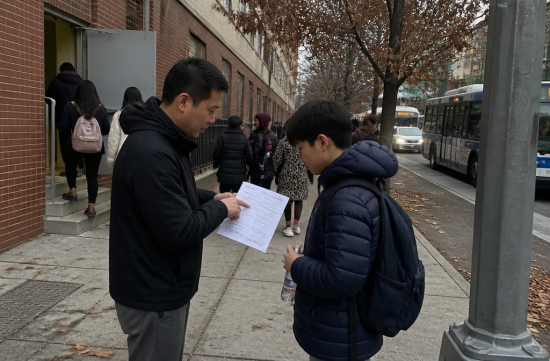
As we enter the second week of November, the atmosphere in New York 8th grade households changes a bit. The SHSAT, or Specialized High Schools Admissions Test, is just around the corner.
This year, there's an additional variable. Starting from the fall of 2026, the SHSAT will change from a paper test to a computer-adaptive format.
So today, I'll skip the study methods and focus on what needs to be checked on the day of the exam, specifically for Bronx families.
First, let's clarify the date. According to the NYC Department of Education, public middle school students finishing 8th grade will take the exam on Wednesday, November 18, at their own school.
Private, Catholic, charter schools, and integrated schools with 6-12 grades for 8th graders, as well as homeschooled students, have different arrangements. They must go to a designated central testing site on Saturday, November 14, or Sunday, November 15.
9th graders will take the exam on Saturday, November 21. Students who cannot attend on this date will be given an alternative date.
Registration closed on October 30 on MySchools. What needs to be done now is to check the test ticket.
The ticket will indicate the exam date and location. Approved accommodations should also be listed here, so if your child has an IEP or 504 plan, make sure to check that section carefully.
If you're going to a weekend testing site, there's a catch. The time listed on the ticket is the arrival time, not the exam start time.
The Department of Education guidelines note that the actual start may be delayed by more than an hour. It's important to provide a hearty breakfast and factor in the waiting time.
Students taking the exam at their school can go according to their usual arrival time. Still, it's best to minimize the risk of being late that day, as Bronx bus routes can be unpredictable in the morning.
Now, let's talk about what to bring. Surprisingly, the only thing that must be brought is the assistive technology specified in the IEP and indicated on the ticket.
The rest is optional. The ticket, sharpened pencils and erasers, highlighters, and a silent wristwatch without calculation functions are allowed items.
The Department of Education provides computers. Personal laptops cannot be brought, and calculators, smartwatches, tablets, earbuds, and smart glasses are all prohibited.
Cell phones can be brought into the testing room, but they must be turned off and cannot be in pockets, hands, or on desks.
It's a good idea to discuss this at home beforehand. The guidelines clearly state that prohibited electronic devices cannot be kept on one's person during breaks.
Snacks must be quiet and unwrapped, and can only be eaten before the exam or during breaks. Water must be in a soft plastic container that doesn't make noise if it tips over.
Scratch paper will be distributed on-site and collected afterward. Scoring will be based solely on the answers entered on the screen. If answers are worked out on paper and not transferred, they will receive a score of zero.
Let's review the exam structure once more. There are 50 questions each for ELA and math, with a standard time of 180 minutes, and students can choose which subject to start with.
Each subject includes 10 field-test questions that do not count toward the score. Since you won't know which questions are field-test items, it's best not to worry about them.
I believe this point is the most important. Once you move on from a math problem or a standalone ELA question, you cannot go back.
This means that the strategy used during the paper test, such as skipping difficult questions to return to them later, will not work this time. You can only navigate within the set of passages until submission.
The Department of Education also advises not to spend more than a few minutes on any one question and to eliminate incorrect choices before making an educated guess. Since you have to select an answer to move on to the next question, guessing is more reasonable than lingering too long.
English learners or qualified former ELLs will receive a total of 360 minutes of extended time and a paper bilingual glossary. Personal dictionaries cannot be brought, so make sure to confirm that as well.
From the Bronx perspective, the weight of this exam feels a bit different. Two of the eight testing schools, Bronx High School of Science and the High School of American Studies at Lehman College, are right in this neighborhood.
There are strong opinions both for and against the single-score selection method for the SHSAT. Some argue it's a fair standard, while others believe it reflects the disparities in preparation resources.
Regardless of the debate over the system, I believe we must prevent losing points due to mistakes on the day of the exam. That's a loss unrelated to skill.
Finally, in the last week leading up to the exam, I recommend running through the practice test on the Department of Education's SHSAT portal. It can be done directly in the browser without logging in, and it's very effective for getting familiar with the screen navigation.
Results will be available in early spring 2027 on MySchools. Until then, just make sure to have your ticket, a turned-off cell phone, and ample time to arrive. If it were me, I would double-check these three things the night before.
 ChocoWaves
 MorningStar80








 MacMorningBlog |
 Texas Migration Story |
 seadoll |

 Round and Round Children's Song Kingdom |

 new sugar |

 charmee |

 vale vale |
 starline |

 Exciting FM Radio |

 My Love DS |
 Hardworking CPA |
 People Moon |
 Carolina border |
 korian87 |
 dancing in the rain |
 bravo777 |
 yolo1990 |
 Valley Hong |
 zentra95 |
 wishi |
 abox |
 Belgray Miscellany |
 Spaghetti Pasta Fan |
 softmoony |
 Karina's Blog |
 Moscow Kim |
 steadyo |
 Michigan Enthusiast |
 Shinbaram Dr. Blog |