
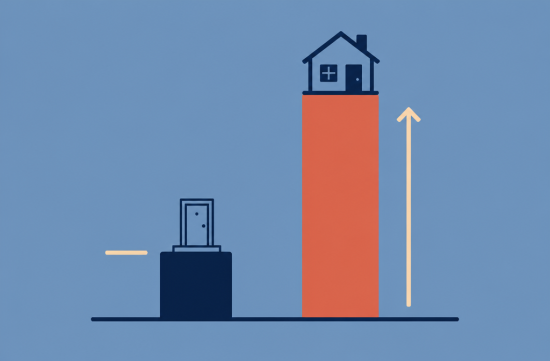
In a nutshell, the Roland Heights market in October can be summarized as follows: rents remained steady, while interest rates became a more significant variable than home prices.
First, let's clarify the reference point. The neighborhood-level transaction statistics for October are still being compiled as of early November. Therefore, this article organizes the latest available data along with their dates.
Let's start with rent. According to data released by RentCafe in early June, the average rent for apartments in Roland Heights was $2,245, which is a 0.13% increase from a year ago.
By unit type, the average rent for a one-bedroom was $2,034, and for a two-bedroom, it was $2,419. The June data from Apartments.com also showed similar figures: $1,974 for a one-bedroom and $2,436 for a two-bedroom.
Point2 reported an average of $2,243 in May, reflecting a 0.5% decrease compared to the previous year. While the decimal points may differ across sources, the trend is the same. It's hard to say definitively whether rents have gone up or down; they are essentially stable.
Single-family home rents tell a different story. Trulia reported the rent for homes at $3,800 in May. There is quite a gap between apartment and house rents.
One important number that tenants in this area should know is that Roland Heights is an unincorporated area of LA County, not a city. Therefore, the County Rent Stabilization Ordinance (RSTPO) applies.
According to the County Department of Consumer and Business Affairs (DCBA), the maximum allowable increase for general applicable units from July 1, 2026, to June 30, 2027, is 1.919%. The cap for the previous period was 1.930%.
Qualified small landlords can increase rents by up to 2.919%, while luxury units can go up by 3.919%. The formula is based on 60% of the CPI change over the 12 months ending in September, and general units cannot exceed a 3% increase.
However, not all homes are subject to this. Fully applicable units must have two or more rental units on one site and have received occupancy approval before February 1, 1995.
Buildings constructed after that date or single-family homes have different conditions. The best way to determine where your home falls is to check directly at rent.lacounty.gov or call the county consultation line.
Now, let's look at sales. According to Weichert's early August estimates based on listings, the median estimated price was $975,000. It's important to note that this is a listing price indicator, not a sale price.
For actual sales data, Redfin's January figures are useful. The median sale price was $930,000, with homes selling on average in 30 days, and 47.1% sold for more than the listing price.
When you line up the numbers, a picture emerges. The beginning of the year saw actual sales at $930,000, while summer listings were at $975,000. Sellers still have high expectations.
The real star of October was the interest rate. According to Freddie Mac's weekly survey, the average for a 30-year fixed mortgage was 7.40% on October 8 and 15, marking the highest level since November 2023.
Since then, it has dipped slightly. On October 22, it was 7.32%, and on the 29th, it was 7.24%. The 15-year fixed rate was recorded at 6.60%.
Compared to a year ago, the difference is striking. The 30-year fixed rate from the same survey on October 30 last year was 6.17%. That's an increase of over 1 percentage point in just one year.
I did some calculations. If you buy a $975,000 home with a 20% down payment, borrowing $780,000, your principal and interest payment at 7.24% would be $5,316 per month. At 6.17%, it would have been $4,762.
That's a difference of about $550 a month. This amount does not include property taxes and insurance, so the actual burden is even greater. Honestly, I was a bit shocked when I saw these numbers.
In the same neighborhood, two-bedroom rents are in the $2,400 range. The gap between rent and mortgage payments for the same home exceeds double. I believe this structure is also related to why rents are not rising right now.
There was also some movement in the investment sector. In June, industry reports indicated that Advanced Real Estate acquired the 126-unit apartment complex Casa La Paz in Roland Heights.
This suggests that institutional funds are entering the area's multifamily market even during a period of high interest rates. It signals that this area is viewed as having a low risk of vacancy due to its school district and living infrastructure.
Now, let's compare two options side by side. The first is to maintain your current rent while monitoring interest rate trends. If your unit falls under the county cap of 1.919%, the increase will be limited until June of next year.
The second option is to buy now. With fewer competitors in the market, there is relatively more room for price negotiation. If interest rates drop, you might consider refinancing later.
However, refinancing is not guaranteed. No one can predict when or how much rates will drop. The first priority is whether you can manage the monthly payments at the current rates.
If it were me, I would proceed this way. If it's for personal residence and I plan to stay for over five years, I would start looking at listings and negotiating. If not, I would maintain my rent while saving for a larger down payment.
I have one request for tenants. When you receive a rent increase notice, first check whether your unit is subject to county ordinances and if the increase rate is within the cap. This is an area that can easily be overlooked.
When the October neighborhood transaction statistics are released, I will compare them again in next month's briefing. The figures in this article are based on data from RentCafe, Apartments.com, Point2, Trulia, Weichert, Redfin, Freddie Mac, and LA County DCBA announcements.
 LegoJellyMon




 Choco Choco Star |
 gentle |
 neapolis |
 moo moo |

 ultron78 |

 Community Cross |
 Famous Attractions in the United States |

 Rowland Mama |

 American History This and That |
 People Moon |
 Alaska Salmon Buyer |
 solvix18 |
 California Information News |
 HAWAII Korean Church News |
 Raomi News |
 My Love DS |
 Hardworking CPA |
 Carolina border |
 korian87 |
 dancing in the rain |
 bravo777 |
 yolo1990 |
 Valley Hong |
 zentra95 |
 wishi |
 abox |
 Belgray Miscellany |
 Spaghetti Pasta Fan |
 softmoony |