

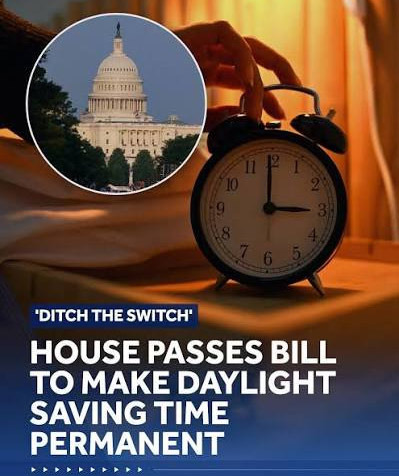
If you live in California, there are two things you definitely do every year.
One of them is changing the clock forward by one hour and then back again during Daylight Saving Time (DST).
Most of the U.S. follows a similar pattern. Among the 50 states, Hawaii and most of Arizona do not observe Daylight Saving Time.
When I first came to the U.S., I thought, "Why are we still doing this when the rest of the world has stopped?" But now, it might be changing.
The U.S. House of Representatives recently passed the 'Sunshine Protection Act,' which aims to make Daylight Saving Time permanent, drawing significant attention. The bill passed with bipartisan support, receiving 308 votes in favor and 117 against.
Many people are asking, "Does this mean Daylight Saving Time is going away?" To be precise, it means the clock-changing practice will be eliminated.
However, it does not mean that time will disappear; rather, it will maintain the current summer time year-round.
In other words, it means that after moving the clock forward in March, it will not be turned back in November.
Supporters of this bill argue that there are many benefits.
The biggest reason is health.
Studies have consistently shown that simply changing the clock by one hour disrupts sleep patterns and temporarily increases heart disease, traffic accidents, and workplace injuries.
Additionally, being able to enjoy more sunlight after work in winter could boost spending and outdoor activities, which would benefit retail and dining industries.
Former President Trump also supports ending the clock changes for these reasons.
However, there are significant opposing views.
The biggest concern is winter mornings. If Daylight Saving Time is maintained year-round, some northern areas may not see the sun rise until after 9 a.m. in winter.
There are strong concerns about students walking to school in the dark and the safety of drivers on their morning commutes.
In fact, the U.S. experienced a similar situation in 1974 during the oil crisis when permanent Daylight Saving Time was implemented, but it was reverted to the original system within a year due to public backlash.
So, it's not over yet.
While it has passed the House, it still needs to clear the Senate. Currently, opinions in the Senate are divided, and it remains uncertain whether there will be enough support for the bill to pass.
After passing the Senate, it must also be signed by the President to become law.
If it ultimately passes, most states in the U.S. will no longer have to change their clocks every March and November.
However, it is not yet confirmed.
For now, it is most accurate to understand that "it is the Senate's turn to make the final decision on whether to implement a system that no longer changes the clock."
 UnivStudent







 novapixel |
 Victory 1988 |
 washington mom |

 El Dorado |
 Baguette Blog |
 ollege Mom |
 Coco and Lulu |
 Snack-like Blog Writing |
 Until the Day It Gets Better |
  bryvexi |
  koala organic farm |
  riverstone |
  My Antonio |
  California Information News |
  chilli chilli |
  Moon Su San |
  vanilla |
  norvexi |
  Lunch and Dinner Mexican Taco |
  skykong |
  My Circle |
  urban legend |
  coolriver |
  Good Neighborhood, Wealthy District Information |
  Ro Ro Car |
  Amber H |
  new sugar |
  Palm 1000 |