
These days, the atmosphere in my friends' group chats at work has changed dramatically. Everyone seems to feel a sense of urgency.
This is a signal that performance evaluation season has begun. Many companies have this schedule packed from fall to winter.
Interestingly, instead of managers assigning scores first, employees are asked to write and submit their own performance reviews. There's a deadline for submission, which adds a bit of pressure.
When I first heard about this, I thought, "What's the big deal? The manager will just review it anyway."
But upon further investigation, I found that this self-review carries much more weight than I expected. In fact, this single page serves as both the starting point and the benchmark for evaluations.
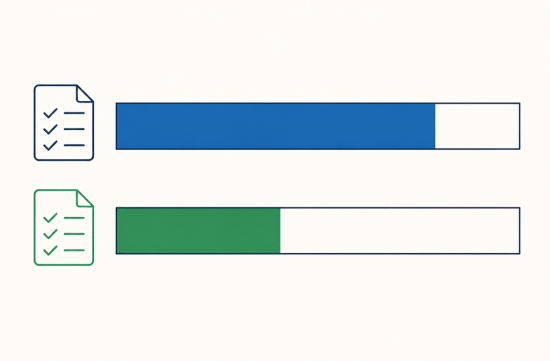
According to a SHRM survey, 71 percent of U.S. companies still maintain an annual performance evaluation system. However, in the same survey, 90 percent of HR professionals said that ongoing evaluations are more accurate.
It's ironic that they continue to use the annual method despite believing it's not accurate. This means that the weight of the self-review, which is written just once a year, becomes significantly heavier.
In fact, a survey found that 91 percent of responding companies want to link performance to pay. Whether it's a salary increase, bonus, or promotion, the conversation ultimately starts with this one document.
The problem is that managers don't remember every detail of their subordinates' work over the year. This is especially true if there are multiple team members involved.
As a result, there tends to be a reliance on the expressions and scores that employees provide in their self-reviews. If an employee rates themselves low, the manager tends to view them that way too, and if they write confidently, they are viewed more favorably.
Experts advise against cramming everything into the evaluation season and suggest creating a brag document to record achievements throughout the year. It's much more accurate and quicker to jot things down as they happen rather than digging through emails or calendars later.
Getting feedback from colleagues or people you've worked with can also be helpful. There are often instances where others remember your achievements better than you do.
Here's a somewhat bittersweet statistic.
A study from Harvard Kennedy School asked individuals with similar skills to rate themselves on a scale of 100 points, and the average score for women was 46, while for men it was 61. Despite having no skill difference, a habit of underestimating themselves led to a 15-point gap.
If you think about how this gap can translate into salary differences, it's a bit unfair, isn't it? The saying that humility is a virtue can actually backfire in this situation.
So, I believe we should question the notion that writing a self-review humbly is always the best approach.
Then, you might wonder how to write it effectively to increase your chances of success.
Experts commonly recommend using the STAR method. This involves organizing your review in the order of Situation, Task, Action, and Result.
First, briefly describe the situation, then outline the task you were responsible for within that context.
Next, detail the actions you took, and finally, present the results with numbers.
Instead of saying, "I worked hard on customer service," you should say, "I exceeded the quarterly goal by 15 percent." Including just one number makes it much more persuasive from the evaluator's perspective.
However, there's no need to list ten or twenty examples. It's better to focus on three or four solid examples per evaluation period, as these are more memorable.
When discussing areas for improvement, it's better to conclude with, "I plan to improve this aspect" rather than just saying, "I failed here." Acknowledging the problem while also presenting a plan is key.
This year, it's also good to keep in mind that the budget for raises is not particularly generous.
A Mercer survey projected the average performance-based raise for 2026 to be 3.2 percent, while a Willis Towers Watson survey estimated it at around 3.5 percent. The fact that both organizations' figures align suggests a reliable trend.
By industry, healthcare and retail are expected to see raises around 2.9 percent, while finance, energy, and high-tech sectors may rise to 3.7 percent. This indicates that the share of raises varies by industry.
The limited budget means that who gets a larger share can be determined by that one self-review.
Recently, some companies have been trying to separate salary discussions from performance evaluations. However, this is still a minority practice, and most companies continue to operate within this structure.
If it were me, I would approach this season by emphasizing numbers and evidence rather than humility.
If you have a habit of underestimating yourself due to your personality or gender, it might be worth consciously breaking that habit just this once.
 SilentGoddess








 Always Dreaming of Big Success |
 happy 9 |
 coloradoman |
 pintos |
 mapsina |
 Kitchen Ideas |
 Young Kim |
 Things to know |
  The Long Shot |
 business lim |
  anchor |
  stalion |
  Investment Beginner Company Information Encyclopedia |
  sweetfox |
  ceporta |
  H Leader |
  My tracks |
  Yes Dorian |
  novent |
  calviro |
  Enjoying Samba at Home |
  Once in a Lifetime |
  novapixel |
  Korea Tiger News |
  Banana |
  rouge88 |
  toffee |
  King County |
  DREAM BIG |