
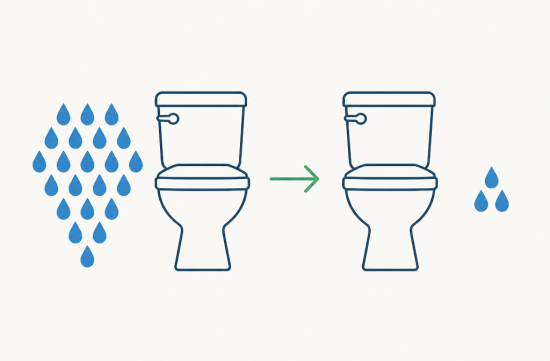
Last month, while looking at my water bill, I was shocked by the amount. It was much higher than usual, and I spent a long time trying to figure out what went wrong.
It turned out the culprit was the toilet. An old toilet was using more water than I realized.
In American households, toilets account for a surprisingly large portion of water usage. It is said that a single toilet can make up about 30 percent of indoor water use.
This means that toilets use more water than showers or washing machines. So, it makes sense that just replacing one toilet can have a significant impact on overall water costs.
The problem is that the amount of water used by toilets varies widely. This difference is even more pronounced in older homes.
Toilets installed before the 1980s could use up to 6 gallons per flush. Models from the early 1990s commonly used 3.5 gallons.
Some old commercial valve-type toilets reportedly used between 3 to 7 gallons per flush, which is an enormous amount by today's standards.
In contrast, modern WaterSense certified toilets use 1.28 gallons or less per flush. This is 20 percent less than the current federal standard of 1.6 gallons.
Just looking at the numbers, you can see a significant difference in water usage between old and new toilets. The difference can be as much as 5 gallons per flush.
So, how much money can you actually save? I looked up data from the EPA, and they provided some surprisingly specific numbers.
Replacing an old, inefficient toilet with a WaterSense certified model can reduce household toilet water use by 20 to 60 percent. This translates to about 13,000 gallons saved per year for a single household.
In monetary terms, the EPA explains that this can save over $170 a year. Over the lifespan of the toilet, this can add up to a difference of $3,400, which is not a small amount.
Of course, these numbers are averages, so there will be variations from home to home. The savings will depend on the number of family members, how often the toilet is used, and how old the original toilet was.
How many times the bathroom is used each day is also an important variable. Larger households tend to feel the benefits of replacing a toilet more quickly.
I also looked at the average water bills across the U.S. It turns out that the average monthly water bill is about $49.
However, when you include sewer fees, the total bill can vary significantly by region. As of 2024, the average in the Northeast was about $141.53 per month, while in the South, it was around $118.21.
It was surprising to see such differences in water bills even within the same country. In areas where water costs are high, the impact of replacing a toilet is likely to be felt even more.
Now, you might be wondering how much it costs to replace a toilet. The price of a WaterSense certified toilet can vary widely, so it's hard to give a specific amount.
However, many local water utilities offer rebate programs for replacing old toilets. I found that there are quite a few options available.
In Portland, you can get a rebate of $70 per toilet, while Utah offers up to $150. In the Tampa Bay area, if you replace a toilet made before 1993, you can receive up to $200 back.
Since the conditions and amounts vary by location, if you've moved, I recommend checking your local water utility's website. You might find some surprisingly helpful rebates.
However, it's worth noting that rebates often do not cover installation costs. While you may receive support for the toilet itself, installation usually incurs additional expenses.
If you're renting, asking your landlord to replace the toilet can be a good option. An old toilet can reduce water costs for the landlord as well, so they may be more willing to agree.
I think I would start by checking when my toilet was installed. Many toilets have the manufacturing date stamped inside the tank or on the back.
If it's a model from before the 1990s, it's definitely worth considering a replacement. You could easily recoup your investment in a few years.
Of course, replacing a single toilet may not dramatically reduce your water bill. However, over the years, it's clear that it can make a significant difference.
Especially when buying or renting an older home, I recommend paying attention to the condition of the toilet. Even though it seems like a small detail, it can have a surprisingly large impact on your monthly fixed costs.
After experiencing this, I've started to reevaluate the old fixtures throughout my home. My interest, which began with the toilet, has now expanded to faucets and showerheads.
While it may be difficult to replace everything at once, it seems practical to start with the oldest and most water-consuming fixtures. I believe starting with the toilet is the best first step.
 FairyWoodman


 Silent Sea |
 Pointy |
 Idaho's Sumi's House |
 holy cheese |
 Michigan Enthusiast |
 Minnesota Sonata N |

 Minnesota Lakes and Clouds |


 Investment Beginner Company Information Encyclopedia |
  sweetfox |
  ceporta |
  H Leader |
  My tracks |
  Yes Dorian |
  novent |
  calviro |
  Enjoying Samba at Home |
  Once in a Lifetime |
  novapixel |
  Korea Tiger News |
  Banana |
  rouge88 |
  toffee |
  King County |
  DREAM BIG |
  Good News Good Thoughts |
  peelynew |
  Helpful Life Stories |