
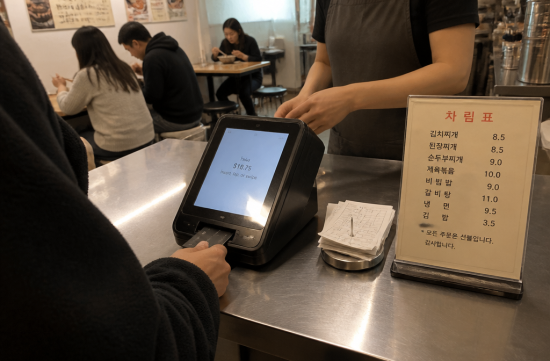
When dining at a Korean restaurant and noticing that the receipt has no tip line, it can be quite surprising. The card terminal doesn't show options for 18% or 20% tips; it just displays the total amount.
Recently, more Korean restaurants in Koreatown have started experimenting with no-tip policies. While still a minority, there seems to be a growing interest among restaurant owners as word spreads.
A recent example is a cold noodle shop that opened in LA's Koreatown, which sells mul naengmyeon and bibim naengmyeon for $12.99 each and has declared that they will not accept tips or service charges. Instead, customers order directly at the counter and pick up their food.
Surprisingly, the response has been quite positive. With clear pricing and no need to feel awkward when paying, customers actually feel more comfortable.
In fact, American consumers are already feeling quite fatigued by the tipping culture.
A survey released in May found that 81% of Americans believe the current tipping culture has become unmanageable.
55% of respondents said they leave tips not out of joy, but due to social pressure and guilt.
However, this issue isn't just about the customers. Eliminating tips ultimately means changing the entire wage structure for restaurant workers.
According to federal labor law, the minimum wage for tipped employees is $2.13 per hour.
This is based on the assumption that tips will make up the difference, allowing for a tip credit of $5.12, which is the difference between the federal minimum wage of $7.25 and the tipped minimum wage.
Maryland has a higher standard, requiring that tipped employees receive at least $3.63 per hour in cash.
If the total, including tips, does not reach the state minimum wage of $15 per hour, the employer must make up the difference.
In contrast, California does not recognize tip credits at all.
Regardless of how much in tips they receive, employers must pay a full cash wage of $16.90 per hour.
Additionally, there are now tax benefits related to tips. Starting in 2025, a new law will allow for federal income tax deductions on tip income up to $25,000 per year.
However, this benefit only applies to voluntary tips given by customers, not to service charges or automatic gratuities imposed by restaurants. So, for employees, switching from tips to service charges means losing this tax benefit as well.
Thus, even the same no-tip experiment can have completely different implications for employers and employees depending on the state and whether it's tips or service charges.
In places like Maryland that rely on tip credits, eliminating tips means they need to fill that gap in labor costs. Typically, this leads to menu prices being raised by 10 to 20 percent or adjusting hourly wages.
It's worth noting that it's possible to keep tips while also wanting to share them with kitchen staff; however, the employer must forgo the tip credit and pay all employees the full minimum wage.
The problem is that there have been several past experiments, and the results haven't been very favorable.
In 2015, a large seafood chain tested a no-tip policy in 18 locations. In 14 of those locations, customer traffic dropped by 8 to 10 percent, and the chain eventually reverted to a tipping model.
A well-known restaurant group in New York also eliminated tips in 2015, incorporating a service charge into prices. They raised hourly wages and provided benefits like paid time off, but menu prices increased by about 15 to 20 percent.
However, when sales halved during the pandemic in 2020, they returned to a tipping model because employees had no way to supplement their income.
A restaurant in San Francisco followed a similar path. After operating without tips for ten months, the turnover rate for employees who previously received tips soared to 70%.
Interestingly, when speaking with long-time Korean servers, some expressed a different reaction. Rather than being upset about the elimination of tips, they appreciated the stability of their monthly income not fluctuating based on customer moods.
From my perspective, there seems to be a distinct point that separates success from failure.
Failed attempts often involved simply removing tips while keeping the traditional serving model intact.
In contrast, those that changed their operational model to include counter ordering and self-pickup have managed to endure.
Ultimately, if you want to eliminate tips, it seems you need to change not just the price tags but also the way the restaurant operates.
If you plan to work at a Korean restaurant, be sure to check whether the hourly wage includes tips or not.
 RubyStar




 Always Dreaming of Big Success |
 happy 9 |
 coloradoman |
 pintos |
 mapsina |
 frostpup |
 foxtrot83 |

 Good Karma |
 Investment Beginner Company Information Encyclopedia |
  sweetfox |
  ceporta |
  H Leader |
  My tracks |
  Yes Dorian |
  novent |
  calviro |
  Enjoying Samba at Home |
  Once in a Lifetime |
  novapixel |
  Korea Tiger News |
  Banana |
  rouge88 |
  toffee |
  King County |
  DREAM BIG |
  Good News Good Thoughts |
  peelynew |
  Helpful Life Stories |