
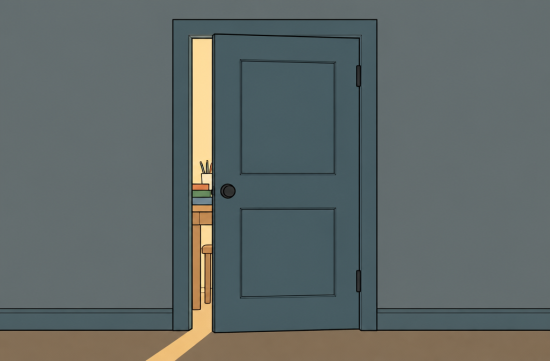
I once witnessed a somewhat unfamiliar scene while visiting a friend's house in America. Before entering her teenage son's room, my friend always knocks and waits outside if there is no response.
As someone who grew up in Korea, I found that fascinating. I wondered why parents couldn't just enter their child's room like they would their own bedroom, but it turns out that this is more than just a matter of courtesy.
Among American parents, this behavior is closely tied to the concept of privacy. They view their children as independent individuals, and there is an underlying assumption that each individual has their own space.
However, what's truly interesting is that American kids practice distinguishing between lies and privacy from a young age.
For example, if a child doesn't tell their parents about a fight with a friend at school, the typical Korean reaction might be to ask why they are hiding it. But in American culture, it's often accepted as a right not to share.
On the other hand, lying is treated as a completely different issue. There is a clear distinction made between not saying something and fabricating a falsehood.
I initially thought this was just a parenting trend, but upon researching, I found that it has been a topic of study in developmental psychology for quite some time. It is said that children begin to understand the concept of secrets around the age of three.
The ability to lie develops a bit later, increasing significantly between the ages of four and five. In an experiment conducted by Canadian psychologist Victoria Talwar and her team, 36 percent of three-year-olds who secretly peeked at a toy lied to conceal that fact.
By the ages of four to seven, that percentage reportedly exceeds half. It's somewhat amusing yet understandable that as children grow older, their lying skills improve.
However, there is an important point to note here. Scholars view the act of keeping a secret and lying as entirely different categories.
Someone who keeps a secret does not intend to give the other person a false impression. They are simply withholding certain information.
In contrast, lying involves the intention to implant a false image in the other person's mind. Teaching children this distinction clearly is one of the key aspects of American parenting.
As they reach their teenage years, this boundary becomes even more pronounced. Actions like locking doors or putting passwords on phones are viewed in America more as a natural part of growing up rather than rebellion.
According to psychologists, a teenager's desire for privacy signals a psychological move towards independence from their parents. Therefore, rather than treating it as a problem, it is approached as a normal developmental stage.
Of course, not all parents accept this readily. Many still draw the line, asserting their authority in the name of safety, claiming, "It's my house and my child."
Interestingly, research has shown that when parents are overly controlling, children often find more creative ways to hide things. The more surveillance there is, the more their skills in concealment increase, creating a paradox.
On the flip side, there is also research indicating that teenagers with too many secrets from their parents are at a higher risk of psychological distress.
So, neither the idea of being completely open nor the notion of respecting privacy unconditionally is the answer. Finding a balance is key.
Thus, what American parenting emphasizes is not full disclosure but a combination of selective sharing and honesty. It acknowledges that there are things that don't need to be said, but when they do speak, they should speak the truth.
In comparison to Korea, this point of view is somewhat different. There is still a relatively strong sentiment that parents should know everything about their children.
However, I have heard that many Korean parents are also grappling with boundary issues these days. Particularly, there are increasing reports of similar conflicts regarding phones and social media.
Personally, I find this method of distinction quite reasonable. The demands of not lying and of sharing everything are fundamentally different, yet in reality, these two are often conflated.
If children cannot distinguish between the two, it can lead to counterproductive outcomes. When their privacy is not acknowledged, they may ultimately learn to lie in order to protect something.
Thus, respecting privacy could actually be a way to reduce lying. The more you try to block it, the more holes you create.
The essence of the American approach is ultimately this: teaching children how to draw a clear line between what doesn't need to be said and what must be said honestly.
This reminds me of sports, where having clear rules allows for a more vigorous competition within those boundaries. When the rules are vague, violations tend to increase.
Whether or not one has children, I believe this sense applies to adult relationships as well. Confusing not speaking with deceiving ultimately breaks trust.
In the end, what matters is not whether secrets exist, but the ability to manage those secrets so they do not turn into lies. Just having that clear distinction can significantly improve relationships.
 FingerJax


 Korea Tiger News |
 Alpha and Omega World |
 Florida King |
 AH LALA |
 Victory 1988 |
 Belgray Miscellany |
 ness 6 |
 luido |

 anchor |
  stalion |
  The Long Shot |
  Investment Beginner Company Information Encyclopedia |
  sweetfox |
  ceporta |
  H Leader |
  My tracks |
  Yes Dorian |
  novent |
  calviro |
  Enjoying Samba at Home |
  Once in a Lifetime |
  novapixel |
  Banana |
  rouge88 |
  toffee |
  King County |
  DREAM BIG |