
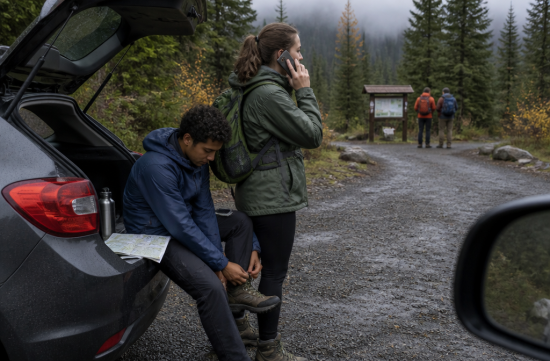
Last weekend, I saw something interesting at the parking lot entrance of a trail. A friend who looked like a college student pulled out a flip phone from his pocket and snapped it open to make a call.
At first, I thought it was a backup phone he brought for hiking. But then I noticed that his friend also had a similar flip phone. Seeing them both using it casually made me realize it was a trend.
Curious, I looked it up and found out that this is part of the 'dumbphone' trend that's been talked about among U.S. Generation Z lately. It refers to phones that intentionally have fewer features, almost the opposite of smartphones.
As someone who can't go a day without a smartphone, I was genuinely curious why they would choose something less convenient. So, I organized some numbers and reasons for this article.
First, let's look at the atmosphere. In a survey conducted by the Pew Research Center in April 2025, 48% of American teens aged 13 to 17 said that social media generally has a negative impact on their peers.
In 2022, this figure was 32%. It's quite a significant jump in just three years, which surprised me a bit.
In the same survey, 45% of teens reported that they spend too much time on social media, an increase from 36% in 2022.
Interestingly, only 14% said they personally feel negatively affected by it. It's funny how many worry about others but think they're fine themselves; I can relate to that.
This sense of fatigue is reflected in their device choices. According to a CNN report, sales of flip phones from HMD, which makes Nokia-branded phones, doubled between 2022 and 2023.
In Canada, a CBC report citing Counterpoint data stated that sales of basic feature phones increased by 25% during the same period. Of course, this is still a small piece of the overall mobile phone market.
So, not everyone is switching to flip phones. However, it signals a small shift in direction.
Companies are also taking action. Light, known for its minimal phones, unveiled a new flip model called 'Light Flip' in July this year.
According to TechCrunch, it's priced at $299 and is set to launch in April 2027. It features the old-school T9 keypad for text input, and it does have a camera and 5G.
At first, I couldn't understand why someone would pay $299 for a phone without an app store or feeds. But then I realized that the price is more about buying peace and quiet than functionality.
Looking into the reasons, there are three main ones. The first is notification fatigue.
It's the desire to escape the constant buzzing. Many of us have experienced deleting an app only to reinstall it later. Making it impossible to install apps is a way to rely less on willpower.
The second reason is the Y2K aesthetic. There's a term called 'anemoia' for nostalgia about times we haven't experienced, and the sound of closing a flip phone embodies that feeling.
Especially, flip phones have small screens and uncomfortable keypads, making it hard to hold onto them for long. This inconvenience acts as a brake, in a way.
The third reason is identity. Many express pride in having a phone with poor image quality and inconvenient texting, despite complaining about it.
For Korean parents, this trend might be quite welcome. It's always a dilemma about when and what kind of first phone to give to their kids.
There's also talk from schools. Washington state currently doesn't have a statewide ban on phones in schools.
Instead, a law passed in 2026 requires the state superintendent's office (OSPI) to study this issue and provide recommendations by the end of 2027. In the meantime, many school districts are creating their own rules.
Since the rules vary by district, the atmosphere can differ quite a bit even within the same area. It's best to check the school's website or student handbook for the specific regulations of the school your child attends.
That said, it's hard to say that a dumbphone is the answer. Using banking apps, two-factor authentication, and maps can be quite cumbersome without a smartphone.
So, many people actually leave their smartphones at home and only take a flip phone for weekends or hikes. It's more about creating distance rather than completely disconnecting.
I've felt the urge to try it myself. When I go hiking, I often don't get good reception anyway, so just having a few photos and the ability to make calls would be enough.
Ultimately, this trend seems less about rejecting technology and more about reclaiming control. It's about pulling out the device when I need it, rather than the device calling to me.
I don't think I would switch to a flip phone right away. Instead, I'm considering starting with putting my smartphone in a drawer for one day on the weekend.
Like taking a slow, long walk on a trail, gradually adjusting the distance from my phone seems like the best way to go. Would you be willing to try using a flip phone again?
 RapidValley98


 Anjollinya Blog |
 Anova US Beauty Information |
 anchor |
 Korea Tiger News |
 Alpha and Omega World |
 Always Dreaming of Big Success |

 summita |
 French Macarons |

 Who's watching? |
  eclipse |
  quietwave |
  Hajiwon Blog Hair Salon |
  hoosierdaddy |
  saffronroute |
  korvex93 |
  Mini Mee |
  Darnignac |
  vanilla |
  selvon |
  brownie |
  Star Blog |
  The Day the Sun Rises |
  sweetpop |
  California Kangaroo |
  zanero |
  station |
  Static |
  Star Way |