
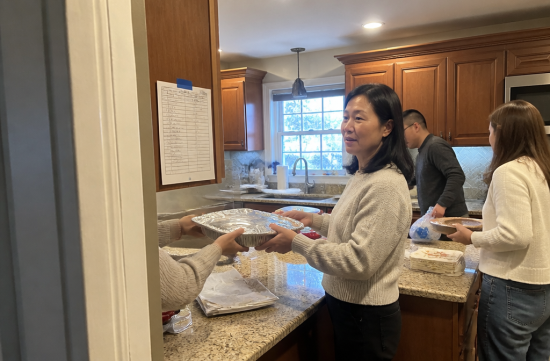
When you attend a year-end potluck, you often see this scene: three plates of japchae on the table, but no salad, and everyone awkwardly smiles while holding their plates.
There's plenty of food left, but the money has been spent. That's why I believe the success of a potluck depends more on the rules than on cooking skills.
First, let's look at the numbers. According to a 2025 survey by the American Farm Bureau Federation (AFBF), the average cost for a basic Thanksgiving meal for ten people was $55.18 nationwide.
The Northeast was more expensive, averaging $60.82. If you add ham, potatoes, and green beans to the menu, the cost in the Northeast can rise to $82.97.
I'm referring to last year's figures since this year's survey results weren't available at the time I looked. Additionally, this amount doesn't include alcohol and disposable items, so the actual receipt will be longer.
So, can we really cut costs in half? If we calculate based on last year's national average, the answer becomes clear.
If the host only takes care of the turkey, they only need to pay the average price of a 16-pound turkey, which is $21.50. That's 39% of the total.
Last year, the price of turkey was $1.34 per pound, down 16.3% from the previous year. Since this year's prices are not yet available, it's best to compare local grocery store flyers directly for the most accurate information.
If the remaining $33.68 is split among four households, each household would only pay $8.42. This significantly reduces the host's burden.
However, we need to be honest here. This is just splitting the costs; it doesn't mean the total expenses have decreased.
If everyone brings "generously," the total amount can actually increase compared to preparing everything alone. True savings occur when we set rules to limit that generosity.
The first rule is to finalize the number of attendees. Get responses on how many people will come by a week before the party.
This year, Thanksgiving is on November 26, so there are 18 days left. Sending out the invitation this week is not too early.
The second rule is to assign categories instead of specific dishes. For example, appetizers, sides, desserts, and drinks.
It doesn't matter if it's a Google Sheet or a group chat. If everyone can see who is responsible for which category, it can prevent three plates of japchae from appearing.
The third rule is portion sizes. One potluck guide suggests one dish for every 3-4 people.
So, if there are 10 people, there's no need for each household to bring 10 servings. Writing down "one dish serves four people" in advance is the biggest saving tip.
The fourth rule is to set a budget cap. I would suggest writing something like "no more than $20 per household" in the invitation.
Worried about bringing up money? I believe that one line actually makes guests feel more comfortable. It eliminates the need to worry about who brought the best dish.
Also, make sure to mention that it's okay not to cook. A store-bought salad or a pie from a bakery is also a valid contribution. This helps reduce the need to buy new ingredients that will only be used once.
The fifth rule is to be cautious with beef. As of August, retail beef prices have risen 5.9% compared to last year, and the USDA projected an overall increase of 9.4% for this year.
Although there was a 1.0% decrease in September, if you choose ribs as the main dish, the budget will quickly fall apart. I would suggest going with turkey or pork as the main dish and saving ribs for next year.
The sixth rule is to create a category for non-cooking items. Drinks, ice, plates, and napkins also count as a category.
Busy people can opt for that category, and the host saves on disposable item costs. If everyone brings their own drinks, the receipt will be significantly shorter.
The seventh rule is to be mindful of language. It's best not to assign someone to bring kimchi just because they are Korean in a mixed group of American colleagues. Let everyone choose what they want to bring.
The eighth rule is about oven usage. Since there's only one oven at home, it's easier to ask for dishes that can be warmed up or served at room temperature.
Make sure to include in the rules that the host shouldn't bear all the responsibilities alone. Designate someone to set the table and someone to help with the dishes afterward, so even if it's not about money, you'll have energy left for the next day. This way, you'll be more inclined to gather again next year.
The last rule is about safety and leftovers. The USDA Food Safety and Inspection Service advises not to leave perishable food out for more than 2 hours and to eat or freeze leftovers within 4 days.
So, I would like to include in the rules to "bring one empty container each." Sharing leftovers can reduce both wasted food and the money needed for groceries the next day.
Some might wonder if it's better to just meet at a restaurant. According to September price statistics, dining out has increased by 3.5% over the past year, while groceries have only risen by 1.8%.
For me, I choose home because of the time factor. Restaurants have to clear tables for the next group, but at home, no one is asking you to leave the dining table.
Even though there seem to be many rules, you can sum it up in three lines in the invitation: how many people, what categories, and how much. This year, I hope you start with these three lines.
 MyHearts


 content |

 Carolina border |

 Que Buena |

 juicylol |

 Mr Song Song |

 ringwinds |

 Living in New Jersey blog |

 Miju Communication News Blog |

 Dollydori, Lover of Movies |


 Anytime Journey |
 frostpup |
 Non-Stop Squat Team |
 laughing |
 sweetvan |
 lattepop |
 Augusta Univ |
 Well Done Sir |
 nrixa |
 vrixen73 |
 A landlocked state |
 rockets |
 Smile Face |
 Polaris |
 Should we begin? |
 tarvion |
 kodak |
 Lifestyle Information Search USA |
 yenne |
 beerdreamer |
 Chino Min |