
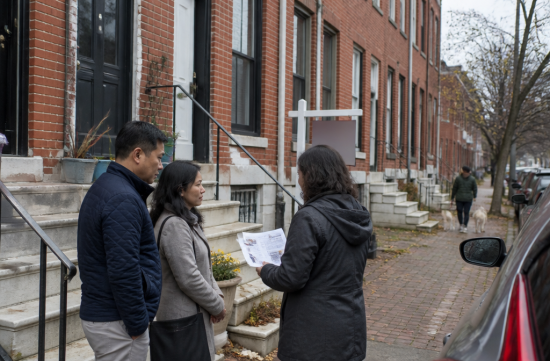
If you're looking at homes in Baltimore, the most significant number to note in October isn't the home prices, but the interest rates. As of October 29, the average 30-year fixed rate from Freddie Mac is 7.24%, which is over 1 percentage point higher than last year's 6.17%.
Just on September 3, it was at 6.71%. Then it rose to 7.40% on October 8 and 15, before dropping for two consecutive weeks.
Calculating for a $200,000 loan on a 30-year fixed rate, at 6.17% your monthly payment would be $1,221, while at 7.24% it would be $1,363.
That's a difference of $142 a month, or $1,704 over a year. It's more significant than you might think.
First, I should clarify that the October sales statistics for the city of Baltimore have not yet been published in the public records I checked. The home prices and inventory are based on data up to September, while the rental information reflects movements from October.
Let's start from within the city. According to data compiled by FRED from Realtor.com, the median listing price in Baltimore City for September was $200,000.
This is down 9.07% from the same month last year. However, this is not the actual sale price but rather the asking price, which can fluctuate depending on the number of listings. It doesn't mean that home prices have dropped by 9%.
What's more noteworthy is the inventory and time on the market. Active listings in September were 2,744, which is a 15.3% increase from 2,380 in September of last year.
The median time on the market has also increased from 49 days to 62 days. For sellers, that feels like a significant 13 days longer.
The overall metro area presents a slightly different picture. According to Redfin, the average monthly median sales price for the Baltimore metro from January to June this year was $402,198, which is up 3.8% from last year.
During the same period, inventory increased by 12.3% to 10,774 listings, while transaction volume decreased by 2.0%. The median time on the market increased by 8.3 days to 39.1 days.
Prices are holding steady, but inventory is building up while transactions are declining. Since the city and metro have different price ranges, they shouldn't be lumped together.
This metro data only goes up to June, so the impact of rising interest rates after September is not yet reflected.
Now, moving on to rentals. According to the Apartment List November report, the median rent in Baltimore City is $1,498, which is a 0.5% decrease over the month of October.
Year-over-year, it has increased by 2.2%. Compared to the overall Maryland increase of 0.3% and the national increase of 0.1% during the same period, this is relatively fast.
A one-bedroom apartment averages $1,268, while a two-bedroom averages $1,587. Both are higher than the national medians of $1,215 and $1,369, respectively.
Expanding to the metro area, the median rent is $1,789, with an annual increase of 1.7%. Columbia has seen the fastest increase at 4.2%, while Odenton is the most expensive at $2,531.
Columbia is a popular area for Korean families looking to settle in the Howard County school district, making these numbers particularly noteworthy. Those looking to rent should budget accordingly.
Rental figures can vary significantly across different sites. When analyzing trends, it's best to compare data from the same source.
Investors should be aware of the vacant property tax issue. According to city ordinances, a special tax rate can be applied to vacant buildings deemed unsafe or unsuitable for habitation, with the first taxable year starting on July 1 of this year.
The first year's rate is $6.744 for every $100 of assessed value, which is three times the base rate of $2.248. From the following year, it will increase to $8.992, four times the base rate.
At the time of city council approval, reports indicated that over 10,000 buildings would be affected. I have not been able to verify how the actual assessments have been issued through the city's finance department.
If you're considering purchasing a vacant property to renovate, be sure to directly inquire with the city about its vacant designation and tax history before signing a contract. Concerns have been raised in the city council about the potential for increased taxes if permits are delayed, so plan for a longer renovation period.
For homes you intend to live in, the situation is quite the opposite. The city has already lowered the effective tax rate in its budget announcement and plans to reduce it below $2 per $100 by the 2028 fiscal year.
If it's your primary residence, check your tax bill to see if the Targeted Homeowners Tax Credit is being applied. Don't rely solely on the previous owner's tax bill amount when purchasing a home.
There are also important changes for tenants. The Strengthening Renters' Safety Act, which took effect in January, prioritizes inspections for rental buildings with 20 or more units that have a history of violations, allowing for the denial, suspension, or revocation of rental licenses based on the results.
The criteria include two or more of the following: unresolved violation notices for over 90 days, four or more violation notices, a certain number of 311 complaints, or a HUD INSPIRE score below 79.
The city announced on August 10 that it had filed a lawsuit against the landlords operating Kernan Gardens apartments. The city claims issues such as unlicensed operation and problems with heating and hot water, but I have not been able to verify the outcome of the trial.
Landlords must display their rental license number in common areas, contracts, and advertisements, so be sure to check that number first. You can also find a list of buildings prioritized for inspection on the city housing department's website.
If I were to buy a home right now, I would prioritize looking at inventory over interest rates. Homes that have been on the market for a long time may offer room for negotiation on price or closing cost credits.
If I were looking to invest for rental income, I would take a more conservative approach. It's essential to evaluate whether the increase in rent exceeds the burdens of interest rates, taxes, and licensing management on a building-by-building basis.
It will be interesting to see if this trend continues into October transactions as statistics become available. I lean towards the possibility that inventory will continue to increase.
 Forest 98






 Dr. Kelso |

 silents |

 Choco Choco Star |

 gentle |
 neapolis |

 sugarotter |

 foxtrot83 |

 frostpup |

 Good Karma |
 milkbear |
 Non-Stop Squat Team |
 laughing |
 sweetvan |
 lattepop |
 Augusta Univ |
 Well Done Sir |
 nrixa |
 vrixen73 |
 A landlocked state |
 rockets |
 Smile Face |
 Polaris |
 Should we begin? |
 tarvion |
 kodak |
 Lifestyle Information Search USA |
 yenne |
 beerdreamer |
 Chino Min |