
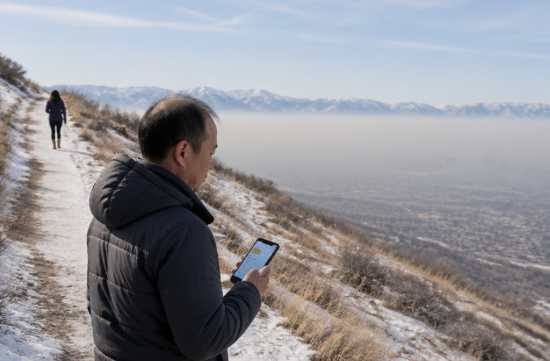
There are days when I raise the blinds in the morning and the Wasatch Mountains seem to have completely disappeared. It's not snowing, but the entire valley is hazy, and when you step out of the car, your nose feels stuffy.
Now that it's November, it's that time of year again. While my hair situation has already been negotiated, I'm not willing to compromise my lungs, so I've set some guidelines in advance this year.
An inversion is simply a pot with a lid on it. Normally, the air gets cooler as you go higher, but in this phenomenon, cold air settles at the bottom and warm air covers it.
The Salt Lake Valley is surrounded by mountains, so once this lid is on, it doesn't open easily. Pollutants from cars, homes, and factories accumulate inside.
What's even more frustrating is the chemical reactions happening in the air. During winter inversions, PM2.5, or fine particulate matter, is mostly not emitted directly from chimneys but is newly formed in the atmosphere.
One study found that during periods of severe pollution, ammonium nitrate accounted for up to 70-80% of the total mass. It seems to form more readily in colder temperatures, making it a perfect match for winter in this area.
How often does this happen? According to a National Weather Service forecaster, there are usually 5-6 instances of prolonged inversions during winter.
On January 13, the AQI in Salt Lake City reached 123 at 2:45 PM, marking it as the worst in the nation. This was reported by Fox 13, citing IQAir data. It was quite embarrassing for a ski town.
There are also health statistics to consider. A study analyzing 3,425 asthma-related emergency room visits in Salt Lake County over five winters from 2003-04 to 2007-08 found that the risk of visits on the 4th to 6th day of an inversion was 1.19 times higher than on non-inversion days.
While this isn't an enormous number, it's not something to brush off, thinking you can just wait a few days.
However, this correlation mainly appeared on days when PM10 and temperatures were above the median, and the researchers noted that further verification in other regions is needed. This means the numbers don't definitively establish causation.
Intermountain Health specifically warns those with asthma and COPD, individuals with a history of heart disease or stroke, and children to be cautious. The CDC also mentions pregnant women in their wildfire smoke advisories.
So when should we start being careful? According to AirNow, an AQI of 51-100 is considered moderate (yellow), 101-150 is unhealthy for sensitive groups (orange), and 151-200 is unhealthy (red).
In terms of concentration, orange indicates a PM2.5 range of 35.5-55.4 micrograms. Utah school guidelines suggest that sensitive students, such as those with asthma, should stay indoors during this range.
Older charts might be confusing. Starting May 2024, the upper limit for 'good' air quality has been lowered from 12.0 to 9.0. This means that days that used to be green may now show up as yellow.
You can check air quality at air.utah.gov or through the UtahAir app. They provide real-time concentrations and forecasts for three days. Since air quality can change hourly, it's best not to just check once in the morning.
As for exercise, Intermountain Health recommends doing it as early as possible and avoiding running or biking during rush hours. On red days, switch to indoor workouts.
There's also an interesting suggestion in the same guidance: exercise at higher elevations above the inversion layer. Once you break through the haze, the sky is unbelievably blue, and it's a great excuse to hit the ski slopes.
Masks can be a confusing topic. According to NIOSH guidelines, cloth masks, surgical masks, and bandanas do not fit snugly against the face and lack filters to block smoke particles.
If necessary, opt for NIOSH-approved N95 or P100 masks. When properly fitted, they can reduce exposure by at least a factor of ten. Keep in mind that this information is based on wildfire smoke standards.
However, these masks can make breathing more difficult. If you have heart or lung issues or are on respiratory medication, consult with a doctor or pharmacist first.
Inside your home, check the CADR when buying an air purifier. If the term is unfamiliar, think of it as the number indicating how much clean air is produced per minute. The EPA recommends looking for the tobacco smoke category for fine particulate matter.
According to EPA estimates, a 300-square-foot room requires a CADR of at least 195. This is based on an 8-foot ceiling, so if your ceiling is higher, you'll need to choose a larger number. Room size is more important than brand.
Avoid products that emit ozone. The EPA warns that some ionization or plasma products may release ozone. It's not a joke if you're trying to clean the air but end up irritating your lungs.
Don't forget about firewood. Utah's no-burn advisories typically run from November 1 to March 1, and on mandatory burn days, you cannot use fireplaces or wood stoves. Gas and propane are fine.
According to the state's Department of Environmental Quality, violations can result in fines of up to $150, and enforcement may use infrared cameras. You can check the day's conditions at air.utah.gov or by calling 1-800-228-5434.
Pay attention to the signals your body sends. The common advice is for sensitive individuals to monitor for coughing and shortness of breath on these days. If you feel different than usual, it's better not to wait and seek medical attention.
If it were me, I would reduce outdoor exercise starting at orange levels, move indoors when it's red, and ensure the air purifier is set up properly in my bedroom. I'd keep a few N95 masks in the car.
Ultimately, this lid will only lift when a storm comes. Until then, my responsibilities include protecting my health, carpooling, using public transport, and consolidating errands. While I may not be able to restore my hair, I can still take care of my lungs.
 CarrotDetect
 goldenroadtraveler1917


 United States Army |

 premium |
 The Emperor Must Grow |

 squidogame |

 daddyyo |
 tredolo |


 KGOMIO Blog |


 loran |

 Chichiki Chicago Train |
 frostpup |
 Non-Stop Squat Team |
 laughing |
 sweetvan |
 lattepop |
 Augusta Univ |
 Well Done Sir |
 nrixa |
 vrixen73 |
 A landlocked state |
 rockets |
 Smile Face |
 Polaris |
 Should we begin? |
 tarvion |
 kodak |
 Lifestyle Information Search USA |
 yenne |
 beerdreamer |
 Chino Min |