

I have a rough idea of the atmosphere in the stock community before SpaceX went public in June.
They called it a company that could catch rockets with chopsticks, the money tree of Musk, saying it was a "must-buy historical IPO," "like seeing Tesla in its early days," and "it's going to $2,000."
And now, less than two months after the IPO, the mood on the boards has completely flipped.
"I bought at the peak," "When will it recover?" "I was a fool for believing the brokerage's words."
A friend called me asking, "Why is this company dropping?" He wondered why it was falling when the company is good.
What I want to say here is simple.
Those who got burned ignored the warnings, and those who hit it big also ignored the warnings.
If these two statements sound contradictory, you don't really understand what the market is about.
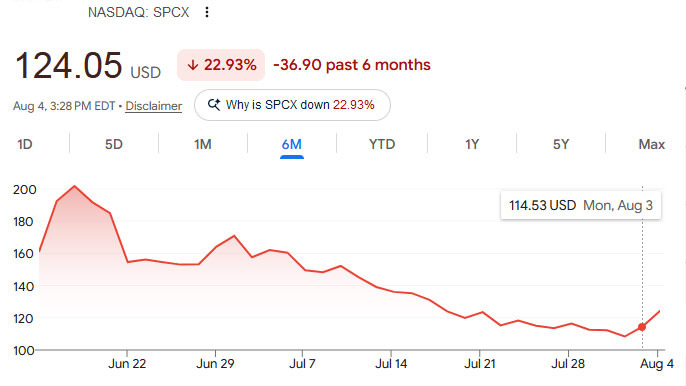
Let's look at the facts without emotions.The offering price was $135 per share. Nasdaq listing on June 12, 2026, ticker SPCX.
It opened at $150 and closed the first day at $160.95. The total offering amount was $75 billion, the largest in IPO history, with a market value of $1.75 trillion based on the offering price.
It became the 7th largest company in the U.S. right after going public.
Then, four days later, on June 16, it hit an all-time high of $225.64 during trading. That was the peak.
Those who bought at this point were dreaming of a trip to Mars but were on a vertical drop into the basement.
On July 27, it hit a 52-week low of $107.01.
Currently, it's around $120.
Based on the lowest price recorded on the 27th, that's about -52% from the peak and about -20% from the offering price.
It halved in just a month and a half. NH Investment & Securities announced that all SpaceX holders among their clients are currently in a loss zone.
Well, if you do the math, that's obvious. If someone hasn't lost money after it broke below $135, that would be strange.
I have no intention of belittling SpaceX's business. Reusable rockets have already changed the game.Most of the launches in the U.S. are handled by this company, and Starlink is genuinely a profitable business.
Contracts with NASA and the Department of Defense are also continuously increasing. From an engineering perspective, this is real.
But whether $1.75 trillion is appropriate is a completely different question.
At the time of the IPO, the EPS was negative. In other words, it's still a loss-making company.
However, on the first day of trading, its market cap exceeded $2 trillion, making it the 7th largest in the world.
This is not a price based on current performance. It's a price paid in advance for the scenario that "we're going to Mars, and Starlink will dominate global communications, and it will all happen."
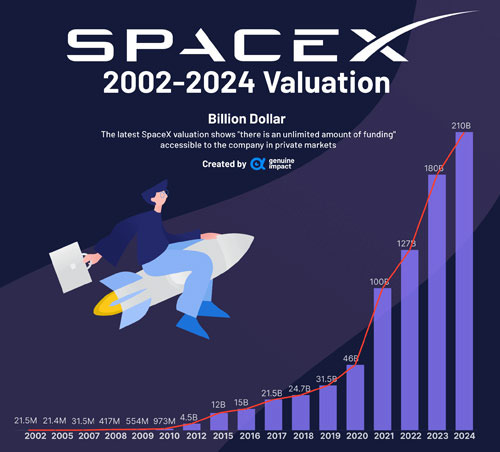
It's like paying today for 20 years into the future.
The technology is real, but the timeline is fake.
When this happens in the market, it's called valuation adjustment.
Moreover, there's a time bomb of lock-up expiration. Typically, it's 180 days, so around December.
Existing investors and employees will gradually release their shares. Economics 101 teaches us what happens when supply increases.
People have a misconception. They think, "If I had listened to the warnings, I wouldn't have gotten burned." That's wrong. Let's list the warnings that were circulating before the IPO.Warning A: "It's overvalued. $1.75 trillion for a loss-making company is insane. Don't buy it."
Warning B: "The subscription competition rate is 4 times. If you miss this, you'll regret it for life. If you don't buy now, you won't be able to buy it."
Both were warnings. One warned against buying, and the other warned against missing out.
And the person who sold at $225 on June 16 and made a 60% profit ignored Warning A.
The person who is currently stuck also ignored Warning A. The only difference is the entry and exit points; the warnings ignored were the same.
On the other hand, what about those who ignored Warning B and didn't buy at all? Based on the current situation, they are considered geniuses.
But if the stock price had gone to $400, that person would have been labeled as "someone who missed out due to fear." The judgment remains the same, but the label changes.
What does this mean? It means you can only tell which warning was correct after the results come out.
Those who say, "See, I told you so" after the fact are not predicting; they are just one of many predictions that happened to be right.
In the market, there are always bulls and bears talking at the same time, and half of them will inevitably be right. That shouldn't be called insight.
Look at the analysts' target prices now. The highest 12-month target price is $800, and the lowest is $62. There are 27 experts recommending a buy, and 1 recommending a sell. The spread is 13 times.
Do you know what this means? It means that Wall Street experts also don't know the value of this company. They just give target prices without admitting they don't know.
So what should you do?The question of whether to listen to warnings is fundamentally the wrong question. The real question is this: "How much do I lose if I'm wrong?"
Position sizing is everything. If you put 40% of your retirement funds into a stock two weeks after its IPO, that's not a mistake in stock judgment; it's a failure in risk design.
If you hold the same stock as 3% of your assets, even if it halves, you can just say, "Oh, that's a bit unfortunate" and move on.
Your judgment can be wrong.
But creating an irrecoverable structure when you're wrong is a lack of skill.
And the time horizon. If you're going to look at SpaceX for 10 years, then $108 right now is actually a meaningless number.
On the other hand, if you need money within 6 months, you shouldn't have entered a stock like this in the first place.
Many of those who got burned didn't choose the wrong company; they chose the wrong timeline.
What I've learned since coming to live in the U.S. is that this country doesn't stop you from buying anything. Instead, you take all the results. Whether you earn or lose, it's all yours.I believe this is fair. If you're given the freedom to enter the market, it's fair that you also bear the losses.
A system where someone else takes responsibility ultimately becomes a system where no one takes responsibility.
So don't blame the brokerage reports, YouTubers, or the mood of the community.
Those people don't have access to your account.
You pressed the buy button.
I don't know if SpaceX will be $500 or $50 in five years.
Anyone who claims to know is selling something.
But one thing is certain: the same thing will happen next time.
Whether it's OpenAI or anywhere else, when the next big IPO comes, the stock community will heat up again, warnings will come from both sides, and someone will get burned again.
When that happens, the question you should ask is not "Is this company good?" but rather "Is this price right, and if I'm wrong, how much will I lose?"
Once again, I emphasize that judgments can be wrong. However, you must understand that creating an irrecoverable structure when you're wrong is a lack of skill.
 WinterZone
 vibecoasttraveler1982
 CoinLegend
 FairyWoodman






 Jellia Angel |
 Investment Campus Home Ownership |
 zenvior |
 El Dorado |
 SAY YOU SAY ME |
 There Are Such Things in the World |
 Sunny's Travel in America |
 Superman Cat Blog |
 Happy Together 213 |
  Conflite Teacher |
  summita |
  Ari Songhan American Immigration Life |
  marketbox |
  yentra |
  Iowa Egen Aunt |
  donut33 |
  gravity |
  American Golf Course Travelogue |
  Agenda Center |
  digital |
  timemachine |
  Starry Eyes |
  Desert King |
  Texas Real Estate Blog |
  U.S. Retirement Pension Information |
  Seattle - Emerald City |
  Texas Migration Story |