
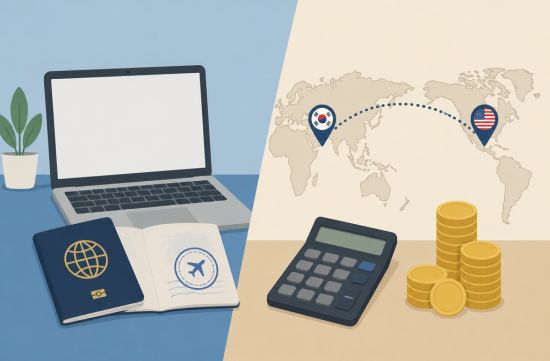
Let me start with a story about a Korean friend I met by chance at a jazz bar in New Orleans last month. This friend, who was working for an American company, planned to return to Korea for a few months to care for their parents but ended up staying with just a laptop. At first, everything seemed fine, but after about six months, paperwork started to become a problem.
The first issue is the visa. Entering the U.S. on a tourist visa or without a visa and working remotely for an American company for several months can be seen as exceeding the allowed stay. The Korean government has recognized this gray area and has started a pilot program for a workation visa, known as the F-1-D digital nomad visa, which officially transitioned to a regular visa starting June of this year after a trial run in 2024.
This visa allows for a stay of up to three years, and the conditions are quite specific. Your annual income must exceed twice the per capita gross national income of Korea, which is approximately 88.1 million won, you must have at least one year of relevant work experience, and you must have personal insurance of at least 100 million won that covers medical emergencies and repatriation. Most importantly, your employer must be registered overseas, not in Korea. This means that if you switch to a Korean company, you will no longer meet the visa's requirements.
However, even after sorting out the visa, you can't relax just yet. The next issue is taxes. U.S. citizens and permanent residents are required to report their worldwide income to the IRS, regardless of where they live. This means it applies whether you earn money in Korea or elsewhere.
Fortunately, there are relief measures. By utilizing the Foreign Earned Income Exclusion (FEIE), you can be exempt from U.S. federal taxes up to a certain amount. As of 2025, the exclusion limit is $130,000, and it will increase to $132,900 in 2026. However, to qualify for this exclusion, you must meet certain conditions, such as the physical presence test or the bona fide residence test, so keeping a detailed record of the days spent outside the U.S. throughout the year is crucial.
But it doesn't end there; you also need to consider taxes in Korea. According to Korean tax law, if you reside in Korea for more than 183 days, you may be considered a resident and have an obligation to report your worldwide income there as well. This can lead to a situation where a person is considered a resident in both the U.S. and Korea, known as dual residency. In this case, the determination of residency will depend on the criteria set by the Korea-U.S. tax treaty, which considers factors such as where your center of living is, and where your family and assets are located.
My friend ultimately consulted with an accountant to recalculate their days of stay and applied to switch their visa to the F-1-D. Hearing this made me realize once again that whether in travel or life, enjoying sweet leisure requires solid preparation. The romance of remote work is undeniable, but to sustain that romance, I recommend getting your paperwork in order. Consulting with a tax advisor or an immigration attorney is not just an option; it's essential, so keep that in mind.
 RajoHarvest


 Jellia Angel |
 Investment Campus Home Ownership |
 zenvior |
 El Dorado |
 SAY YOU SAY ME |
 King King TV |

 ORAVEZIN Oppa |
 melon90 |

 yentra |
  donut33 |
  gravity |
  American Golf Course Travelogue |
  There Are Such Things in the World |
  Agenda Center |
  digital |
  timemachine |
  Starry Eyes |
  Desert King |
  Texas Real Estate Blog |
  U.S. Retirement Pension Information |
  Seattle - Emerald City |
  Texas Migration Story |
  Unknown Dog Walk blog |
  California Dreamer |
  Bearded Strawberry Smoothie |
  Heart Ticker |
  JESIKYEOALBA BLOG |